IT SYSTEMS • SOFTWARE TESTING • QUALITY ASSURANCE

Software Testing & Quality Assurance Project Guidance

Understand how to design, execute, automate, and document software testing across unit, integration, system, API, regression, and end-to-end testing projects.

SOFTWARE TESTING & QA

Build software that can be tested, validated, and trusted.

Software development does not end when the application compiles or the first working feature appears. A reliable system must be evaluated against its requirements, expected behaviour, failure conditions, integration points, and real usage scenarios.

Software testing and quality assurance provide the structured processes used to discover defects, validate functionality, reduce regression risk, and generate evidence that a system behaves as intended.

Our technical guidance helps students, researchers, and project teams understand how testing fits into the software development lifecycle. This includes everything from individual unit tests to complete end-to-end application validation and automated CI/CD testing.

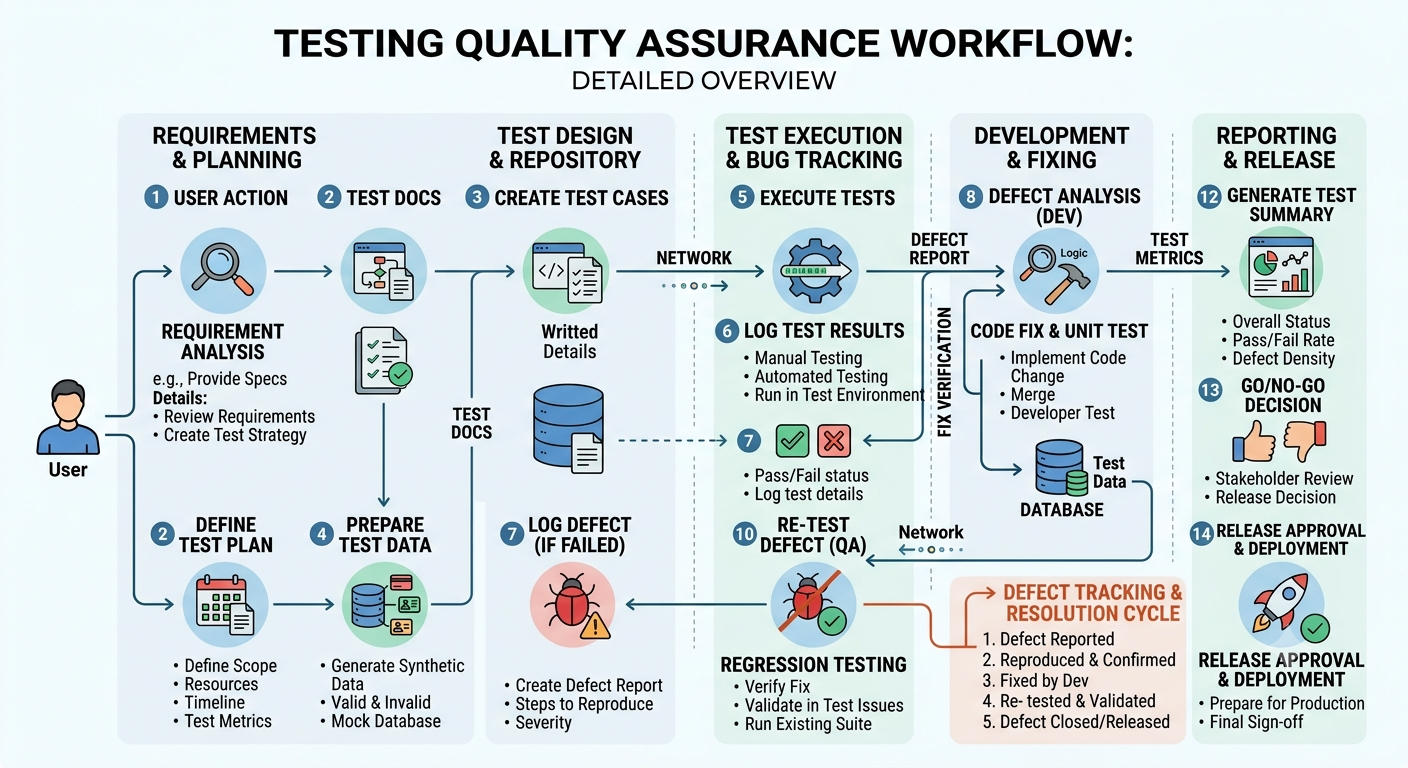
Software testing and quality assurance workflow showing how requirements, test planning, automated and manual testing, defect analysis, validation, and quality assurance fit together across the software development lifecycle

WHY SOFTWARE TESTING IS CHALLENGING

Testing is more than checking whether a button works.

Academic software projects frequently become difficult at the testing stage because students are expected to demonstrate not only that their software works, but also that they have systematically evaluated how it behaves under different conditions.

Effective testing requires an understanding of the application itself, the requirements it is expected to satisfy, the technologies involved, and the types of failures that could occur.

  • Incomplete requirements: Ambiguous or incomplete requirements make it difficult to determine what should actually be tested.
  • Large numbers of possible inputs: Even a relatively small application can have an enormous number of possible input combinations and execution paths.
  • Integration complexity: APIs, databases, external services, authentication systems, and other components can introduce failures that are not visible when individual components are tested separately.
  • Regression risk: A change intended to fix one problem can unintentionally break functionality that previously worked.
  • Test evidence: Academic projects often require students to demonstrate not simply that tests were executed, but what was tested, what happened, and what the results mean.
  • Automation decisions: Not every test should necessarily be automated. Selecting appropriate tests for automation requires understanding their purpose, frequency, stability, and maintenance cost.

CORE TESTING AREAS

Comprehensive guidance across the software testing lifecycle.

Different testing levels answer different questions. A strong testing strategy combines them according to the architecture, requirements, risks, and objectives of the project.

Test Planning & Strategy

Develop a structured testing strategy based on project requirements, application architecture, risks, technical constraints, and expected quality objectives.

  • Test plans and test strategies
  • Testing scope and objectives
  • Functional and non-functional testing
  • Risk-based testing
  • Test environments and test data
  • Entry and exit criteria

Unit Testing

Understand how individual functions, classes, modules, and components can be tested independently to identify defects early in the development lifecycle.

  • Unit test design
  • Assertions and test fixtures
  • Test isolation
  • Mocks and stubs
  • Boundary and edge-case testing
  • Code coverage analysis

Integration Testing

Validate how individual software components communicate and work together across application boundaries, databases, APIs, and external services.

  • Component integration
  • API integration testing
  • Database integration
  • Service-to-service testing
  • Interface validation
  • Integration failure analysis

System & End-to-End Testing

Evaluate complete application workflows from the user's perspective while validating whether the implemented system satisfies its functional requirements.

  • End-to-end workflows
  • System testing
  • User journey validation
  • Functional requirements
  • Regression testing
  • Acceptance criteria

Test Automation

Understand how repetitive and regression-heavy testing activities can be automated to improve consistency, repeatability, and development feedback.

  • Automated test suites
  • Regression automation
  • Browser and UI testing
  • API test automation
  • CI/CD test execution
  • Automated reporting

Debugging & Defect Analysis

Trace unexpected application behaviour back to its underlying cause and develop a structured approach to reproducing, isolating, and resolving defects.

  • Bug reproduction
  • Root-cause analysis
  • Debugging workflows
  • Log analysis
  • Stack traces
  • Defect classification

TESTING STRATEGY

Different testing levels answer different engineering questions.

A mature testing strategy does not depend entirely on a single type of test. Unit tests can provide fast feedback about individual components, while integration and system tests evaluate how those components behave together.

End-to-end testing can then validate important user journeys across the complete application. The appropriate balance depends on the architecture and objectives of the project.

We can help you understand why a particular testing level is appropriate, what it should validate, and how its results contribute to the overall quality argument for the system.

COMMON TESTING TYPES

  • Functional testing
  • Unit testing
  • Integration testing
  • System testing
  • End-to-end testing
  • Regression testing
  • Smoke testing
  • Sanity testing
  • Acceptance testing
  • Performance testing
  • Usability testing
  • Compatibility testing
  • API testing
  • Database testing
  • Security testing

TEST CASE DESIGN

Good test cases deliberately explore both expected and unexpected behaviour.

A useful test case should have a clear purpose. Rather than simply entering a few values into an application and recording that it appears to work, effective testing considers what happens when assumptions are violated.

Depending on the assignment, test design may involve:

  • Valid and invalid input combinations
  • Boundary-value analysis
  • Equivalence partitioning
  • Decision-table testing
  • State-transition testing
  • Exception and error-condition testing
  • Authentication and authorization scenarios
  • Database constraint and transaction behaviour
  • API response and error-code validation
  • Browser, device, and environment compatibility

The goal is not to create the largest possible number of test cases. It is to create a meaningful set of tests that provides strong evidence about the behaviour and quality of the system.

QUALITY ASSURANCE PRINCIPLES

Quality assurance connects testing with the wider engineering process.

Testing is one part of quality assurance. QA also considers how software is designed, developed, reviewed, documented, maintained, and evaluated throughout its lifecycle.

01

Requirements Traceability

Every important test should have a clear relationship with a functional requirement, acceptance criterion, business rule, or technical expectation.

02

Early Defect Detection

Testing should not be treated as an activity that begins only after development is complete. Unit and integration testing can identify defects much earlier.

03

Repeatability

A useful test should produce consistent and explainable results when executed under the same conditions.

04

Risk-Based Prioritization

Testing effort should reflect the potential impact and likelihood of failure rather than treating every feature as equally important.

05

Evidence-Based Validation

Test results, logs, screenshots, execution records, and defect reports provide evidence that the system was evaluated against defined expectations.

06

Continuous Improvement

Defects and failed tests should contribute to improving both the software and the testing process itself.

TEST AUTOMATION & CI/CD

Automated testing becomes especially valuable when software changes frequently.

Modern development workflows may involve developers committing code several times a day. Running the entire relevant test suite manually after every change is inefficient and can introduce inconsistency.

Automated tests can provide rapid feedback by executing predictable checks whenever code changes. When integrated into a CI/CD pipeline, they can help identify regressions before changes move further through the delivery process.

Academic DevOps and software engineering projects may therefore involve designing workflows where:

  • Source code is committed to version control.
  • Dependencies are installed automatically.
  • Unit tests are executed during the build process.
  • Integration or API tests run against appropriate environments.
  • Failures prevent later pipeline stages when appropriate.
  • Test results are recorded as part of the build evidence.
  • Successful builds can proceed to subsequent deployment stages.

This creates a connection between software development, quality assurance, and DevOps rather than treating testing as a completely separate activity.

TESTING TOOLS & TECHNOLOGIES

Guidance across common testing frameworks and development environments.

The right testing tool depends on the programming language, application architecture, testing objective, and project requirements. We focus on understanding those choices rather than treating a particular framework as universally appropriate.

  • Jest
  • Vitest
  • PyTest
  • JUnit
  • TestNG
  • JUnit 5
  • Selenium
  • Playwright
  • Cypress
  • Postman
  • Newman
  • JUnit
  • Maven
  • Gradle
  • GitHub Actions
  • GitLab CI

QUALITY ASSURANCE WORKFLOW

A structured process from requirements through defect verification.

The exact workflow varies by project, but a disciplined sequence helps ensure that testing remains connected to the system requirements and produces useful technical evidence.

Understand the system

Review the requirements, architecture, user workflows, technology stack, interfaces, database dependencies, and expected behaviour before designing tests.

Define the testing strategy

Determine which testing levels and techniques are appropriate and identify the areas that require the greatest testing attention.

Design test cases

Develop meaningful test scenarios covering normal conditions, boundary values, invalid inputs, failure conditions, integration points, and important user workflows.

Execute and record

Run the tests in a controlled environment and document expected results, actual results, failures, evidence, and relevant execution details.

Analyse defects

Investigate failed tests, reproduce defects, examine logs and application behaviour, and identify the underlying technical cause.

Retest and validate

Verify that fixes resolve the original defect without introducing regressions elsewhere in the application.

TESTING DOCUMENTATION

Good testing produces evidence that can be explained.

Academic projects frequently require more than a statement such as "all tests passed." A strong testing section should explain what was tested, why it was tested, how it was tested, and what the results demonstrate.

Depending on the assignment requirements, documentation may include test plans, test case tables, traceability matrices, screenshots, execution logs, defect reports, test summaries, and analysis of failed or successful scenarios.

We help connect this evidence to the underlying requirements so that the testing section becomes part of the technical argument for the quality of the system.

COMMON DELIVERABLES

  • Software test plans
  • Test strategy documents
  • Functional test cases
  • Unit test suites
  • Integration test scenarios
  • API testing documentation
  • Regression test suites
  • Defect and bug reports
  • Requirements traceability matrices
  • Test execution reports
  • Quality assurance reports
  • Testing sections for technical project reports

ACADEMIC & RESEARCH SUPPORT

Testing guidance for coursework, capstones, and research projects.

Software testing assignments can appear in many different academic contexts. The testing objective may be a dedicated QA module, part of a software engineering project, a component of a capstone, or part of the evaluation methodology for a research prototype.

1. Software Engineering Students

Guidance with test planning, unit testing, integration testing, debugging, test automation, defect analysis, and QA documentation.

2. IT & Computing Students

Support for testing assignments involving applications, databases, APIs, web systems, enterprise software, and technical projects.

3. Capstone Project Teams

Help designing practical testing strategies and presenting convincing evidence that a software system satisfies its requirements.

4. Postgraduate Researchers

Technical support for evaluating research prototypes, experimental systems, software implementations, and data-processing applications.

5. Web & Application Developers

Guidance on introducing structured testing into application development workflows and improving reliability through automated validation.

6. Students Working with CI/CD

Support for incorporating automated tests into build and deployment pipelines and understanding how testing contributes to continuous integration.

RELATED IT & SOFTWARE ENGINEERING AREAS

Testing connects closely with the rest of the engineering lifecycle.

Software quality cannot be considered completely independently from architecture, development, databases, APIs, cloud infrastructure, and DevOps. These areas often influence how a testing strategy should be designed.

For broader software development guidance, see Software Engineering.

For architecture and design decisions, explore System Architecture & Design.

For development and deployment automation, see DevOps & Containerization.

For application interfaces and backend communication, explore API & Application Integration.

For database-related testing and data validation, see Database Design & SQL.

RESPONSIBLE TECHNICAL GUIDANCE

The objective is to understand why a system passes or fails.

Effective software testing is not simply about generating a collection of test cases. It involves understanding system behaviour, identifying meaningful risks, interpreting results, and explaining what the evidence tells us about the quality of the implementation.

Our role is to make these technical concepts clearer through explanations, reviews, troubleshooting, test-design guidance, and research-oriented support.

Academic work should remain your own. The purpose of our technical guidance is to help you understand the testing process and make stronger engineering decisions.

TESTING & QA FAQ

Questions about software testing and quality assurance project support.

A few common questions about testing projects, automation, debugging, and QA documentation.

What types of software testing projects do you support?

We support projects involving unit testing, integration testing, system testing, end-to-end testing, regression testing, API testing, database testing, performance testing, acceptance testing, test automation, debugging, and software quality assurance.

Can you help me create a software test plan?

Yes. We can help structure a test plan around project requirements, testing objectives, scope, test levels, test environments, test data, risks, entry and exit criteria, expected deliverables, and reporting requirements.

Can you help design test cases?

Yes. Test cases can be developed around normal inputs, invalid inputs, boundary conditions, edge cases, business rules, user workflows, integration points, and expected system behaviour.

Can you help with automated testing?

Yes. Guidance can cover automated unit tests, API testing, browser testing, regression suites, test execution, reporting, and integrating automated tests into CI/CD workflows.

Can you help analyse failed tests and bugs?

Yes. We can help interpret test failures, reproduce defects, examine logs and stack traces, isolate the underlying cause, and explain how the defect affects system behaviour.

Can you help with testing documentation?

Yes. Support can include test plans, test cases, traceability matrices, defect reports, test execution summaries, test result documentation, and quality assurance sections of technical project reports.

Can testing be integrated into a DevOps project?

Yes. Automated testing can be incorporated into CI/CD workflows so that unit, integration, API, or other appropriate tests are executed automatically during development and deployment processes.

Do you guarantee a particular academic grade?

No. We provide technical guidance and educational support, but final grades and academic outcomes are determined by the relevant institution and assessment criteria.
HAVE A TESTING PROJECT?

Let's understand what needs to be tested before deciding how to test it.

Share your project requirements, application details, test assignment, failed test output, QA documentation requirements, or automation challenge and discuss the most appropriate technical approach.

Discuss Your Testing Project
Chat with us on WhatsApp