IT SYSTEMS • SOFTWARE ENGINEERING • ARCHITECTURE

System Architecture & Design Project Guidance

Understand how complex software systems are structured, how their components interact, and how architectural decisions connect requirements, data, applications, infrastructure, security, and deployment.

SYSTEM ARCHITECTURE & DESIGN

Turn project requirements into a system that makes technical sense.

A software project can contain perfectly written code and still suffer from poor architecture. When responsibilities are unclear, components are tightly coupled, data flows are difficult to understand, or technology decisions are made without considering the wider system, even relatively simple applications can become difficult to develop and maintain.

System architecture provides the higher-level structure that connects requirements with implementation. It describes the major components of a system, their responsibilities, their interactions, the data they use, the external systems they depend on, and the environment in which the solution will operate.

Our System Architecture & Design Project Guidance helps students and researchers understand these relationships and make defensible technical decisions throughout their projects.

FROM REQUIREMENTS TO ARCHITECTURE

Architecture provides the bridge between what a system must do and how it will actually work.

A well-designed architecture does not begin with a technology list. It begins with the problem being solved. Requirements, users, constraints, data, integrations, quality attributes, and operational expectations should influence the structure of the final system.

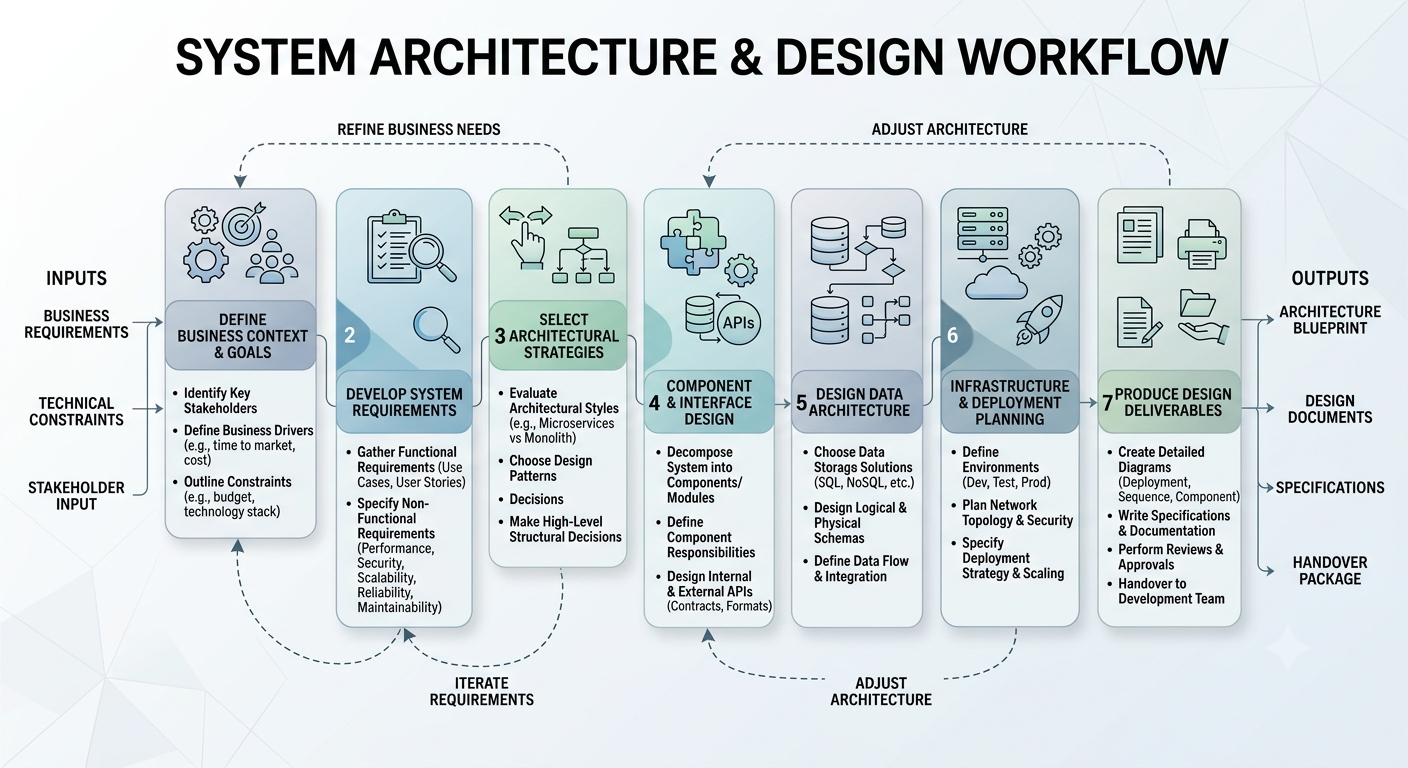
System architecture and design diagram showing the relationship between requirements, system components, data, interfaces, infrastructure, and deployment
A system architecture model connects requirements, application components, data, integrations, infrastructure, and deployment decisions.

WHY SYSTEM DESIGN IS CHALLENGING

Architecture is about making decisions under constraints.

System design assignments can appear straightforward because the final deliverable may only consist of diagrams and a written architecture document. In reality, producing a defensible design requires several technical decisions to work together.

Students often have to decide how the system should be divided, where data should live, how components communicate, which responsibilities belong together, which technologies are appropriate, and how the system should respond when individual components fail.

The difficulty increases when the project introduces cloud infrastructure, distributed services, external APIs, authentication, large data volumes, concurrent users, or strict performance and availability requirements.

  • Turning vague requirements into explicit system boundaries
  • Choosing an architecture appropriate to the project's scale
  • Separating responsibilities between components and services
  • Designing reliable data and communication flows
  • Balancing scalability, performance, security, and simplicity
  • Explaining architectural trade-offs in technical documentation

CORE ARCHITECTURE AREAS

From requirements and architecture patterns to data and component boundaries.

System architecture is not a single diagram. It is a collection of related technical decisions that describe how the complete system is expected to behave.

Requirements Analysis

Every architecture begins with a clear understanding of what the system is expected to accomplish. We help translate functional requirements, non-functional requirements, business rules, user expectations, and technical constraints into architectural decisions that can be explained and evaluated.

  • Functional and non-functional requirements
  • Business rules and system constraints
  • Functional decomposition
  • Quality attributes and acceptance criteria
  • Stakeholder and system boundaries
  • Traceability between requirements and design decisions

Architectural Styles & Patterns

Different systems require different architectural approaches. A small academic application may benefit from a straightforward layered architecture, while a distributed platform may require event-driven, service-oriented, or microservice-based design. We provide guidance on selecting and explaining an architecture appropriate to the project rather than applying a pattern simply because it is popular.

  • Layered and n-tier architecture
  • Client-server architecture
  • Monolithic and modular application design
  • Service-oriented architecture
  • Microservices architecture
  • Event-driven architecture
  • Serverless and cloud-native patterns
  • MVC and related application patterns

Component & Module Design

A good architecture makes the responsibilities of different parts of a system clear. Component and module design focuses on identifying the major building blocks, defining their responsibilities, and establishing appropriate relationships between them.

  • Component identification and responsibilities
  • Module decomposition
  • Interfaces and dependencies
  • Separation of concerns
  • Loose coupling and cohesion
  • Service boundaries
  • Dependency management

Data Architecture

System architecture and data architecture are closely connected. Applications need clearly defined approaches for storing, accessing, transforming, and exchanging information. We help students reason about data flows, persistence, database selection, data ownership, and integrity as part of the overall system design.

  • Data modelling
  • Relational and NoSQL database considerations
  • Entity relationships
  • Data ownership and boundaries
  • Persistence architecture
  • Data flows between components
  • Transactions and consistency
  • Caching and data access patterns

ARCHITECTURE DOCUMENTATION

Diagrams should explain the architecture, not simply decorate the report.

Architecture assignments frequently require UML diagrams, system context diagrams, data flow diagrams, deployment models, or other forms of technical documentation.

The important question is not how many diagrams a project contains. Each diagram should communicate a specific aspect of the system and remain consistent with the written architecture.

We provide guidance on selecting the appropriate diagram, deciding what information it should contain, and connecting it to the requirements and architectural decisions described elsewhere in the project.

COMMON DELIVERABLES

  • System context diagrams
  • Use case diagrams
  • Class diagrams
  • Sequence diagrams
  • Activity diagrams
  • Component diagrams
  • Deployment diagrams
  • Data flow diagrams
  • Entity-relationship diagrams
  • Architecture decision records
  • System architecture documents
  • Technical design specifications

QUALITY ATTRIBUTES

A technically correct architecture also has to satisfy non-functional requirements.

Two architectures may both satisfy the functional requirements of an application while behaving very differently under real operating conditions. Quality attributes help evaluate those differences.

Scalability

How well can the system accommodate increasing users, transactions, workloads, or data volumes without requiring fundamental architectural changes?

Availability

How should the system behave when individual components, services, infrastructure resources, or network connections become unavailable?

Performance

Which architectural decisions influence response time, throughput, resource utilization, concurrency, and overall system responsiveness?

Security

How should authentication, authorization, data protection, trust boundaries, secrets, and security controls be incorporated into the architecture?

Maintainability

Can developers understand, modify, test, and extend the system without introducing unnecessary complexity or widespread changes?

Reliability

How does the architecture handle failures, unexpected inputs, dependency outages, data errors, and recovery scenarios?

ARCHITECTURAL TRADE-OFFS

There is rarely one universally correct architecture.

One of the most important concepts in system design is that architectural decisions involve trade-offs. Increasing scalability may introduce additional infrastructure and operational complexity. Strong consistency can influence performance and availability. Microservices can provide independent deployment but may introduce distributed-system challenges that would not exist in a modular monolith.

Good architecture documentation therefore explains not only what was selected, but why it was selected and which alternatives were considered.

For academic projects, this reasoning is particularly important because architecture marks often depend on the student's ability to justify technical decisions rather than simply reproducing a popular architecture pattern.

Architecture quality is not measured by complexity. A simpler design that satisfies the requirements and can be clearly justified is often stronger than an unnecessarily complex architecture filled with technologies the project does not actually need.

SECURE SYSTEM DESIGN

Security should be considered part of the architecture.

Security is not something that should be added only after the architecture has been completed. Trust boundaries, authentication, authorization, data protection, secrets, network segmentation, logging, and failure behaviour can all influence architectural decisions.

Depending on the project, architecture guidance may include secure API boundaries, identity and access management, protection of sensitive data, least-privilege principles, secure communication, and appropriate separation between internal and external components.

For cybersecurity-focused architecture work, this can also connect directly with threat modelling and secure software development practices.

Explore Cybersecurity Services

DEPLOYMENT ARCHITECTURE

The architecture should describe where the system actually runs.

Application architecture and deployment architecture are related but not identical. A system may contain well-defined application components while requiring a separate model showing servers, containers, cloud services, networks, databases, gateways, and other infrastructure.

We provide guidance on connecting the logical architecture to its physical or cloud deployment environment. This can include virtual machines, containers, managed databases, load balancers, API gateways, cloud services, networking components, and deployment pipelines.

  • Cloud and on-premises deployment models
  • Containerized application deployment
  • Network and service boundaries
  • Load balancing and availability considerations
  • Database and storage placement
  • Environment separation and configuration
  • CI/CD and deployment workflows

SYSTEM DESIGN WORKFLOW

A structured approach from requirements to architectural review.

The exact process depends on the project, but a disciplined architecture workflow helps prevent disconnected diagrams and unsupported technology decisions.

Understand the problem

Review the project brief, stakeholders, functional requirements, constraints, expected users, business objectives, and evaluation criteria.

Define the system boundary

Identify what belongs inside the system, what remains external, which actors interact with it, and where important trust and integration boundaries exist.

Decompose the system

Break the system into appropriate layers, components, modules, services, data stores, and external dependencies.

Select the architecture

Evaluate architectural styles and technology choices against the functional requirements and quality attributes of the project.

Model interactions and data

Document component relationships, request flows, data movement, interfaces, dependencies, and important system behaviours.

Evaluate and refine

Review the architecture for scalability, security, performance, maintainability, reliability, technical feasibility, and consistency with the requirements.

ACADEMIC & RESEARCH SUPPORT

System architecture guidance across coursework, capstones, and research projects.

Architecture appears across many different academic disciplines. A software engineering student may need to design a web application, an IT student may be analysing an enterprise system, while a postgraduate researcher may be developing a technical prototype around a particular research problem.

The underlying architectural questions remain similar: What does the system need to accomplish? What are its major components? How do those components communicate? Where does data reside? What constraints influence the design? And how can the resulting architecture be justified?

  • Software engineering students
  • Computer science students
  • Information technology students
  • Systems analysis students
  • Final-year and capstone project teams
  • Postgraduate software engineering students
  • Researchers developing technical prototypes
  • Students preparing software design documentation

RESPONSIBLE TECHNICAL GUIDANCE

The goal is to understand why the architecture works.

System architecture is fundamentally a reasoning exercise. Simply receiving a diagram does not explain why components were separated, why a particular architecture pattern was selected, or what trade-offs were considered.

Our guidance focuses on making those technical decisions understandable. We can review architecture diagrams, explain design patterns, identify inconsistencies, discuss alternatives, and help connect architectural decisions to the requirements and evaluation criteria of a project.

Academic work should remain your own. Our role is to make difficult architectural concepts clearer and help you develop stronger technical reasoning.

SYSTEM ARCHITECTURE FAQ

Questions about system architecture and design project guidance.

Common questions about architecture assignments, UML, software design, and technical project support.

What is system architecture and design?

System architecture and design describes how a software or IT system is structured and how its major components interact. It connects requirements to components, services, databases, interfaces, deployment environments, security considerations, and other technical decisions.

Can you help with a software architecture assignment?

Yes. We provide guidance across requirements analysis, architectural styles, component design, UML diagrams, data architecture, APIs, deployment architecture, quality attributes, architectural trade-offs, and technical documentation.

Can you help me choose between monolithic and microservice architecture?

Yes. The choice should be based on project requirements rather than popularity. We can help compare factors such as system size, team structure, deployment complexity, scalability, operational overhead, data consistency, and maintainability.

Do you help with UML diagrams?

Yes. Guidance can cover use case, class, sequence, activity, component, deployment, and other UML diagrams where they are appropriate to the project. We also help explain how each diagram relates to the architecture and requirements.

Can you help with system design for a capstone project?

Yes. We can help structure the architecture of a capstone project from requirements and system boundaries through component design, databases, APIs, deployment considerations, testing, and technical documentation.

Can you review an architecture I have already designed?

Yes. An architecture review can examine requirements alignment, component responsibilities, dependencies, data flows, scalability, security, performance, maintainability, deployment assumptions, and potential architectural weaknesses.

Will you choose the technology stack for my project?

We can provide technical guidance on technology selection and explain the trade-offs involved. The final choice should reflect the project requirements, learning objectives, constraints, and evaluation criteria.

Do you guarantee a particular academic grade?

No. We provide technical guidance and educational support, but final grades and academic outcomes are determined by the relevant institution and assessment criteria.

HAVE A SYSTEM DESIGN PROJECT?

Let's understand the architecture before choosing the technology.

Share your project brief, requirements, existing architecture, UML diagrams, system design question, or capstone objective and discuss the most appropriate technical approach.

Discuss Your System Design Project
Chat with us on WhatsApp