Programming & Software Projects
Programming assignments and software projects involving algorithms, application development, debugging, APIs, architecture, testing, and technical documentation.
Explore programming assignment helpASSIGNMENT & ACADEMIC PROJECT GUIDANCE
From programming and cybersecurity to data science, databases, research projects, dissertations, nursing, law, early childhood education, and management, ProjectAssignments helps students understand difficult work, plan effectively, solve technical problems, and strengthen their own academic submissions.
ACADEMIC PROJECT SUPPORT
A technically demanding assignment or project usually involves several connected stages: understanding the requirements, researching the subject, choosing an appropriate approach, developing or analysing the work, documenting the process, and reviewing the final result.
This is particularly true for computer science, information technology, cybersecurity, data science, software engineering, business research, healthcare, law, education, and postgraduate projects. The final document may be only one part of a much larger process.
A programming project may require architecture and testing. A machine-learning assignment may require dataset preparation, model selection and evaluation. A dissertation may require careful research design, methodology, data analysis and interpretation.
Our role is to make those difficult parts easier to understand and work through systematically.
ProjectAssignments is designed around guidance, technical understanding and research support. That means a student can seek help with a difficult concept, discuss a methodology, troubleshoot a technical problem, review an approach, or obtain feedback on work they have developed.
The aim is not to replace the student's own academic work. It is to provide the expertise and structure needed to help them develop it more confidently.
THE PROJECT LIFECYCLE
The exact workflow differs between disciplines, but most technical and research projects move through a similar sequence of understanding, research, planning, development or analysis, documentation, and review.
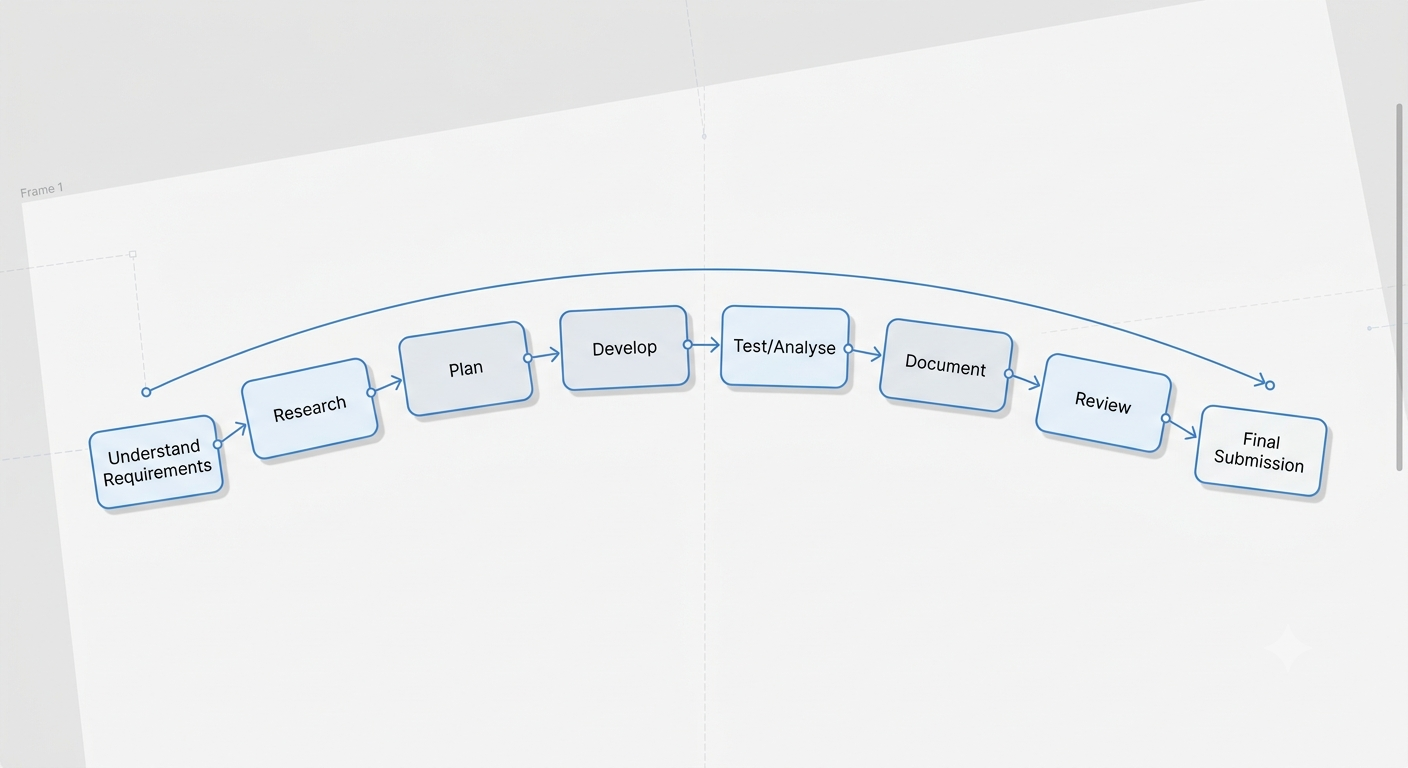
The major stages involved in taking an academic project from initial requirements through research, development, analysis, documentation, review, and final submission.
Following a structured process is useful because problems found during the final stage are often much harder to fix than problems identified during planning. Clear requirements and an appropriate methodology can therefore save significant time later.
TYPES OF ACADEMIC PROJECTS
Academic project work can range from programming and software development to research, data science, cybersecurity, databases, healthcare, law, education, management, dissertations, and technical reporting.
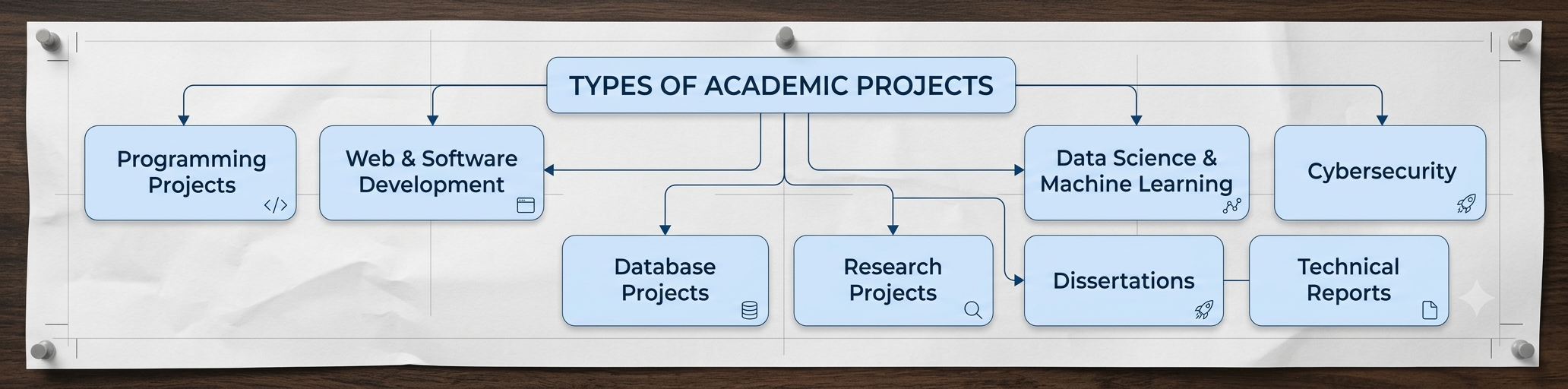
Examples of technical, research, professional, and postgraduate academic projects that may require different forms of subject expertise.
Programming assignments and software projects involving algorithms, application development, debugging, APIs, architecture, testing, and technical documentation.
Explore programming assignment helpGuidance covering relational database design, ER modelling, normalization, SQL queries, transactions, DBMS concepts, and database documentation.
Explore database assignment helpTechnical and research guidance covering security assessment, vulnerability analysis, risk, governance, security frameworks, and cybersecurity documentation.
Explore cybersecurity assignment helpSupport for data preparation, machine-learning workflows, model evaluation, experimentation, interpretation, and research documentation.
Explore data science assignment helpResearch planning, literature reviews, methodology development, quantitative and qualitative approaches, data analysis, and interpretation.
Explore research project helpStructured guidance for dissertations, postgraduate research, MBA projects, DBA work, research proposals, methodology chapters, and technical studies.
Explore dissertation project helpAcademic guidance for nursing assignments covering clinical concepts, evidence-based practice, healthcare research, nursing theory, case analysis, and academic documentation.
Explore nursing assignment helpGuidance for law assignments involving legal research, case analysis, legislation, legal principles, critical discussion, argument development, and academic writing.
Explore law assignment helpAcademic guidance for early childhood education assignments covering child development, learning theories, curriculum planning, pedagogy, inclusion, and reflective practice.
Explore early childhood assignment helpSupport for management assignments involving business strategy, leadership, organisational behaviour, operations, marketing, human resources, and business analysis.
Explore management assignment helpWHAT SUPPORT CAN INVOLVE
Not every student needs support with an entire assignment. Often the most useful intervention is focused on one technical, analytical, research, or documentation problem.
Break complex programming, database, cybersecurity, data science, research, healthcare, law, education, management, or systems concepts into understandable components.
Discuss research questions, literature-review approaches, methodology choices, data collection, analysis, and interpretation.
Work through debugging, implementation decisions, database problems, analytical workflows, system design, and technical reasoning.
Understand datasets, preprocessing, statistical approaches, machine-learning experiments, evaluation measures, and interpretation of results.
Improve the explanation of methods, technical decisions, results, limitations, diagrams, testing evidence, and conclusions.
Identify gaps, inconsistencies, unclear reasoning, methodological weaknesses, technical issues, and opportunities to improve the final work.
A STRUCTURED APPROACH
The most useful academic support is not simply about reaching an answer. It should help you understand how and why the answer, method, implementation, or conclusion was reached.
Start with the assignment brief, project specification, marking criteria, research question, technical requirements, or learning outcomes. Understanding the actual problem comes before choosing a solution.
Identify appropriate sources, concepts, technologies, methods, datasets, tools, and analytical approaches. A clear plan reduces unnecessary work later.
Technical concepts, programming problems, research methodology, data analysis, system design, and interpretation can be broken into smaller and more manageable components.
The practical or analytical stage may involve coding, modelling, experimentation, data analysis, technical implementation, research analysis, or development of project artefacts.
Academic work needs more than a result. Methods, decisions, assumptions, findings, limitations, technical evidence, and conclusions should be explained clearly.
A final review can identify unclear reasoning, technical inconsistencies, documentation gaps, methodological weaknesses, referencing problems, and opportunities to improve clarity.
EXPLORE SPECIALIST AREAS
Our broader assignment and project guidance connects with specialist technical resources across the website. These pages provide more detailed explanations of particular technologies and disciplines.
DATA SCIENCE
Explore ARFF datasets, preprocessing, classification, clustering, model evaluation, and practical machine-learning workflows.
Explore the WEKA guideLOW-LEVEL PROGRAMMING
Learn about registers, instructions, memory addressing, the stack, procedures, Linux system calls, debugging, and low-level programming concepts.
Explore the NASM guideTECHNICAL AREAS
Explore the broader collection of cybersecurity, programming, database, networking, systems analysis, research, and data analysis topics.
Explore technologiesProjectAssignments is intended to provide educational, technical, and research guidance. We can help explain concepts, discuss approaches, review work, troubleshoot technical problems, and strengthen understanding. Students remain responsible for following their institution's academic integrity requirements and for submitting work that accurately represents their own contribution.
FREQUENTLY ASKED QUESTIONS
Some common questions about the type of academic and technical support available through ProjectAssignments.
We focus particularly on technical and research-oriented academic work, including programming, software development, databases and SQL, cybersecurity, data science, machine learning, nursing, law, early childhood education, management, research methodology, technical reports, dissertations, MBA projects, and DBA research.
Yes. Guidance can cover programming concepts, algorithms, debugging, software architecture, databases, APIs, testing, documentation, and understanding implementation decisions. The objective is to help you understand the technical work and develop your own academic submission.
Our approach is based on ethical academic guidance rather than submitting work on a student’s behalf. We can help explain concepts, review work, discuss methodology, troubleshoot technical problems, analyse approaches, and improve clarity while the student remains responsible for their own academic submission.
Yes. Research support can include research-question development, literature-review planning, methodology, data-analysis approaches, interpretation of findings, technical research decisions, dissertation structure, and review of research documentation.
Yes. Support does not have to cover an entire project. A focused session can address a specific programming problem, database issue, research-methodology question, data-analysis problem, technical concept, or documentation challenge.
No. Academic assessment remains the responsibility of the relevant institution and instructor. The purpose of our guidance is to improve understanding, technical quality, research structure, and the student’s ability to explain and develop their own work.
Let's make your work clearer
Tell us what you're researching, building, or trying to understand. We'll help you find the clearest ethical next move.