Programming • Coding • Software Development • Academic Guidance

Programming Assignment Help That Starts With Understanding the Problem

Programming assignments are rarely just about writing code. They often require students to understand a problem, design a logical solution, implement it correctly, test the result, document the work and explain why the chosen approach makes sense.

This guide explains that process step by step and shows where structured academic guidance can help students develop their own understanding and complete their work responsibly.

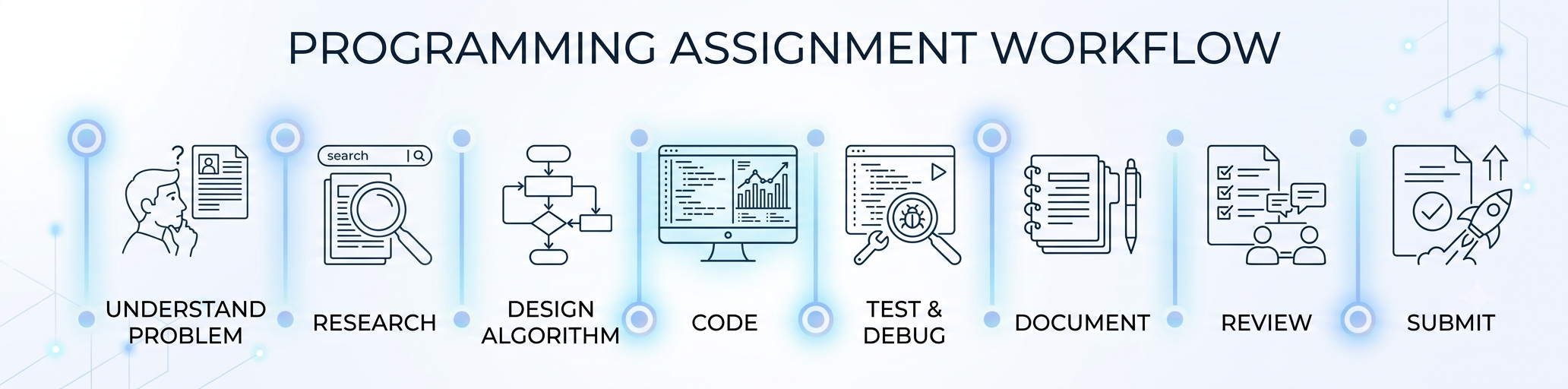
Programming assignment workflow showing the stages from understanding the problem and research through algorithm design, coding, testing, documentation, review and submission

More than writing code

What a programming assignment actually requires

A good programming assignment normally combines problem solving, technical implementation, testing and communication. The code is only one part of the final academic artefact.

Problem solving comes first

Before opening an IDE or writing the first line of code, the problem needs to be understood. What are the inputs? What output is expected? What constraints apply? What assumptions can be made? What does the marking rubric actually assess?

Implementation must be explainable

A technically working program is not necessarily a strong academic submission. Students may also need to explain their algorithm, justify implementation choices, demonstrate testing and connect practical work with concepts taught in the course.

A practical workflow

How to approach a programming assignment

Breaking a programming task into smaller stages makes a complex brief easier to understand and reduces the temptation to start coding before the problem has been properly analysed.

01

Understand the problem

Identify the objective, inputs, outputs, constraints, assumptions and assessment requirements.

02

Research

Review relevant concepts, documentation, algorithms, libraries and reliable technical resources.

03

Design the algorithm

Plan the solution using pseudocode, flowcharts, diagrams or other suitable design techniques.

04

Code

Implement the planned solution using the required programming language and development environment.

05

Test & debug

Test different inputs, identify failures and correct syntax, logical and runtime problems.

06

Document

Explain the implementation, technical decisions, testing strategy and outcomes.

07

Review

Compare the completed work with the original assignment brief and marking criteria.

08

Submit

Confirm that the required files, source code, report, screenshots and supporting artefacts are included.

Where students commonly need guidance

Programming assignments combine several different skills

The difficult part is not always the programming language itself. Students can encounter challenges at almost every stage of the assignment.

Understanding the brief

Break the assignment question into its functional, technical and documentation requirements before starting to code.

Algorithms and logic

Translate the problem into a logical sequence using algorithms, pseudocode, flowcharts or appropriate data structures.

Programming and implementation

Develop the solution in the required programming language while keeping the code readable, structured and explainable.

Testing and debugging

Identify errors, test expected and unexpected inputs, and improve the reliability of the implementation.

Documentation

Explain the approach, implementation decisions, testing process and results in a way that matches the assignment requirements.

Review and refinement

Check the final work against the original brief, marking criteria, technical requirements and academic expectations.

Programming technologies

Programming languages commonly encountered in academic work

The exact language depends on the course, module and assignment specification. The underlying problem-solving process, however, remains broadly similar.

PythonJavaCC++JavaScriptC#PHPSQL

Programming assignments can also involve databases, web development, APIs, object-oriented programming, data structures, algorithms, software testing, data analysis and other technical areas. Where appropriate, students can explore the site's technology guides for deeper explanations of individual technologies.

Common difficulties

Why programming assignments can become challenging

Recognising the actual source of difficulty is often the first step towards solving it.

Understanding what the assignment question is actually asking
Converting a problem statement into an algorithm or solution design
Choosing suitable data structures or programming techniques
Writing code that is both functional and easy to explain
Finding and fixing syntax, logical and runtime errors
Testing programs beyond the obvious happy-path examples
Explaining technical decisions in an accompanying report
Connecting practical implementation with theoretical concepts

Academic integrity

Guidance should strengthen understanding, not replace the student's work

Programming assignments are intended to demonstrate what a student understands and can do. Getting help understanding a difficult concept is very different from submitting someone else's work as your own.

Useful academic assistance can include explaining a programming concept, helping interpret an assignment brief, discussing an algorithm, reviewing a student's approach, identifying why an implementation is failing, or explaining how testing and documentation should be approached.

Students should always follow their institution's rules about collaboration, permitted assistance, artificial intelligence, source-code reuse and submission requirements.

Learn about our broader assignment and project guidance

A useful way to think about programming support

The goal is not simply to obtain a working program. The goal is to understand how the solution works, why it works, how it was tested and how it can be explained.

  • Understand the concept
  • Build the solution
  • Test and explain it

Programming assignment FAQ

Questions students commonly ask

What should I do before starting a programming assignment?

Start by reading the complete brief and identifying the required inputs, outputs, constraints, deliverables and marking criteria. Then research the relevant concepts and design the solution before beginning implementation.

Is programming assignment help only about writing code?

No. Depending on the assignment, students may need support with problem analysis, algorithms, data structures, debugging, testing, documentation, technical reports and explaining implementation decisions.

Which programming languages can academic assignments use?

This depends on the course and assignment. Common examples include Python, Java, C, C++, JavaScript, C#, PHP and SQL, although universities may require other languages or specific frameworks.

Why is testing important in a programming assignment?

Testing demonstrates whether the implementation behaves as expected across different inputs and conditions. It can also reveal logical, runtime and edge-case problems that may not be obvious during initial development.

Can programming guidance help me understand a difficult assignment?

Yes. Academic guidance can be useful for clarifying the assignment requirements, explaining technical concepts, discussing possible approaches and helping students understand problems in their own work. Students should remain responsible for their final submission and follow their institution's academic-integrity requirements.

Let's make your work clearer

Bring us the difficult part.

Tell us what you're researching, building, or trying to understand. We'll help you find the clearest ethical next move.

Get Guidance
Chat with us on WhatsApp