Why WEKA
A visual environment for understanding machine learning.
WEKA brings data preparation, machine learning algorithms, evaluation methods, and visualization together in a common environment. It is particularly useful when the objective is not simply to run a model, but to understand how the model works and explain the experimental methodology clearly.
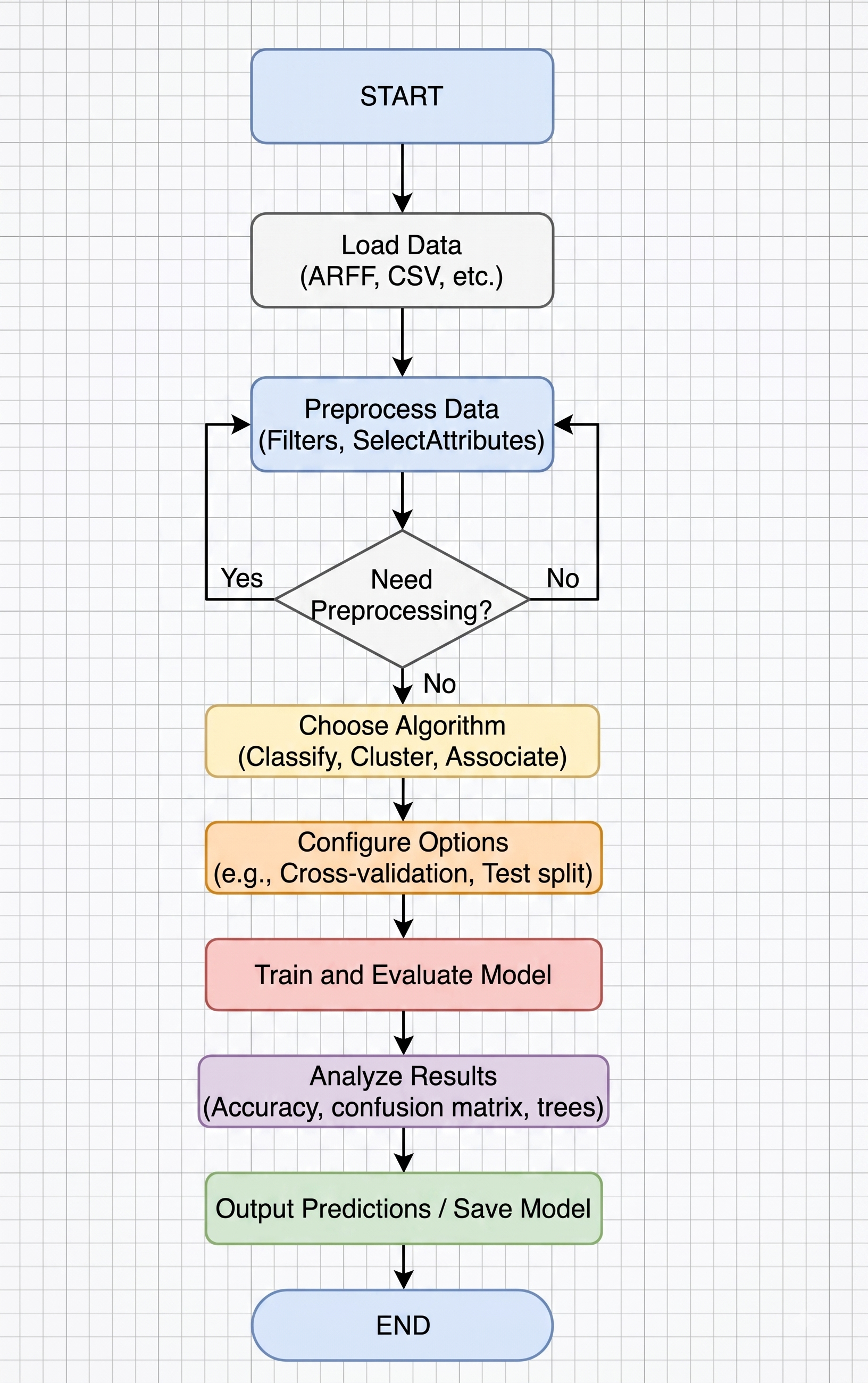
A structured WEKA workflow from data preparation through model evaluation and prediction.
Developed at the University of Waikato in New Zealand, WEKA provides tools for data preprocessing, classification, regression, clustering, association-rule mining, attribute selection, and visualization. Its graphical interfaces make it possible to experiment with machine-learning techniques without requiring every stage of the workflow to be implemented from scratch.
WEKA remains particularly valuable in teaching, research, and experimental data-mining work, where reproducible methodology and clear interpretation of model results are as important as obtaining a prediction.
WEKA at a glance
One workbench, multiple analytical workflows.
WEKA provides several interfaces that support different styles of machine-learning experimentation.
| Interface | Primary purpose | Typical use |
|---|---|---|
| Explorer | Interactive data loading, preprocessing, modelling, evaluation, and visualization. | Coursework, exploratory analysis, rapid experiments, and model development. |
| Experimenter | Structured comparison of algorithms and parameter configurations across datasets. | Empirical research and comparative model evaluation. |
| Knowledge Flow | Visual, component-based construction of data-processing workflows. | Repeatable pipelines and stream-oriented processing. |
| Workbench | Unified workspace combining WEKA applications and installed extensions. | Users who want a centralized analytical environment. |
| Command Line | Direct execution of WEKA classes and configurations. | Automation, scripting, batch execution, and advanced workflows. |
Core capabilities
From raw datasets to interpretable models.
A typical WEKA workflow can cover most of the major stages of a machine-learning experiment.
Data preprocessing
Clean, transform, filter, normalize, discretize, and prepare datasets before modelling. Missing-value handling, attribute filtering, and feature transformations can be incorporated directly into the workflow.
Classification
Explore algorithms including J48, Random Forest, Naive Bayes, SMO, MultilayerPerceptron, IBk, and other learning approaches for supervised prediction tasks.
Explore WEKA classification →Regression
Build predictive models for numerical outcomes using linear and other regression-oriented learning techniques.
Clustering
Investigate unlabeled datasets using methods such as SimpleKMeans, EM, and hierarchical clustering.
Explore WEKA clustering & evaluation →Association rules
Discover relationships between variables using techniques such as Apriori and FP-Growth, with measures including support, confidence, and lift.
Attribute selection
Identify informative features and reduce unnecessary attributes using evaluators and search strategies available through WEKA.
ARFF datasets
Understanding WEKA's native data format.
The Attribute-Relation File Format, commonly known as ARFF, provides a structured way to describe a dataset's attributes and instances.
An ARFF file contains two principal sections: a header defining the relation and attributes, followed by a data section containing the individual instances. WEKA also supports other data sources and formats, including CSV files and database connections.
@relation customer_churn_analysis

@attribute age numeric
@attribute account_type {standard, premium, enterprise}
@attribute monthly_spend numeric
@attribute support_tickets_opened numeric
@attribute churn_status {true, false}

@data
34,standard,120.50,2,false
45,premium,450.00,0,false
23,standard,89.00,5,true
52,enterprise,1250.75,1,false
29,standard,110.20,8,true
Understanding the ARFF structure is particularly important when preparing datasets for academic experiments because attribute definitions, nominal values, data types, and missing values all influence how WEKA interprets the dataset.
Practical methodology
A structured WEKA machine-learning workflow.
A sound experiment should follow a reproducible sequence rather than simply selecting an algorithm and reporting its accuracy.
Load and inspect the dataset
Open the ARFF or CSV dataset in Explorer and inspect attributes, class distributions, missing values, and basic dataset characteristics.
Preprocess the data
Apply appropriate filters for missing values, attribute transformations, normalization, discretization, or class balancing where justified.
Select relevant attributes
Use attribute evaluators and search methods to identify potentially useful features and reduce unnecessary dimensionality.
Choose and configure the model
Select an appropriate classifier, regressor, clusterer, or association-rule algorithm and document its important configuration parameters.
Evaluate the model
Use an appropriate validation strategy such as cross-validation or a supplied test set rather than relying solely on training-set performance.
Interpret and document the results
Analyse accuracy, precision, recall, F-measure, ROC information, confusion matrices, model structures, and other metrics relevant to the research question.
Algorithms
Understanding the models behind the output.
WEKA is useful not only for executing algorithms, but also for examining the reasoning and mathematics behind their results.
| Algorithm | Category | Typical purpose |
|---|---|---|
| J48 | Decision tree | Classification using a tree-based representation of decision rules. |
| Random Forest | Ensemble learning | Combining multiple decision trees for classification and regression. |
| Naive Bayes | Probabilistic classification | Classification using conditional probability assumptions. |
| SMO | Support Vector Machine | Classification using a support-vector learning approach. |
| IBk | Instance-based learning | Classification using the k-nearest-neighbour approach. |
| SimpleKMeans | Clustering | Partitioning observations into clusters around centroids. |
Explore WEKA in depth
Go deeper into classification and clustering.
The WEKA guide provides the foundation. These focused resources explore two major machine-learning workflows and their practical interpretation in greater depth.
WEKA Classification
Learn how supervised classification works in WEKA, including J48 decision trees, Naive Bayes, Random Forest, IBk, training and testing, cross-validation, confusion matrices, precision, recall, and F-measure.
Read the classification guide →WEKA Clustering & Evaluation
Explore unsupervised learning with SimpleKMeans, cluster selection, centroids, distance, cluster evaluation, interpretation, limitations, and academic reporting.
Read the clustering guide →WEKA Academic Projects
Bring the different parts of a WEKA experiment together: dataset preparation, algorithm selection, evaluation, interpretation, and technical documentation.
Explore technical services →Model evaluation
Accuracy is only one part of the analysis.
A meaningful machine-learning experiment should select evaluation measures that match the problem and explain what each metric tells the reader.
Precision
Measures how many instances predicted as positive were actually positive.
Recall
Measures how many of the actual positive instances were correctly identified.
F1-score
Combines precision and recall into a single harmonic-mean measure.
WEKA can also provide confusion matrices and other evaluation information that help researchers understand where a model is succeeding and where it is making errors.
WEKA versus code-first tools
When does WEKA make sense?
Python and R are powerful ecosystems, particularly for production systems and highly customized workflows. WEKA offers a different advantage: a visual and comparatively accessible environment for experimentation and explanation.
| Dimension | WEKA | Python | R |
|---|---|---|---|
| Primary workflow | GUI + Java API + CLI | Code-first | Code-first |
| Learning curve | Accessible for beginners | Requires Python proficiency | Requires R proficiency |
| Experimentation | Highly visual | Highly programmable | Highly programmable |
| Academic methodology | Strong for structured experiments | Highly flexible | Strong statistical ecosystem |
| Production development | More specialized | Extremely broad ecosystem | Broad analytical ecosystem |
Academic and research support
WEKA guidance for coursework, capstones, and research.
The difficult part of a WEKA project is often not clicking Start. It is designing a defensible experiment, interpreting the output correctly, and explaining the methodology.
Dataset preparation
Guidance on ARFF conversion, preprocessing, missing values, feature selection, class imbalance, and dataset structure.
Experimental design
Support for selecting algorithms, configuring evaluation strategies, comparing models, and documenting parameters.
Results interpretation
Help understanding confusion matrices, performance metrics, model structures, comparative results, and limitations.
Methodology writing
Technical review of methodology sections, experiment descriptions, tables, figures, and academic explanations.
WEKA implementation
Practical guidance for configuring the Explorer, Experimenter, Knowledge Flow, filters, classifiers, and evaluation options.
Java API integration
Guidance for advanced projects that integrate WEKA's Java functionality into custom applications or broader analytical workflows.
Frequently asked questions
Common WEKA questions.
What is WEKA used for?
WEKA is a machine-learning and data-mining workbench used for tasks including preprocessing, classification, regression, clustering, association-rule mining, attribute selection, experimentation, and visualization.
What is an ARFF file?
ARFF stands for Attribute-Relation File Format. It defines the structure of a dataset through a relation declaration, attribute definitions, and a data section containing the instances.
What is the difference between J48 and C4.5?
J48 is WEKA's implementation of the C4.5 decision-tree algorithm. It provides a WEKA-compatible implementation of the decision-tree methodology associated with C4.5.
Can WEKA be used for text-mining projects?
Yes. WEKA supports text-processing workflows, including converting string attributes into machine-learning features using filters such as StringToWordVector.
Can you help with a WEKA academic project?
ProjectAssignments provides technical guidance covering dataset preparation, preprocessing, algorithm selection, experiment configuration, evaluation, result interpretation, and technical documentation.
Does ProjectAssignments guarantee a particular grade?
No. Our role is to provide technical guidance, research support, and structured assistance. Final academic assessment remains the responsibility of the relevant institution and instructor.
ProjectAssignments provides technical guidance and educational support intended to help students understand machine-learning concepts and develop their own academic work. Materials and explanations should be used responsibly and in accordance with the academic-integrity requirements of the relevant institution.