IT SYSTEMS • APIs • APPLICATION INTEGRATION
API & Application Integration Project Help and Technical Guidance
Understand how modern applications communicate, exchange data, authenticate users, and integrate independent services through well-designed APIs and application architectures.
API & APPLICATION INTEGRATION
Modern software is rarely an isolated application.
Most modern applications depend on multiple software components communicating with one another. A web application may rely on a backend API, authentication service, database, payment gateway, third-party platform, cloud service, or several independently deployed microservices.
APIs provide the interfaces through which these systems exchange information and functionality. Designing those interfaces correctly requires much more than knowing how to send an HTTP request. Developers need to understand data contracts, authentication, authorization, error handling, versioning, validation, security, performance, and integration testing.
Our API and application integration project guidance helps students, researchers, and professionals understand these concepts and apply them to software engineering projects, coursework, capstone systems, research prototypes, and technical documentation.
WHY API PROJECTS ARE CHALLENGING
API development sits at the intersection of multiple engineering disciplines.
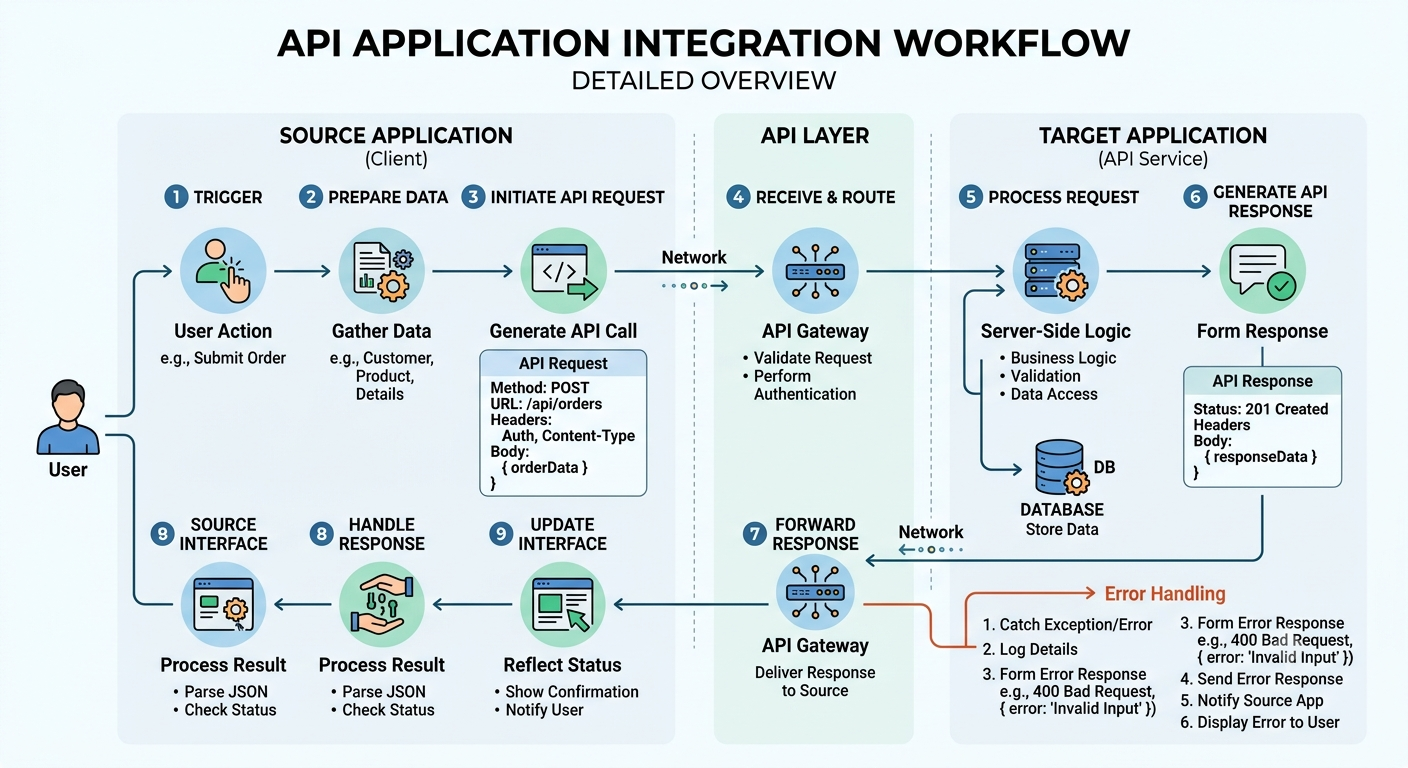
A simple API endpoint can hide a surprising amount of engineering complexity. The endpoint has to accept input, validate it, authenticate the requester, determine whether that requester is authorized to perform the operation, interact with the appropriate service or database, and return a predictable response.
Integration becomes even more complicated when several independently developed systems are involved. Differences in data formats, authentication mechanisms, error handling, network reliability, versioning, and service availability can all affect the final architecture.
- Designing clear and consistent API contracts between independent systems.
- Choosing appropriate authentication and authorization mechanisms.
- Validating request data and handling malformed or unexpected input.
- Designing meaningful HTTP status codes and error responses.
- Managing API versions without unnecessarily breaking existing clients.
- Securing sensitive data during transmission and processing.
- Testing interactions between multiple applications and services.
- Understanding performance, reliability, caching, retries, and failure handling.
REST API DEVELOPMENT
Designing REST APIs that are understandable, predictable, and maintainable.
REST remains one of the most widely encountered approaches for building web APIs. Academic projects commonly require students to design endpoints for creating, retrieving, updating, and deleting resources while following appropriate HTTP semantics.
Effective REST API design requires consideration of both the individual endpoints and the overall API contract. Resources, URLs, HTTP methods, request bodies, response structures, status codes, validation rules, and error formats should work together consistently.
Common REST API concepts we cover
- Resource-oriented endpoint design
- GET, POST, PUT, PATCH, and DELETE semantics
- HTTP status codes and error handling
- Request and response body design
- JSON data structures and serialization
- Pagination, filtering, sorting, and searching
- API versioning strategies
- Input validation and schema enforcement
- Idempotency and safe request handling
- API documentation with OpenAPI and Swagger
API ARCHITECTURE OPTIONS
REST is not the only way applications communicate.
Depending on the requirements, an application may use REST, GraphQL, gRPC, messaging systems, or a combination of communication patterns. Understanding the differences helps students make technically defensible architecture decisions instead of selecting a technology simply because it is popular.
GraphQL
GraphQL provides a query-based approach in which clients can request the data they require through a defined schema. It can be particularly useful where clients have different data requirements or where aggregating information from several backend sources is important.
- Schema and type system design
- Queries, mutations, and resolvers
- Nested data retrieval
- Authorization at resolver and field levels
- Query complexity and performance considerations
gRPC
gRPC is commonly encountered in distributed systems and microservice environments where efficient service-to-service communication is important. It uses Protocol Buffers to define strongly typed service contracts.
- Protocol Buffer schemas
- Service and method definitions
- Unary and streaming communication
- Inter-service communication
- Service contract and compatibility management
API AUTHENTICATION & AUTHORIZATION
An API must determine not only who is calling it, but what that caller is allowed to do.
Authentication and authorization are closely related but distinct concepts. Authentication establishes the identity of a requester, while authorization determines which resources and operations that identity is permitted to access.
API projects frequently require students to implement or analyze authentication mechanisms such as API keys, session authentication, OAuth 2.0, OpenID Connect, and JSON Web Tokens.
Authentication and authorization topics
- API keys and service credentials
- Session-based authentication
- OAuth 2.0 authorization flows
- OpenID Connect concepts
- JWT structure and validation
- Role-based access control
- Object-level authorization
- Service-to-service authentication
- Token expiration and refresh mechanisms
- Secure credential and secret management
API SECURITY
Integration design must account for security from the beginning.
APIs frequently expose sensitive functionality and data, which makes them an important security boundary within modern applications. Poor input validation, broken authorization, excessive data exposure, insecure authentication, and insufficient rate limiting can create significant risks.
We provide guidance on understanding common API security weaknesses and designing appropriate defensive controls.
- Input validation and schema validation
- Authentication and authorization controls
- Object-level access control
- Rate limiting and throttling
- Secure CORS configuration
- Transport encryption using HTTPS/TLS
- Protection against injection attacks
- Secure error handling
- Prevention of excessive data exposure
- API logging and monitoring
Security considerations can also be connected with broader application security concepts covered through our cybersecurity services and secure software development guidance.
APPLICATION INTEGRATION
Connecting independent applications into one coherent system.
Application integration involves more than connecting two endpoints. The systems being integrated may have different data models, authentication mechanisms, availability requirements, technologies, and development teams.
A well-designed integration layer provides clear boundaries between those systems while translating data and requests where necessary.
Common integration scenarios include:
- Web applications communicating with backend services.
- Mobile applications consuming REST or GraphQL APIs.
- Microservices communicating with other internal services.
- Applications integrating with third-party SaaS platforms.
- Payment systems communicating with external payment providers.
- Enterprise systems exchanging customer or operational data.
- Cloud services interacting through APIs and event-driven interfaces.
- Legacy systems being integrated with newer applications.
MICROSERVICES & BACKEND SERVICES
API design becomes especially important in distributed architectures.
Microservice architectures divide application functionality into independently developed and deployed services. APIs and service contracts become the mechanisms through which these services communicate.
Academic projects involving microservices often require students to reason about service boundaries, communication patterns, data ownership, failure handling, and deployment architecture.
- Identifying appropriate service boundaries
- Designing service contracts
- Synchronous versus asynchronous communication
- Service discovery concepts
- API gateways and routing
- Distributed authentication and authorization
- Timeouts, retries, and failure handling
- Centralized logging and observability
- Independent service deployment
- Managing distributed data and consistency
DATA EXCHANGE & VALIDATION
Reliable integration depends on reliable data contracts.
When two applications communicate, both sides need a shared understanding of the data being exchanged. Inconsistent field names, data types, validation rules, or assumptions can cause integration failures even when the API itself is technically reachable.
We can help with the design and analysis of structured data contracts, validation rules, serialization, and transformation logic.
- JSON request and response structures
- Schema validation
- Data serialization and deserialization
- Data type consistency
- Required and optional fields
- Validation error structures
- Data transformation between systems
- Backward-compatible API changes
API TESTING & VALIDATION
An integration is only useful if its interfaces behave predictably.
API testing evaluates whether endpoints behave correctly under valid, invalid, expected, and unexpected conditions. Testing should cover both individual API operations and the interaction between multiple services.
API testing may include:
- Functional API testing
- Positive and negative test cases
- Authentication and authorization testing
- Input validation testing
- Response schema validation
- Integration testing
- Contract testing
- Performance and load testing
- Error and failure-path testing
- Automated API regression testing
TECHNOLOGIES & TOOLS
API and integration projects across modern development stacks.
The appropriate technology depends on the project's requirements and architecture. We provide guidance across commonly encountered application development and integration technologies.
- Backend: Node.js, Express, Python, Django, Flask, FastAPI, Java, Spring Boot, C#, and ASP.NET Core
- Frontend: React, Next.js, JavaScript, and TypeScript
- API styles: REST, GraphQL, gRPC, and service-oriented interfaces
- Data formats: JSON, XML, Protocol Buffers, and structured schemas
- API documentation: OpenAPI and Swagger
- Testing: Postman, automated test frameworks, integration testing, and contract testing
- Infrastructure: Docker, cloud services, API gateways, and reverse proxies
- Databases: PostgreSQL, MySQL, MongoDB, and other application data stores
API PROJECT WORKFLOW
A structured approach to API and application integration projects.
A disciplined integration process helps prevent architectural problems from appearing later in implementation and testing.
- Understand the requirements. Identify the applications involved, expected data flows, functional requirements, security constraints, and project objectives.
- Define the integration architecture. Determine service boundaries, communication patterns, endpoints, data contracts, and dependencies.
- Design the API contract. Define resources, operations, request and response structures, validation rules, status codes, and error handling.
- Implement authentication and security. Establish appropriate authentication, authorization, transport security, validation, and rate-limiting controls.
- Test the integration. Verify individual endpoints as well as interactions between dependent applications and services.
- Document and evaluate. Explain architectural decisions, API contracts, testing results, limitations, and potential improvements.
ACADEMIC & RESEARCH SUPPORT
API guidance for coursework, capstones, research, and technical projects.
API and application integration appears in many types of academic and research projects. You may be asked to build a REST API, connect a frontend to a backend, integrate a third-party service, design a microservice architecture, or evaluate the security of an existing API.
Our guidance can help you understand the technical reasoning behind those tasks rather than treating API development as a collection of disconnected implementation steps.
- API development assignments
- Software engineering capstone projects
- REST and GraphQL coursework
- Microservices architecture projects
- Backend and frontend integration
- Third-party API integration
- API security assessments
- API testing and documentation
- Distributed systems projects
- Research prototypes involving multiple services
RESPONSIBLE TECHNICAL GUIDANCE
The goal is to understand how systems communicate, not merely make an API work.
A technically functional API is only one part of a successful integration project. Good engineering also requires clear contracts, appropriate security controls, predictable error handling, maintainability, testing, and documentation.
Our role is to make those technical concepts easier to understand and help you reason through the engineering decisions involved in your project.
Academic work should remain your own. We provide technical explanations, architecture reviews, troubleshooting guidance, and research-oriented support so that you can develop a stronger understanding of the systems you are building.
API & INTEGRATION FAQ
Questions about API and application integration projects.
Common questions about REST APIs, application integration, authentication, testing, and distributed systems.
What types of API projects do you support?
We support REST, GraphQL, gRPC, backend API development, third-party API integration, microservice communication, authentication, authorization, API testing, documentation, and related application integration projects.
Can you help with REST API assignment projects?
Yes. Guidance can cover REST resource design, HTTP methods, request and response structures, validation, authentication, authorization, error handling, versioning, testing, and API documentation.
Can you help integrate a frontend with a backend API?
Yes. We can explain how frontend applications communicate with backend services, including request handling, authentication, JSON data exchange, error handling, and integration testing.
Do you provide help with API authentication and JWTs?
Yes. Guidance can cover authentication concepts, JWT structure and validation, token expiration, refresh mechanisms, role-based access control, and secure API authorization.
Can you help with microservices integration?
Yes. We can provide guidance on service boundaries, API contracts, synchronous and asynchronous communication, service authentication, failure handling, API gateways, distributed data, and observability.
Can you help test an API?
Yes. API testing guidance can cover functional tests, negative test cases, authentication testing, schema validation, integration tests, contract testing, automated regression testing, and performance considerations.
HAVE AN API OR INTEGRATION PROJECT?
Let's understand the integration challenge before choosing the implementation.
Share your API requirements, architecture diagram, project brief, integration problem, research objective, or technical question and discuss the most appropriate approach.
Discuss Your API Project