Understand the application
Identify the application architecture, dependencies, runtime requirements, configuration, and deployment objectives.
DEVOPS • CONTAINERIZATION • CLOUD INFRASTRUCTURE
Technical guidance for Docker, containerization, CI/CD pipelines, infrastructure automation, cloud deployment, Kubernetes, Terraform, and modern software delivery workflows.
DEVOPS & CONTAINERIZATION
Modern software engineering does not end when application code is written. Applications need to be built, tested, packaged, configured, deployed, monitored, and maintained across environments.
DevOps brings these activities together by connecting software development with infrastructure, automation, testing, release management, and operations. Containerization adds another important layer by providing a consistent way to package applications and their dependencies.
Our DevOps and containerization project guidance helps students, researchers, and professionals understand these relationships and apply them to software engineering projects, cloud deployments, technical assignments, and capstone systems.
WHY DEVOPS PROJECTS ARE CHALLENGING
A common misconception is that DevOps simply means using Docker, GitHub Actions, Jenkins, or Kubernetes. In reality, DevOps projects involve a collection of interconnected engineering decisions.
A change in application architecture can affect the build process. A change in the deployment environment can affect configuration. A container image can introduce dependency or security problems. A CI/CD pipeline can successfully build an application while still failing during deployment.
Academic projects become particularly challenging because students are often expected to explain not only how a tool was configured, but why a particular architecture or workflow was selected.
CORE DEVOPS AREAS
DevOps projects can span source control, automated testing, containers, infrastructure, cloud platforms, monitoring, and deployment. We can help connect these individual components into a coherent engineering workflow.
CI/CD practices automate the process of taking source code through validation, testing, packaging, and deployment. Students often need to understand both the technical pipeline and the reasoning behind its individual stages.
Containers provide a standardized environment for packaging applications and their dependencies. Understanding containerization requires more than knowing individual Docker commands; it requires understanding images, layers, networking, storage, configuration, and lifecycle management.
Modern infrastructure is increasingly managed through automation rather than manual configuration. Infrastructure as code allows infrastructure definitions to become repeatable, version-controlled, reviewable, and easier to reproduce.
DOCKER & CONTAINERS
Traditional application deployment can become difficult when development, testing, and production environments differ. Libraries, runtime versions, operating-system dependencies, environment variables, and configuration can all introduce inconsistencies.
Containers address part of this problem by packaging an application with the environment it requires. This makes containerization particularly useful for demonstrating reproducible deployment workflows in academic and professional projects.
We provide guidance across the complete container workflow, including image creation, application packaging, networking, storage, configuration, testing, and deployment.
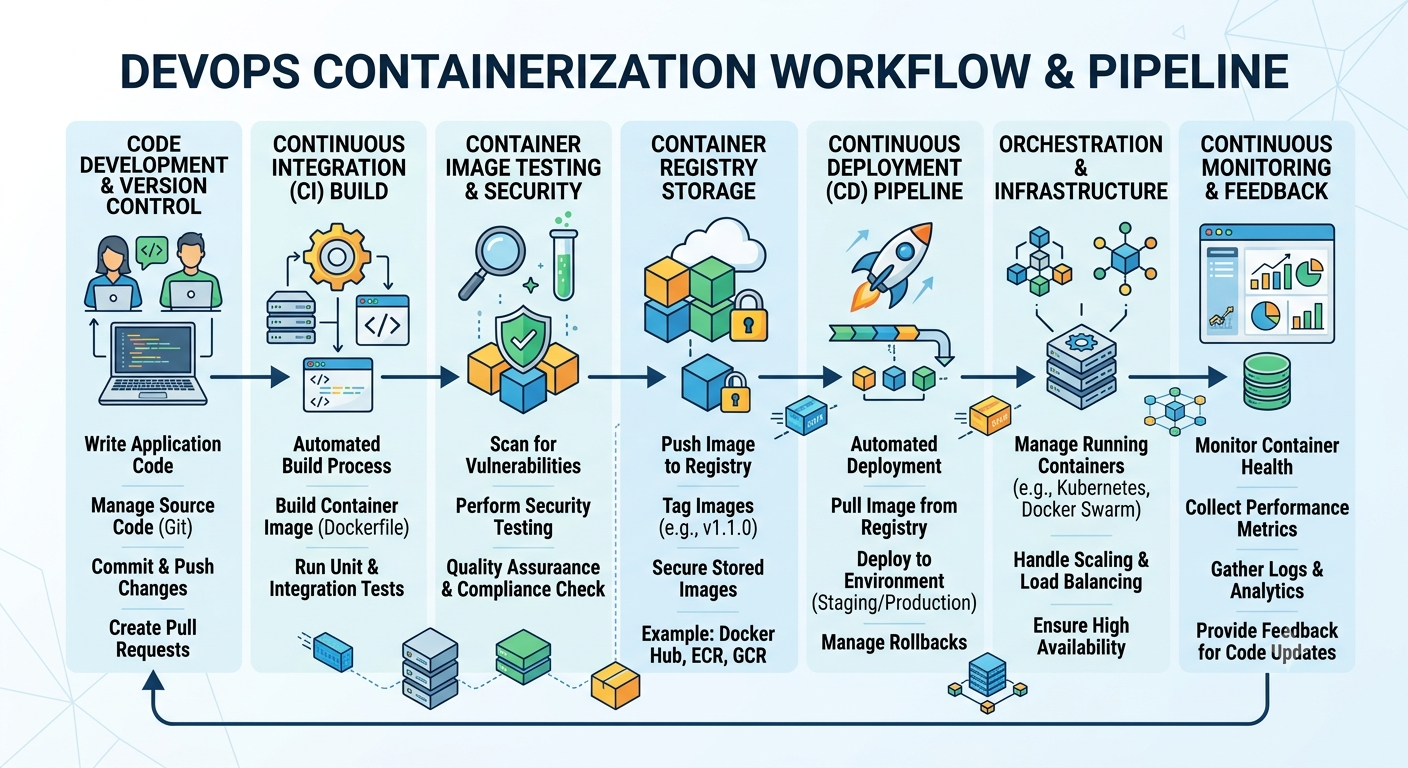
CONTAINER WORKFLOW
CI/CD PIPELINES
Continuous Integration and Continuous Delivery provide a structured approach to validating and releasing software. Instead of relying entirely on manual steps, a pipeline can automatically build the application, execute tests, perform quality checks, create artifacts, build container images, and deploy the resulting system.
A well-designed academic DevOps project should make this workflow understandable. Every pipeline stage should have a clear purpose and relationship to the overall software lifecycle.
Depending on the project, these workflows can be implemented using platforms and tools such as GitHub Actions, GitLab CI/CD, Jenkins, Azure DevOps, or cloud-native CI/CD services.
CONTAINER ORCHESTRATION
Running one container is relatively straightforward. Managing many containers across a distributed environment introduces a different set of engineering problems.
Container orchestration platforms such as Kubernetes provide mechanisms for scheduling workloads, exposing services, managing configuration, maintaining desired state, scaling applications, and handling failures.
For academic projects, the important objective is not simply to memorize Kubernetes resources. It is to understand why orchestration is useful and how the different components contribute to application availability and management.
INFRASTRUCTURE AS CODE
Infrastructure as code applies software engineering principles to infrastructure configuration. Instead of manually creating resources through a cloud console, infrastructure can be represented through version-controlled configuration.
This approach makes it easier to reproduce environments, review infrastructure changes, document architecture, and integrate infrastructure provisioning into automated delivery workflows.
Terraform is one of the commonly encountered tools in this area, but the underlying concepts are more important than any single platform.
DEVSECOPS & SECURITY
DevOps workflows increasingly incorporate security controls directly into the development and deployment lifecycle. This creates the connection between DevOps and DevSecOps.
Security can be considered at multiple points in the pipeline, from dependency analysis and source-code scanning to container image assessment, secret detection, infrastructure validation, access control, and deployment configuration.
These concepts are particularly valuable for projects that combine software engineering, cloud infrastructure, and cybersecurity.
TOOLS & TECHNOLOGIES
Different projects require different tools. The appropriate choice depends on the application, infrastructure, learning objectives, deployment environment, and required level of automation.
Docker, Docker Compose, container registries, container runtimes, and related image-management workflows.
GitHub Actions, GitLab CI/CD, Jenkins, Azure DevOps, and other automated build and deployment platforms.
Terraform and related infrastructure automation concepts for repeatable cloud and infrastructure provisioning.
AWS, Microsoft Azure, and Google Cloud environments, including compute, networking, identity, storage, and deployment services.
Kubernetes and related concepts for managing containerized applications across distributed environments.
DEVOPS PROJECT WORKFLOW
A strong DevOps project connects every stage rather than treating containers, pipelines, infrastructure, and deployment as unrelated exercises.
Identify the application architecture, dependencies, runtime requirements, configuration, and deployment objectives.
Determine the infrastructure, networking, storage, identity, and runtime requirements for the project.
Package the application and its dependencies into reproducible container images while keeping configuration separate.
Connect source control, testing, builds, image creation, artifact management, and deployment through a CI/CD workflow.
Test the resulting system, examine logs and failures, and verify that the deployed application behaves as expected.
Explain the workflow, technology choices, infrastructure, deployment process, and technical decisions clearly.
ACADEMIC & RESEARCH SUPPORT
DevOps concepts are increasingly appearing in software engineering, cloud computing, distributed systems, information technology, and cybersecurity coursework.
We can provide technical guidance for projects involving:
The emphasis remains on understanding the architecture, explaining technical decisions, troubleshooting problems, and developing a coherent project rather than simply treating individual DevOps tools as isolated technologies.
RELATED IT ENGINEERING AREAS
A DevOps project rarely exists in isolation. Architecture, cloud infrastructure, databases, APIs, security, and software engineering decisions all influence how an application is deployed and operated.
Software Engineering — Application architecture, programming, testing, version control, and maintainable software development practices.
System Architecture & Design — System components, interfaces, data flows, deployment architecture, and technical design decisions.
Cloud Architecture — Cloud infrastructure, networking, identity, scalability, availability, and deployment models.
RESPONSIBLE TECHNICAL GUIDANCE
DevOps becomes much easier to understand when the individual tools are connected to the broader software delivery process. Our guidance focuses on architecture, implementation, troubleshooting, technical reasoning, and documentation.
Academic work should remain your own. Our role is to make difficult technical concepts clearer and help you make better engineering decisions.
DEVOPS & CONTAINERIZATION FAQ
A few common questions about the technical guidance we provide.
We provide technical guidance for Docker and containerization projects, CI/CD pipelines, deployment workflows, infrastructure automation, infrastructure as code, Kubernetes concepts, cloud deployment, configuration management, monitoring, and DevOps architecture.
Yes. Guidance can cover Dockerfiles, images, containers, volumes, networking, environment configuration, multi-container applications, Docker Compose, container security considerations, and deployment workflows.
Yes. We can help you understand and design CI/CD workflows covering source control, automated builds, testing, artifact management, security checks, deployment stages, environment configuration, and release strategies.
Yes. Guidance can cover Kubernetes architecture, pods, deployments, services, configuration, secrets, namespaces, ingress concepts, scaling, health checks, and the relationship between containerized applications and orchestration.
Yes. We provide guidance on infrastructure-as-code concepts, Terraform configuration, reusable infrastructure definitions, variables, state, modules, resource dependencies, and repeatable infrastructure provisioning.
Yes. We can help analyze build failures, dependency problems, container issues, environment configuration errors, deployment failures, test failures, authentication problems, and other technical issues affecting a CI/CD workflow.
Yes. DevOps concepts can be incorporated into software engineering and IT capstone projects through automated testing, containerization, deployment automation, infrastructure as code, monitoring, and documented delivery workflows.
No. We provide technical guidance and educational support, but final grades and academic outcomes are determined by the relevant institution and assessment criteria.
HAVE A DEVOPS PROJECT?
Share your DevOps assignment, Docker project, CI/CD pipeline challenge, cloud deployment problem, infrastructure question, or research objective and discuss the most appropriate technical approach.
Discuss Your DevOps Project