IT SYSTEMS • SOFTWARE ENGINEERING • DEVELOPMENT
Software Engineering Projects, Development & Technical Guidance
Understand the principles behind well-designed software — from requirements and architecture to programming, testing, debugging, version control, and technical documentation.
SOFTWARE ENGINEERING
Software engineering is about building systems that can be understood, tested, maintained, and evolved.
Writing code is only one part of software engineering. A successful software project begins with understanding what the system is supposed to accomplish, continues through requirements analysis and architectural decisions, and extends into implementation, testing, deployment, maintenance, and documentation.
This becomes particularly important in academic software engineering projects. Students may be asked to design a complete application, produce UML diagrams, implement a particular architecture, demonstrate object-oriented principles, develop a database-backed system, write automated tests, or explain why particular engineering decisions were made.
Our software engineering consultancy provides structured technical guidance across these stages. The objective is not simply to produce code, but to help you understand the engineering decisions behind the software and communicate those decisions clearly.
WHY SOFTWARE ENGINEERING IS CHALLENGING
A software project can fail even when the code appears to work.
Software engineering requires several different forms of technical reasoning at the same time. A program may produce the expected output while still having poor architecture, duplicated logic, weak error handling, difficult-to-maintain components, inadequate testing, or requirements that were misunderstood at the beginning of the project.
Students often encounter difficulties because individual concepts are taught separately while real projects require those concepts to work together.
Common challenges include:
- Translating an informal project description into clear, testable software requirements.
- Choosing an appropriate architecture instead of immediately starting implementation.
- Understanding how classes, modules, services, databases, and external interfaces should interact.
- Applying object-oriented principles and design patterns without unnecessarily complicating the system.
- Debugging problems that originate from interactions between multiple components rather than from a single line of code.
- Designing meaningful test cases rather than testing only the obvious successful path.
- Maintaining a clear connection between requirements, code, tests, diagrams, and final documentation.
01 • REQUIREMENTS ENGINEERING
Strong software begins with understanding the problem before choosing the implementation.
Requirements engineering establishes what a software system is expected to do and the constraints under which it must operate. This includes understanding users, business or academic objectives, functional requirements, non-functional requirements, assumptions, dependencies, and acceptance criteria.
A technically impressive application can still be considered a poor engineering solution if it does not satisfy the original requirements. For this reason, requirements analysis should influence architecture, implementation, and testing from the beginning.
Areas where we provide guidance include:
- Functional and non-functional requirements
- Use cases and user stories
- Actors, system boundaries, and interactions
- Requirements prioritisation
- Acceptance criteria
- Requirements traceability
- Software Requirements Specification (SRS)
- Identifying ambiguous or conflicting requirements
We can also help connect requirements to subsequent design and testing activities so that the final system can be evaluated against clearly defined objectives.
02 • SOFTWARE ARCHITECTURE & DESIGN
Architecture provides the structure that allows individual components to become a coherent software system.
Once requirements are understood, the next challenge is deciding how the software should be structured. Architecture describes the major components of a system and the relationships between them, while detailed design explains how those components should behave.
Depending on the project, this may involve a layered architecture, client-server architecture, modular design, service-oriented components, microservices, MVC, or another appropriate architectural approach.
Software architecture guidance can cover:
- Architectural styles and patterns
- Separation of concerns
- Modularity and component boundaries
- Coupling and cohesion
- Interfaces and dependencies
- Layered application design
- Client-server systems
- Service-oriented and microservice concepts
- Scalability and maintainability considerations
- Architecture documentation
The goal is to make the architecture defensible: every major design decision should have a relationship to the requirements, constraints, and expected behaviour of the system.
03 • PROGRAMMING & IMPLEMENTATION
Turning a design into maintainable, testable software.
Implementation is where architectural and design decisions become executable software. However, good software engineering involves considerably more than making a program produce the expected output.
Code should be understandable, appropriately structured, and consistent with the architecture. Error handling, validation, interfaces, dependencies, data structures, and testing considerations should all be part of the implementation process.
Programming areas we commonly support include:
- Python application development and object-oriented programming
- Java and enterprise-oriented software development
- C and C++ programming concepts
- C# and .NET application development
- JavaScript and TypeScript development
- Backend and server-side programming
- Object-oriented design and implementation
- Data structures and algorithms
- Error handling and input validation
- Modular programming and reusable components
- Database integration
- API integration
Where a project uses a particular framework, we focus on understanding how the framework supports the underlying software engineering principles rather than treating framework syntax as a substitute for design.
04 • OBJECT-ORIENTED SOFTWARE ENGINEERING
Understanding objects, responsibilities, relationships, and reusable design.
Object-oriented programming is a major component of many software engineering curricula. Students are often expected to demonstrate concepts such as encapsulation, inheritance, polymorphism, abstraction, composition, and interface-based design within a working application.
The difficult part is usually not memorising definitions. The challenge is deciding where these concepts actually make sense in a particular system.
We provide guidance with:
- Class and object modelling
- Encapsulation and information hiding
- Inheritance and polymorphism
- Abstract classes and interfaces
- Composition and aggregation
- Dependency relationships
- SOLID design principles
- Common software design patterns
- Refactoring tightly coupled code
- Designing reusable and maintainable components
05 • UML & SOFTWARE MODELLING
Diagrams should explain the system, not simply satisfy a documentation requirement.
Unified Modeling Language (UML) provides a common way to represent different aspects of a software system. In academic projects, UML diagrams are often used to demonstrate that the student understands the relationship between requirements, design, and implementation.
Depending on the project requirements, we can provide guidance with:
- Use-case diagrams
- Class diagrams
- Sequence diagrams
- Activity diagrams
- State diagrams
- Component diagrams
- Deployment diagrams
- Entity-relationship diagrams
- System architecture diagrams
- Data-flow representations
More importantly, we help ensure that diagrams remain consistent with the actual software design. A class diagram that does not correspond to the implementation, or a sequence diagram that describes behaviour the system does not perform, weakens the overall technical argument of the project.
06 • SOFTWARE TESTING & QUALITY
Testing is an engineering activity, not simply the final step before submission.
Testing provides evidence that software behaves according to its requirements under defined conditions. Effective testing begins with understanding what should be verified and why a particular test is valuable.
Depending on the project, we can provide guidance across multiple testing levels:
- Unit testing: validating individual functions, methods, or components.
- Integration testing: verifying interactions between components and services.
- System testing: evaluating the complete application against its requirements.
- Regression testing: checking that changes have not introduced new defects.
- Acceptance testing: evaluating whether the system satisfies defined acceptance criteria.
Test-case design can also incorporate boundary conditions, invalid inputs, expected failures, exceptional behaviour, and other cases that are easy to overlook when testing only the normal workflow.
07 • DEBUGGING & REFACTORING
Find the underlying cause instead of repeatedly treating the symptom.
Debugging is a systematic process of determining why software behaves differently from what was expected. A useful debugging process begins with reproducing the problem, narrowing the failure, forming a hypothesis, testing that hypothesis, and verifying the correction.
We can provide guidance with problems such as:
- Runtime exceptions and application crashes
- Incorrect program logic
- Unexpected application state
- Database and query-related errors
- API integration problems
- Dependency and configuration issues
- Concurrency-related behaviour
- Input and validation problems
- Regression defects
- Code smells and maintainability problems
Refactoring can then be used to improve the internal structure of working software without changing its intended external behaviour. This may involve simplifying complex methods, separating responsibilities, reducing duplication, or improving component boundaries.
08 • VERSION CONTROL & COLLABORATION
Modern software engineering also requires understanding how changes are managed.
Version control systems provide a structured history of changes to a software project. Git is now fundamental to many software development workflows and is frequently included in academic projects involving collaborative development.
Guidance can cover:
- Git repositories and project structure
- Commits and meaningful commit history
- Branches and feature development
- Merging and resolving conflicts
- Pull-request workflows
- Repository organisation
- Release and version management
- Collaborative development practices
Understanding version control also makes it easier to reason about how a project evolved, identify when a regression was introduced, and collaborate safely when multiple developers are working on the same codebase.
TECHNOLOGIES & ECOSYSTEMS
Guidance across widely used software engineering technologies.
Software engineering projects can involve very different languages and technology stacks. The right choice depends on requirements, project scope, development constraints, learning objectives, and deployment environment.
Areas we commonly encounter include:
- Python: application development, object orientation, APIs, automation, data-driven applications, and testing.
- Java: object-oriented programming, Spring applications, enterprise systems, and backend development.
- C/C++: systems programming, algorithms, memory management, performance-oriented applications, and software design.
- C# / .NET: application development, ASP.NET Core, APIs, object-oriented design, and enterprise software.
- JavaScript / TypeScript: web applications, frontend development, Node.js services, APIs, and full-stack systems.
- SQL: relational databases, queries, data modelling, transactions, and application integration.
- Git: source control, collaborative development, branching, and project management workflows.
SOFTWARE ENGINEERING CAPSTONE PROJECTS
Bringing requirements, architecture, implementation, testing, and documentation together.
Capstone projects are often where students encounter the full complexity of software engineering for the first time. Instead of solving a narrowly defined programming exercise, a capstone may require designing an entire system and defending the technical decisions behind it.
A typical project may require:
- Problem definition and requirements analysis
- System architecture and technology selection
- Database and data-model design
- UML and architecture diagrams
- Application implementation
- API and third-party integration
- Authentication and access control
- Testing and quality assurance
- Version control and development workflow
- Technical documentation
- Performance and scalability considerations
- Project evaluation and limitations
We can help break a large capstone into manageable engineering stages, identify dependencies between those stages, review architectural decisions, troubleshoot implementation problems, and improve the technical explanation accompanying the project.
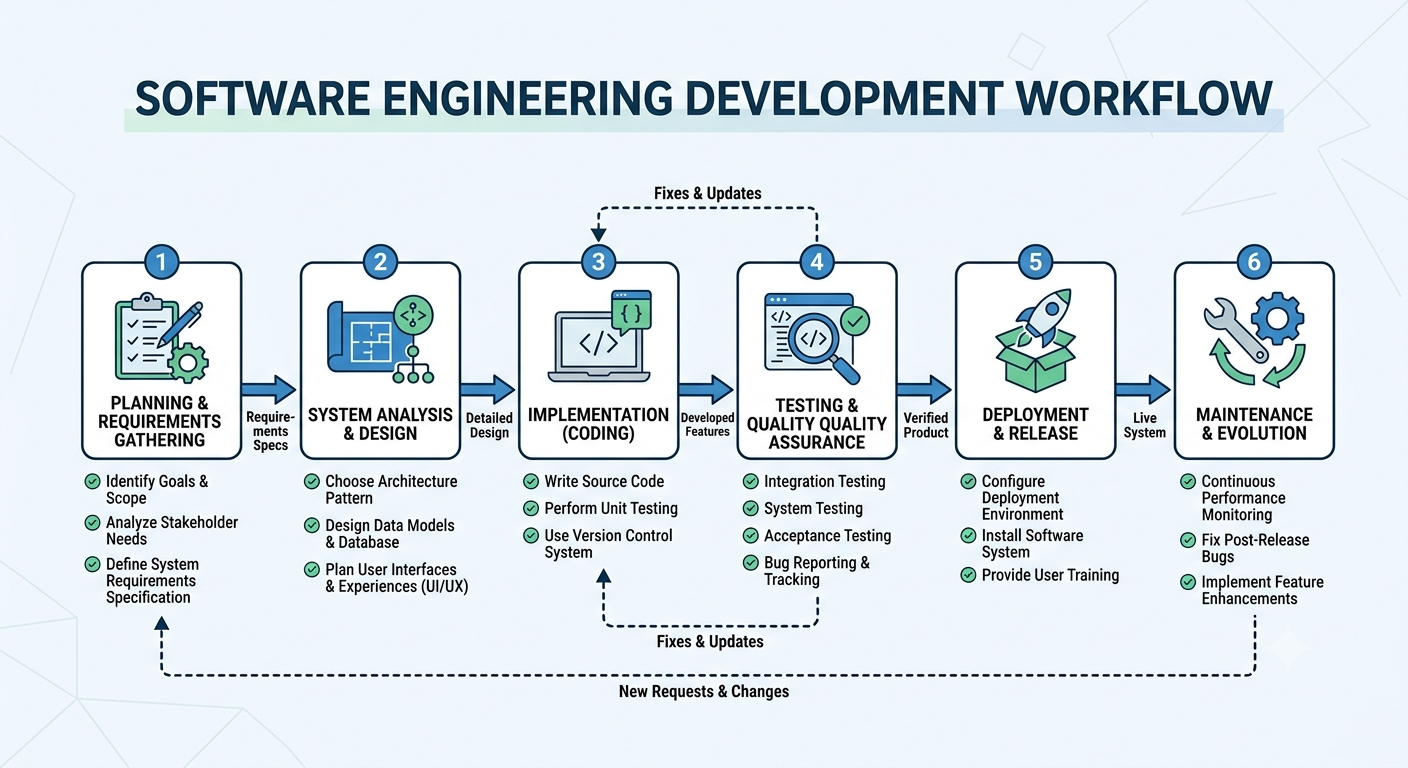
SOFTWARE ENGINEERING WORKFLOW
A disciplined development process keeps technical decisions connected.
Although different development methodologies use different terminology, a strong software project generally needs to move through a connected sequence of activities.
Requirements
Understand the problem, users, constraints, functional requirements, non-functional requirements, and expected outcomes.
Analysis & Design
Model the system and determine the architecture, components, interfaces, data structures, and major technical decisions.
Implementation
Develop the software using appropriate programming practices, frameworks, libraries, databases, and development tools.
Testing
Verify individual components and the complete system against requirements and expected behaviour.
Deployment
Prepare the application and supporting infrastructure for its intended execution environment.
Maintenance & Improvement
Review defects, requirements changes, technical debt, performance issues, and opportunities for future improvement.
TECHNICAL DOCUMENTATION
A technically strong project should also be easy to explain.
Software engineering assessments frequently evaluate both the implementation and the student's ability to communicate the engineering process. Documentation therefore needs to explain the relationship between the problem, requirements, design, implementation, testing, and final results.
Technical documentation may include:
- Software Requirements Specifications
- System architecture documentation
- UML diagrams
- Database and data-model documentation
- API documentation
- Implementation explanations
- Testing strategies and test results
- Deployment documentation
- Technical limitations
- Future enhancement recommendations
Our guidance focuses on making the documentation consistent with the actual system so that diagrams, explanations, implementation details, and testing evidence tell the same technical story.
RELATED IT PROJECT AREAS
Software engineering rarely exists in isolation.
Many software projects overlap with databases, cloud infrastructure, APIs, DevOps, system architecture, and testing. Explore the related areas of our IT consultancy as your project requirements evolve.
RESPONSIBLE TECHNICAL GUIDANCE
The goal is to understand the engineering behind the software.
Software engineering becomes much easier when individual programming tasks are connected to the larger system. We therefore focus on explaining why a particular approach is appropriate, how different components interact, how problems can be diagnosed, and how technical decisions can be evaluated.
Whether you are working through a programming project, UML exercise, software architecture assignment, debugging problem, testing project, or final-year capstone, our technical consultancy is designed to provide structured guidance around the engineering process.
Academic work should remain your own. Our role is to make difficult software engineering concepts clearer and help you develop stronger technical reasoning and project outcomes.
SOFTWARE ENGINEERING FAQ
Questions about software engineering project guidance.
Here are answers to some of the questions students commonly have when working on software engineering projects.
What software engineering projects can you help with?
We provide technical guidance across software requirements, system design, programming, object-oriented development, databases, APIs, testing, debugging, version control, architecture, documentation, and software engineering capstone projects.
Can you help with software engineering capstone projects?
Yes. We can provide structured technical guidance for capstone projects, including requirements analysis, architecture, technology selection, implementation planning, testing strategy, documentation, and project evaluation.
Which programming languages do you support?
Support can cover common software engineering languages and ecosystems including Python, Java, C++, C#, JavaScript, TypeScript, SQL, and related frameworks and development tools.
Can you help debug software engineering projects?
Yes. Debugging guidance can cover identifying the source of errors, understanding program behaviour, tracing execution, analysing exceptions, testing assumptions, and improving the underlying implementation.
Do you provide help with UML and software design?
Yes. Guidance can include use-case diagrams, class diagrams, sequence diagrams, activity diagrams, component diagrams, architecture models, design patterns, and other software design documentation.
Can you help with software testing and quality assurance?
Yes. Support can cover unit testing, integration testing, system testing, test-case design, defect analysis, test planning, debugging, regression testing, and interpreting test results.
Do you guarantee a particular academic grade?
No. We provide technical guidance and educational support, but final grades and academic outcomes are determined by the relevant institution and assessment criteria.
HAVE A SOFTWARE ENGINEERING PROJECT?
Start with the engineering problem, not just the code.
Share your software engineering project brief, requirements, architecture question, programming challenge, testing problem, or capstone objective and discuss the most appropriate technical approach.
Discuss Your Software Engineering Project