CLOUD COMPUTING • ARCHITECTURE • INFRASTRUCTURE

Cloud Architecture Projects, Design & Technical Guidance

Understand how modern cloud systems are designed, deployed, secured, scaled, and documented across AWS, Azure, and Google Cloud.

CLOUD ARCHITECTURE

Design cloud systems by understanding how the pieces work together.

Cloud architecture is much more than selecting a few services from a provider's catalogue. A well-designed cloud system must connect application requirements with compute resources, databases, storage, networking, identity, security, monitoring, deployment, availability, and cost considerations.

Our cloud architecture guidance helps students, researchers, and professionals understand these relationships and develop technically defensible architecture decisions for coursework, capstone projects, research prototypes, and technical case studies.

Whether the project involves a simple web application, a distributed system, a cloud migration, a serverless platform, or a containerized application, the objective is to understand why a particular architecture is appropriate for the workload rather than simply reproducing a collection of cloud services.

Cloud architecture diagram showing application, compute, networking, storage, database, security, and monitoring components in a modern cloud environment
Understanding the relationship between application components, infrastructure, networking, data, security, and operations is central to effective cloud architecture.

CLOUD PLATFORMS

Architecture guidance across AWS, Azure, and Google Cloud.

Cloud providers expose many overlapping capabilities, but the names, implementation details, service boundaries, and design choices differ. A strong academic project should therefore explain both the selected services and the reasoning behind their selection.

Amazon Web Services (AWS)

Architecture guidance across common AWS services and design patterns, including compute, storage, databases, networking, IAM, monitoring, containers, serverless workloads, and scalable application deployment.

Common technologies: EC2, S3, RDS, VPC, IAM, Lambda, ECS, EKS, CloudWatch, API Gateway, Route 53

Microsoft Azure

Support for understanding Azure-based architectures, infrastructure components, identity, networking, application services, storage, databases, monitoring, and deployment strategies.

Common technologies: Virtual Machines, Blob Storage, VNets, Entra ID, Azure SQL, Functions, AKS, App Service, Monitor

Google Cloud Platform (GCP)

Guidance for designing and explaining GCP architectures involving compute, networking, storage, databases, containers, serverless services, identity, and observability.

Common technologies: Compute Engine, Cloud Storage, VPC, Cloud SQL, Cloud Run, GKE, Cloud Functions, IAM, Cloud Monitoring

ARCHITECTURE PRINCIPLES

Cloud architecture is a series of engineering trade-offs.

There is rarely a single architecture that is universally correct. Cloud design involves balancing requirements for scalability, availability, performance, security, operational complexity, and cost.

Scalability

Understand how a cloud system can respond to changing workloads through horizontal scaling, vertical scaling, autoscaling, load balancing, caching, and appropriate service selection.

Availability & Resilience

Design systems that can tolerate component failures through redundancy, fault isolation, health checks, multi-zone deployment, backup strategies, and recovery planning.

Security by Design

Consider identity, access control, network segmentation, encryption, secrets management, logging, monitoring, and secure configuration throughout the architecture.

Performance

Evaluate latency, throughput, resource utilization, database performance, network paths, caching, storage characteristics, and application bottlenecks.

Cost Optimization

Compare architectural alternatives by considering compute utilization, storage, networking, managed services, scaling behaviour, and the ongoing operational cost of the solution.

Operational Simplicity

Understand when managed services, automation, infrastructure as code, centralized monitoring, and standardized deployment processes can reduce operational complexity.

CLOUD INFRASTRUCTURE

Understand the infrastructure behind a cloud application.

Cloud architecture becomes easier to reason about when the system is broken down into its major infrastructure concerns. Each component has a specific responsibility, but the components must ultimately work together as one system.

Compute

Virtual machines, containers, Kubernetes clusters, serverless functions, managed application platforms, and other execution environments.

Storage

Object storage, block storage, file storage, backup systems, archival storage, and storage lifecycle management.

Databases

Relational databases, NoSQL databases, managed database services, caching layers, replication, backups, and high-availability database designs.

Networking

Virtual networks, subnets, routing, gateways, load balancers, DNS, firewalls, private connectivity, and network segmentation.

Identity & Access

Users, roles, service identities, permissions, least privilege, authentication, authorization, and centralized identity management.

Observability

Logging, metrics, monitoring, tracing, alerting, health checks, dashboards, and operational visibility across cloud environments.

CLOUD NETWORKING

A cloud application still depends on a carefully designed network.

Networking is one of the areas where cloud architecture projects can become difficult. Applications may contain public and private components, databases that should not be directly exposed to the internet, load balancers, gateways, service endpoints, and multiple application tiers.

We provide guidance on understanding virtual networks, subnet design, routing, security boundaries, gateways, DNS, load balancing, private connectivity, and communication between distributed components.

  • Virtual networks and subnet architecture
  • Public and private network segments
  • Routing and gateways
  • Load balancing
  • DNS and service discovery
  • Network security controls
  • Private service connectivity
  • Network segmentation and isolation

NETWORK DESIGN QUESTIONS

Every architecture should answer questions such as:

  • Which components need to be publicly accessible?
  • Which services should remain inside private network boundaries?
  • How does traffic move between application tiers?
  • Where should authentication and authorization occur?
  • How is traffic distributed across application instances?
  • What happens if a network component becomes unavailable?
  • How are sensitive databases and internal services isolated?

CLOUD SECURITY

Security should be part of the architecture rather than an afterthought.

Cloud environments introduce powerful capabilities, but they also require careful management of identity, permissions, network exposure, data protection, secrets, logging, and configuration. Security decisions should therefore be considered while the architecture is being designed.

Identity and Access Management (IAM)
Principle of least privilege
Role-based access control
Encryption at rest and in transit
Secrets and credential management
Network segmentation and security groups
Secure storage configuration
Logging, monitoring, and security alerts
Backup and recovery controls
Security-focused architecture reviews

DEPLOYMENT & DEVOPS

Designing the architecture is only part of deploying a cloud system.

Academic cloud projects increasingly involve automated deployment, containers, Infrastructure as Code, continuous integration, and monitoring. Understanding these processes helps connect the architecture diagram to the actual environment in which the application runs.

  • Infrastructure as Code using Terraform and similar approaches
  • CI/CD pipelines for automated application deployment
  • Containerized application deployment
  • Kubernetes and managed Kubernetes concepts
  • Blue-green and rolling deployment strategies
  • Environment separation between development, testing, and production
  • Configuration and secrets management
  • Cloud monitoring, logging, and alerting
  • Backup, recovery, and disaster recovery considerations
  • Infrastructure version control and repeatable deployments

Depending on the project, this may involve tools such as Terraform, Docker, Kubernetes, GitHub Actions, GitLab CI, Jenkins, cloud-native deployment services, and managed container platforms.

SERVERLESS & DISTRIBUTED SYSTEMS

Modern cloud applications increasingly move beyond traditional servers.

Serverless computing, managed databases, event-driven architectures, containers, and distributed services allow developers to build applications without managing every underlying infrastructure component directly.

Understanding these architectures requires looking carefully at service boundaries, event flows, state management, latency, observability, failure handling, and the operational trade-offs introduced by managed services.

Common concepts include:

  • Serverless functions
  • Event-driven architecture
  • Message queues and event buses
  • Microservices
  • Containers and orchestration
  • Managed databases
  • API gateways
  • Asynchronous processing
  • Distributed system failure handling

CLOUD MIGRATION

Moving an existing system to the cloud requires architectural reasoning.

Cloud migration assignments often ask students to evaluate an existing infrastructure and propose a future-state architecture. This involves understanding the current workload before deciding how it should be transformed.

We can provide guidance on migration strategies, dependency analysis, target architecture, database migration, networking, security, deployment, operational considerations, and the trade-offs between rehosting, replatforming, refactoring, and other migration approaches.

  • Assessing the existing application architecture
  • Identifying infrastructure and application dependencies
  • Choosing an appropriate cloud migration strategy
  • Designing the target cloud environment
  • Planning data and database migration
  • Addressing identity and security requirements
  • Planning deployment and validation
  • Comparing cost and operational implications

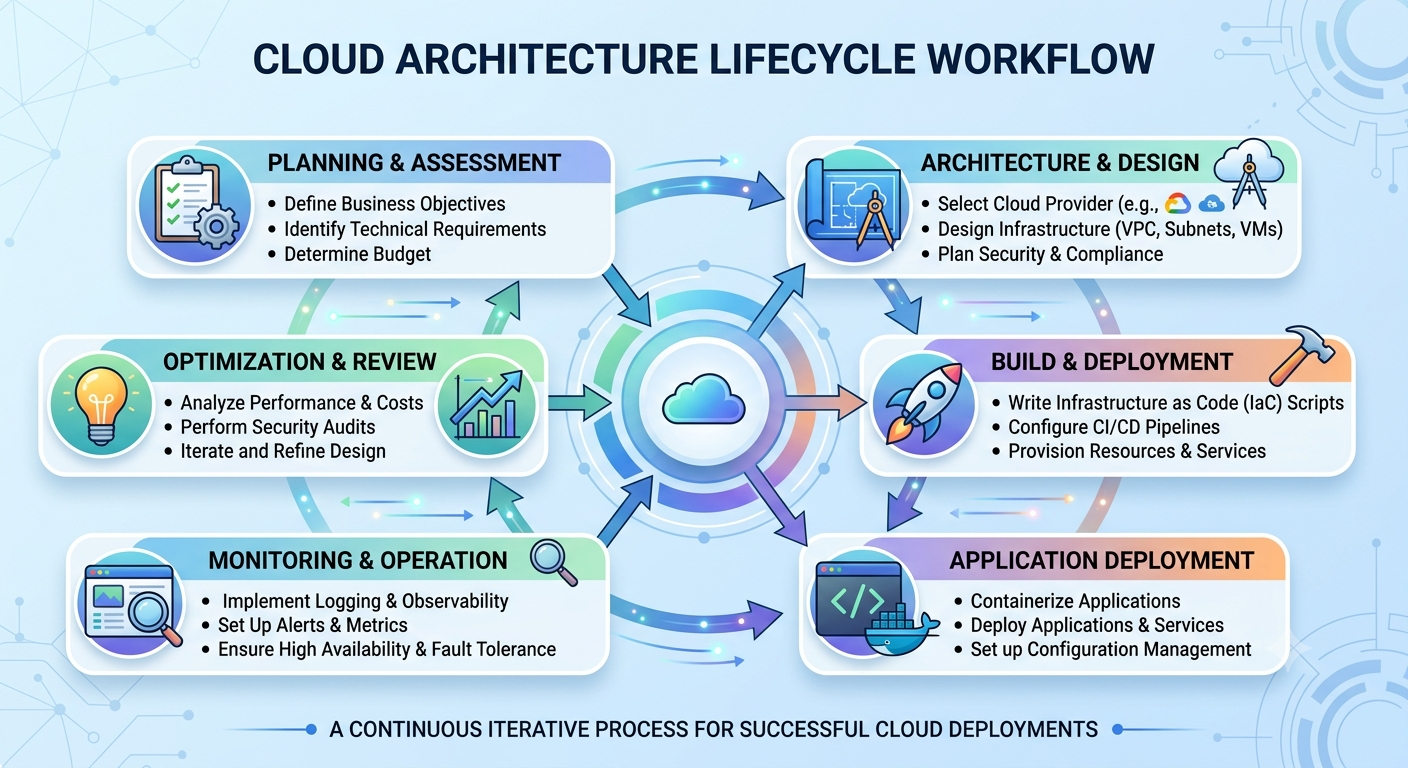
CLOUD ARCHITECTURE WORKFLOW

A structured process for moving from requirements to cloud architecture.

The exact process depends on the project, but a structured workflow helps ensure that infrastructure decisions remain connected to the original application requirements.

Understand the workload

Identify the application requirements, expected users, data characteristics, performance requirements, availability expectations, compliance considerations, and project constraints.

Select the architecture

Determine the appropriate architectural pattern, cloud services, deployment model, networking structure, storage approach, and application components.

Design the infrastructure

Connect compute, storage, databases, networking, identity, monitoring, and application components into a coherent cloud architecture.

Address security and resilience

Evaluate identity and access controls, network boundaries, encryption, backup strategies, failure scenarios, monitoring, and recovery requirements.

Evaluate the architecture

Compare the proposed architecture against requirements for scalability, performance, availability, security, maintainability, and cost.

Document and explain

Produce architecture diagrams, design decisions, deployment documentation, assumptions, trade-offs, and technical explanations that clearly communicate the solution.

ACADEMIC & RESEARCH SUPPORT

Cloud architecture guidance for coursework, capstones, and research.

Cloud computing assignments frequently require students to combine infrastructure knowledge with software engineering, networking, databases, security, and technical documentation.

We help make those relationships clearer so that architecture diagrams and technical reports explain not only what services were selected, but why they are appropriate for the proposed system.

Explore System Architecture & Design
  • Cloud computing assignments and laboratory projects
  • AWS, Azure, and GCP architecture case studies
  • Cloud migration and modernization projects
  • Distributed systems and scalable application projects
  • Cloud security architecture assignments
  • Serverless application projects
  • Containerization and Kubernetes projects
  • Infrastructure-as-Code and Terraform assignments
  • Cloud-based database and data platform projects
  • IT and software engineering capstone projects
  • Cloud architecture diagrams and technical reports
  • Research prototypes involving cloud infrastructure

RELATED IT PROJECT AREAS

Cloud architecture connects naturally with other areas of software engineering.

A cloud architecture project rarely exists in isolation. Application design, databases, APIs, DevOps, security, and system architecture all influence the final solution.

RESPONSIBLE TECHNICAL GUIDANCE

The goal is to understand cloud architecture, not simply copy a diagram.

Cloud platforms contain thousands of services and architectural possibilities. The most useful technical guidance therefore focuses on the reasoning behind a solution: why a particular service was selected, how components communicate, what happens when something fails, how data is protected, and how the system can evolve.

Academic work should remain your own. Our role is to make difficult cloud concepts clearer, review technical decisions, explain architecture trade-offs, and help you develop stronger technical deliverables.

CLOUD ARCHITECTURE FAQ

Questions about cloud computing and architecture project support.

A few common questions about the cloud architecture guidance we provide.

What cloud architecture topics do you support?

We support cloud architecture concepts including compute, storage, databases, networking, IAM, scalability, availability, security, monitoring, containers, serverless architecture, infrastructure as code, deployment, and cloud migration.

Can you help with AWS, Azure, and GCP assignments?

Yes. We provide technical guidance across AWS, Microsoft Azure, and Google Cloud Platform, including architecture design, service selection, infrastructure concepts, deployment approaches, and technical documentation.

Can you help design a cloud architecture diagram?

Yes. Guidance can cover component selection, network boundaries, data flows, application dependencies, security boundaries, availability zones or regions, databases, storage, APIs, and other relevant architectural elements.

Can you help with cloud migration projects?

Yes. Cloud migration projects can involve workload assessment, migration strategies, target architecture, dependency analysis, networking, data migration, security, deployment, cost considerations, and validation.

Do you support Terraform and Infrastructure as Code projects?

Yes. We can provide guidance on Infrastructure as Code concepts, Terraform configuration, reusable infrastructure patterns, variables, state management, environment separation, and repeatable deployment workflows.

Can you help with Kubernetes and container-based cloud projects?

Yes. Support can cover container architecture, Docker, Kubernetes concepts, clusters, services, deployments, networking, configuration, scaling, and managed Kubernetes platforms.

Can you help compare AWS, Azure, and GCP for a project?

Yes. We can help evaluate cloud platforms according to the specific project requirements, including compute, storage, networking, identity, managed services, scalability, operational complexity, and cost considerations.

Do you guarantee a particular academic grade?

No. We provide technical guidance and educational support, but final grades and academic outcomes are determined by the relevant institution and assessment criteria.
HAVE A CLOUD PROJECT?

Let's understand the workload before choosing the cloud architecture.

Share your cloud computing assignment, architecture brief, migration case study, AWS/Azure/GCP project, infrastructure question, or research objective and discuss the most appropriate technical approach.

Discuss Your Cloud Project
Chat with us on WhatsApp