Understand the data requirements
Identify the entities, attributes, relationships, business rules, functional requirements, reporting requirements, and expected database operations.
DATABASES • SQL • DATA ENGINEERING
Expert technical guidance for database architecture, relational modelling, SQL development, normalization, PostgreSQL, MySQL, transactions, indexing, optimization, database security, and application integration.
DATABASE DESIGN & SQL
Database projects are often presented as SQL exercises, but strong database engineering begins much earlier. Before a single query is written, the underlying data requirements, entities, relationships, business rules, constraints, and expected operations need to be understood.
A well-designed relational database should represent the underlying problem accurately while maintaining data integrity, avoiding unnecessary duplication, supporting efficient queries, and remaining understandable as the system grows.
Our database and SQL consultancy helps students, researchers, and professionals understand these decisions and apply them to coursework, laboratory exercises, capstone projects, research prototypes, and software systems.
WHY DATABASE PROJECTS ARE CHALLENGING
Database assignments can appear straightforward when the task is reduced to writing a few SQL statements. Larger projects, however, require several layers of reasoning to work together.
DATABASE ARCHITECTURE
Database design is the process of translating a real-world problem into a structured data model. A good design provides a clear connection between what the application needs to do and how information is stored.
Conceptual modelling focuses on the problem domain rather than implementation details. The objective is to identify important entities, relationships, and business concepts.
Logical design converts the conceptual model into a relational structure. Physical design then considers the characteristics of the selected DBMS and the expected workload.
ER MODELLING
An Entity Relationship Diagram (ERD) provides a visual representation of the entities and relationships that make up a database system. For academic projects, the ERD is often one of the most important pieces of evidence demonstrating that the database design has been understood before implementation.
We provide guidance on identifying entities, attributes, primary keys, foreign keys, relationship types, cardinality, optionality, associative entities, and other modelling decisions.
DATABASE NORMALIZATION
Normalization provides a systematic approach to organizing relational data. Rather than storing repeated information throughout large tables, related information is separated into structures that better represent the underlying dependencies.
Database assignments commonly require students to demonstrate how an unnormalized structure can be transformed through successive normal forms.
Normalization is not simply a checklist. Database design also requires understanding the application's access patterns and deciding when controlled denormalization may be appropriate for performance or reporting requirements.
SQL DEVELOPMENT
SQL is more than SELECT statements. Database projects often require students to understand the different categories of SQL operations and how they interact with the underlying relational model.
TRANSACTIONS & DATA INTEGRITY
Applications frequently perform multiple database operations as part of a single business action. A banking transfer, for example, may require one account to be debited while another is credited. If one operation succeeds and the other fails, the resulting state can be incorrect.
Transaction management provides mechanisms for grouping related operations and maintaining consistent database state.
DATABASE PERFORMANCE
A query that performs well on a small development dataset may become inefficient when millions of records are introduced. Database performance therefore requires understanding data volume, access patterns, indexes, joins, filtering, sorting, aggregation, and query execution strategies.
Performance optimization should not begin by adding indexes everywhere. Each index introduces storage and maintenance costs, particularly for write-heavy systems. The appropriate strategy depends on how the database is actually used.
DATABASE SECURITY
Databases frequently contain some of an application's most sensitive information. Security therefore needs to be considered across the database, application, authentication, authorization, and data-access layers.
Understand users, roles, permissions, least privilege, authentication, authorization, and controlled database access.
Consider sensitive data classification, secure storage, encryption concepts, backups, and appropriate retention.
Understand parameterized queries, prepared statements, validation, and secure database access from application code.
SQL injection is a particularly important example of why database security cannot be separated from application development. Parameterized queries and prepared statements help ensure that user-controlled values remain data rather than being interpreted as SQL instructions.
DATABASE MANAGEMENT SYSTEMS
SQL fundamentals transfer across relational database systems, although individual platforms provide different syntax, extensions, tooling, and implementation characteristics.
PostgreSQL is widely used for application development, research, data-intensive systems, and advanced relational database projects. Guidance can include schema design, constraints, indexes, views, functions, transactions, and PostgreSQL-specific SQL features.
MySQL is commonly encountered in web application and educational environments. Support can include relational modelling, SQL development, joins, constraints, indexing, transactions, and application integration.
SQL Server projects may involve T-SQL, relational design, stored procedures, indexing, transactions, security, reporting, and database administration concepts.
Oracle-based coursework can involve SQL, PL/SQL, schemas, constraints, transactions, stored procedures, triggers, indexing, and enterprise database concepts.
APPLICATION INTEGRATION
Modern applications typically communicate with databases through an application or service layer. Understanding this boundary is important for both database assignments and software engineering projects.
This systems perspective becomes particularly important for capstone projects, where the database is only one component of a larger architecture involving front-end applications, backend services, authentication, APIs, and deployment infrastructure.
DATABASE PROJECT SCENARIOS
Database assignments vary considerably by academic level and subject. The underlying engineering principles, however, can be applied across many different domains.
Designing a relational database for students, courses, departments, instructors, enrolments, examinations, grades, and academic records.
Modelling customers, products, categories, orders, order items, payments, inventory, shipments, and transactional relationships.
Designing data structures for patients, physicians, appointments, treatments, prescriptions, billing, departments, and medical records.
Building relationships between books, authors, publishers, members, copies, loans, reservations, and overdue records.
Working with customers, accounts, transactions, branches, beneficiaries, transfers, and transaction integrity requirements.
Developing analytical schemas, aggregation queries, reporting structures, dimensional models, and data extraction logic.
DATABASE PROJECT WORKFLOW
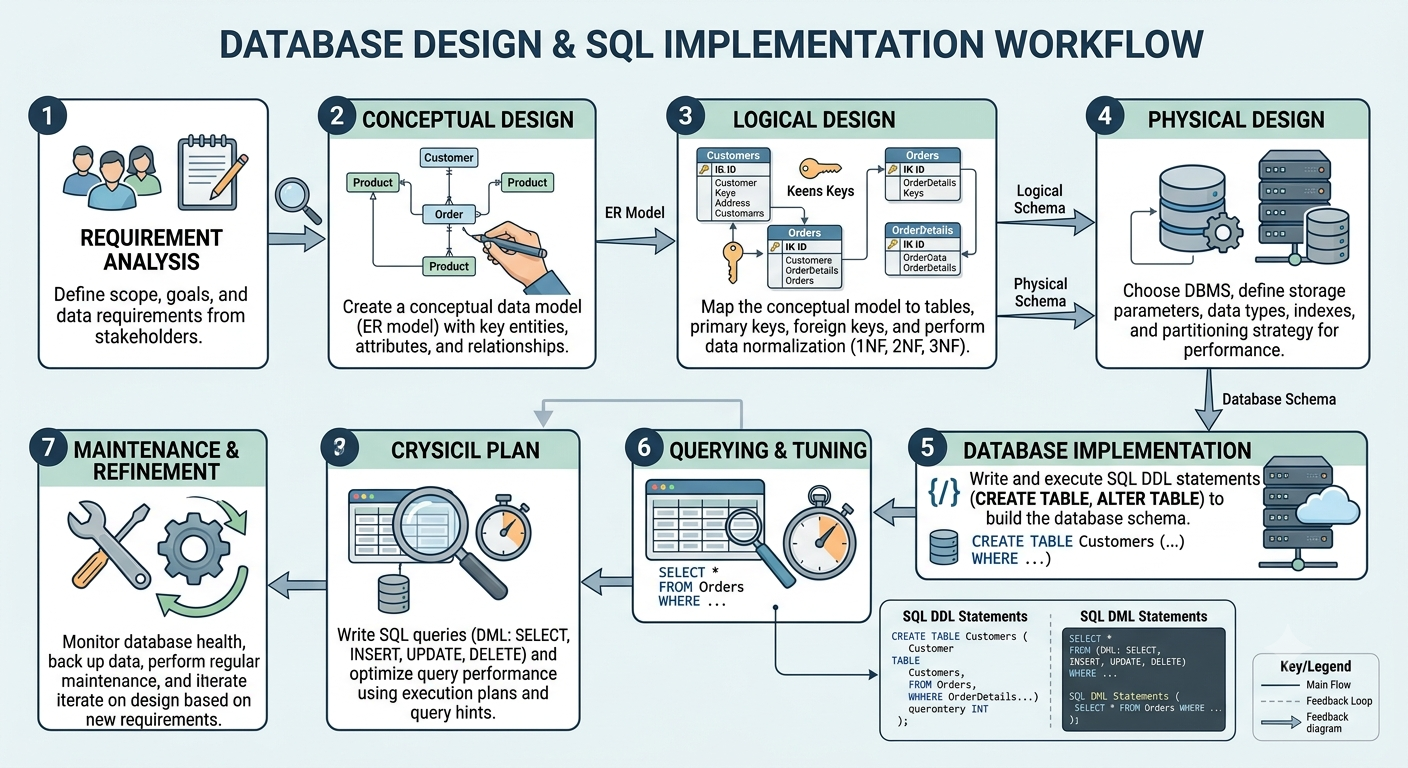
A disciplined database workflow helps prevent problems from being discovered only after the SQL implementation has already been completed.
Identify the entities, attributes, relationships, business rules, functional requirements, reporting requirements, and expected database operations.
Translate requirements into conceptual and logical models using entities, relationships, keys, constraints, cardinality, and appropriate normalization.
Convert the logical design into tables, constraints, indexes, views, procedures, and other database objects using the selected relational database platform.
Create queries for inserting, retrieving, updating, aggregating, and analysing data while validating correctness against expected results.
Review query performance, indexing strategy, transactions, permissions, input handling, and other factors affecting reliability and security.
Connect the database implementation to ER diagrams, schema documentation, SQL scripts, test evidence, design decisions, and project requirements.
DATABASE & SQL PROJECT SUPPORT
Depending on the project, support can focus on a single database concept or span the complete path from requirements to implementation and evaluation.
The objective is not simply to produce SQL that happens to execute. Strong database work should be explainable: the schema should have a reason, relationships should reflect the requirements, constraints should protect data integrity, and queries should solve clearly defined information needs.
RELATED IT ENGINEERING AREAS
Database projects frequently overlap with software engineering, APIs, cloud architecture, DevOps, and system architecture. Understanding these relationships can make larger projects considerably easier to design and explain.
Explore application architecture, programming, testing, and maintainable software design.
Software EngineeringUnderstand how databases fit into larger application and system architectures.
System ArchitectureDATABASE & SQL FAQ
A few common questions about database modelling, SQL, relational systems, and technical project guidance.
We support relational database design, ER modelling, normalization, SQL queries, keys and constraints, joins, subqueries, views, stored procedures, functions, triggers, transactions, indexing, optimization, database security, and application-database integration.
Yes. Guidance can cover identifying entities and attributes, defining relationships and cardinality, selecting keys, resolving many-to-many relationships, normalizing the design, and converting the resulting model into a relational schema.
Yes. Support can include basic and advanced SELECT queries, joins, aggregation, subqueries, CTEs, window functions, INSERT, UPDATE, DELETE, views, stored procedures, functions, and transaction-oriented SQL.
Yes. We provide guidance across common relational database platforms including PostgreSQL, MySQL, Microsoft SQL Server, and Oracle, while accounting for platform-specific syntax and capabilities where relevant.
Yes. We can explain functional dependencies and normalization from first principles and work through First, Second, Third, and Boyce-Codd Normal Forms where they are relevant to the project.
Yes. Query optimization guidance can include examining execution plans, join strategies, filtering, indexing, unnecessary data retrieval, aggregation, subqueries, and other factors affecting database performance.
Yes. Guidance can cover database permissions, least privilege, authentication, parameterized queries, SQL injection prevention, sensitive-data handling, encryption concepts, auditing, and secure application-database integration.
Yes. Technical guidance can span requirements analysis, ER modelling, schema design, normalization, SQL implementation, application integration, testing, optimization, documentation, and project evaluation.
No. We provide technical guidance and educational support, but final grades and academic outcomes are determined by the relevant institution and assessment criteria.
HAVE A DATABASE PROJECT?
Share your database requirements, ER diagram, SQL assignment, schema, query problem, project brief, or research objective. We can help you understand the appropriate modelling, implementation, and evaluation approach.
Discuss Your Database Project