Cybersecurity • Security Operations • SIEM

Security Operations & SIEM Assignment Help and Technical Guidance

Expert guidance for Security Operations Center workflows, SIEM architecture, log analysis, detection engineering, threat hunting, incident response, security monitoring and technical cybersecurity projects. Get structured support for demanding SOC and SIEM coursework, laboratory assignments, research projects and technical reports.

SOC & SIEM expertise

Turn complex security telemetry into meaningful findings.

Modern Security Operations Centers process enormous volumes of security events from endpoints, networks, applications, identity systems and cloud platforms. SIEM technologies help security teams collect, normalize, correlate and investigate this information. Our guidance connects those technical concepts with practical academic assignments, laboratory work and cybersecurity research.

Security Operations and SIEM assignments can be challenging because they combine networking, operating systems, authentication, log formats, threat detection, query languages and incident-response methodology.

Whether the task involves building a SIEM architecture, analysing a collection of security logs, writing correlation rules, developing a SOC dashboard or preparing an incident-response report, the technical work needs to be connected to clear evidence and defensible conclusions.

SIEM Architecture

Understand log sources, collection pipelines, normalization, indexing, storage and security-event processing.

Log Investigation

Analyse authentication, endpoint, network, firewall, application and cloud security events.

Threat Detection

Develop detection logic, correlation rules, hunting queries and alert-investigation workflows.

Incident Response

Study alert triage, investigation, containment, remediation and post-incident reporting.
Why SOC & SIEM assignments are challenging

Multiple technical layers must work together.

A good SIEM project is rarely just a matter of entering a query into a platform. Students often need to understand where the data comes from, how it is normalized, what constitutes suspicious behaviour, how events should be correlated and how findings should ultimately be documented.

Large volumes of security telemetry

SIEM environments can generate enormous numbers of events. Projects therefore require an understanding of filtering, prioritisation, aggregation and false-positive reduction.

Multiple security data sources

Authentication systems, endpoints, firewalls, servers, applications, cloud platforms and network sensors can all contribute different event formats and fields.

Complex detection and correlation logic

Effective investigations may require SPL, KQL, AQL, EQL, regular expressions, time-window analysis, aggregation and multiple-event correlation.

Distinguishing incidents from noise

A meaningful SOC investigation needs to separate routine activity from genuine indicators of compromise and explain why an alert should or should not be escalated.

Security Operations workflow

From security-event collection to investigation and response.

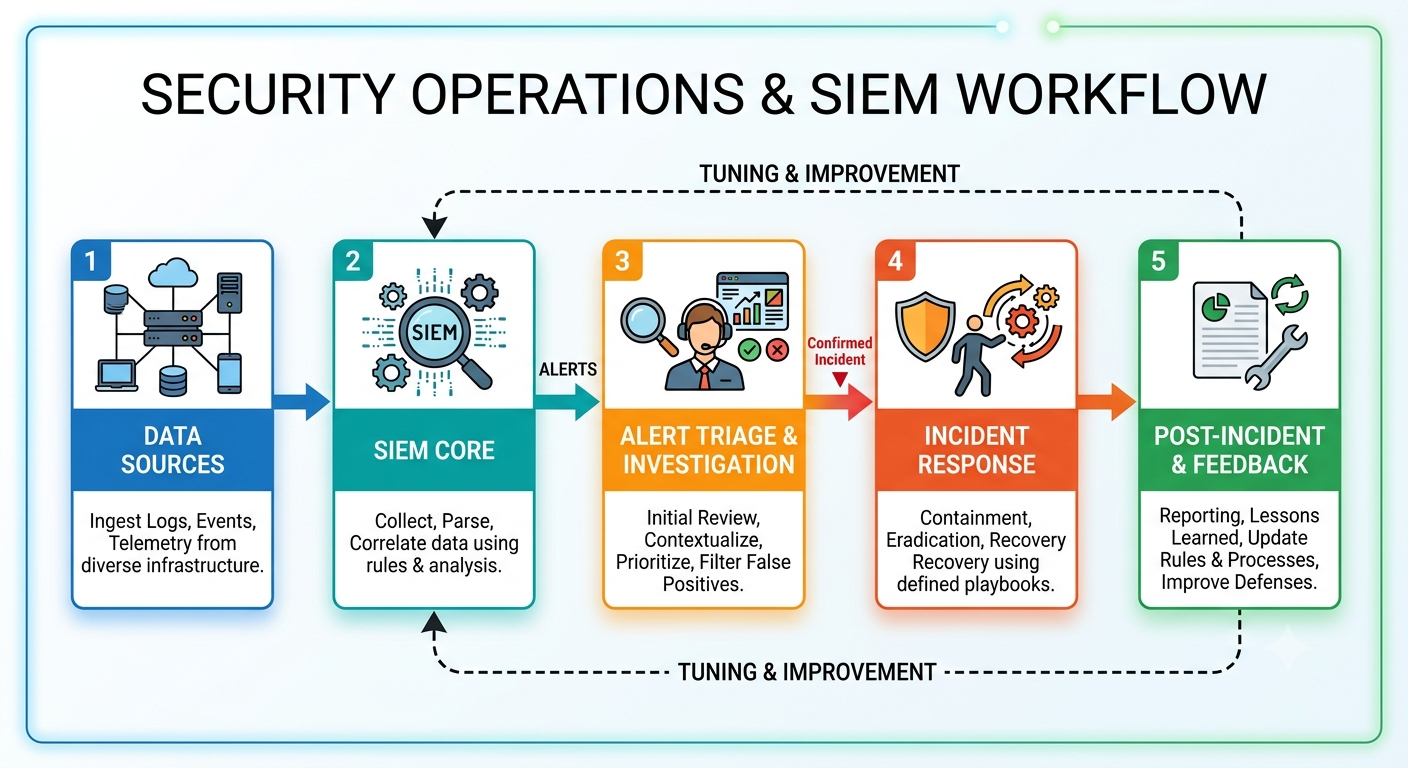
A SIEM supports a continuous security workflow in which telemetry is collected, processed, correlated and investigated before appropriate response and reporting activities take place.

Security Operations and SIEM workflow showing security log collection, event normalization, monitoring, detection and correlation, alert investigation, incident response, security reporting and continuous security operations
Security Operations and SIEM workflow illustrating the progression from security-event collection and analysis to detection, investigation, incident response and reporting.

Technical consultancy pillars

Comprehensive Security Operations and SIEM project coverage.

Support can be structured around a specific assignment question, SIEM laboratory, research topic, technical implementation, security dataset or complete SOC-oriented project.

Consultancy FocusKey Technical ModulesTarget Deliverables & Outcomes
SIEM ArchitectureLog collectors, agents, Syslog, ingestion pipelines, normalization, indexing, storage, retention and high-availability concepts.Architecture diagrams, data-flow models, deployment documentation and technical design explanations.
Log Analysis & NormalizationWindows Event Logs, Linux Syslog, firewall events, authentication records, application logs, JSON and cloud telemetry.Parsed event examples, field mappings, normalized records, investigation notes and evidence tables.
Detection EngineeringCorrelation logic, threshold-based detection, behavioural detection, IOC matching, time-window analysis and alert tuning.Detection rules, query explanations, alert logic, false-positive analysis and MITRE ATT&CK mappings.
Threat HuntingHypothesis-driven searches, suspicious authentication, privilege escalation, lateral movement, command execution and network anomalies.Hunting queries, investigation workflows, evidence summaries and threat-hunting reports.
Incident ResponseAlert triage, investigation, containment, eradication, recovery, root-cause analysis and post-incident review.Incident timelines, response playbooks, investigation reports and remediation recommendations.
SOC Reporting & DashboardsSecurity dashboards, alert metrics, incident summaries, operational reporting and management-oriented security communication.Dashboard designs, SOC reports, visual summaries and structured technical documentation.

Technical analysis

Log analysis, detection engineering and threat hunting.

SIEM projects become much more meaningful when individual security events are connected into a broader investigative story. Technical guidance can cover the complete path from raw telemetry to defensible findings.

Log Collection & Normalization

Understand how Windows Event Logs, Syslog, firewall records, authentication events, application logs and cloud telemetry enter a SIEM and are transformed into searchable security data.

Detection Engineering

Develop structured searches and detection rules using appropriate query languages, thresholds, time windows, aggregation and correlation techniques.

Alert Investigation

Trace related events, examine users, hosts, IP addresses and processes, reconstruct timelines and determine whether an alert represents meaningful security activity.

Threat Hunting

Use hypothesis-driven searches to investigate suspicious authentication, process execution, network communication, privilege escalation and other attacker behaviours.

Supported platforms & toolchains

Guidance across widely used SIEM and security-monitoring environments.

Assignments can be developed around the platform specified by your university, laboratory or research requirements.

Splunk

  • Search Processing Language (SPL)
  • Data onboarding and source analysis
  • Correlation searches and alerts
  • Dashboards and visualisation
  • Threat hunting workflows

Microsoft Sentinel

  • Kusto Query Language (KQL)
  • Analytics rules
  • Azure security telemetry
  • Workbooks and dashboards
  • Incident and investigation workflows

IBM QRadar

  • Ariel Query Language (AQL)
  • Log source analysis
  • Device Support Module concepts
  • Custom rules and building blocks
  • Offense investigation

Elastic Security

  • Elastic Security and SIEM
  • KQL and EQL concepts
  • Elastic Agent and Beats
  • Detection rules
  • Event and process analysis

Monitoring & Network Tools

  • Wireshark
  • Zeek
  • Suricata
  • Syslog and log collectors
  • Network-security telemetry

Detection engineering examples

Practical SOC and SIEM scenarios.

The following examples illustrate the type of technical problems that can be explored through SIEM assignments, laboratory exercises and cybersecurity projects.

Brute-Force Authentication Detection

Identify repeated failed authentication attempts followed by a successful login from the same source, user or endpoint. The exercise can cover event correlation, time windows, thresholds and false-positive analysis.

Authentication LogsCorrelationSPL / KQL

Suspicious PowerShell Activity

Investigate PowerShell process events and command-line telemetry to identify unusual execution patterns and correlate host activity with authentication or network events.

Windows EventsProcess TelemetryMITRE ATT&CK

Unusual Network Communication

Correlate firewall, DNS, proxy or network-monitoring events to identify unexpected destinations, abnormal ports, repeated connections or potentially suspicious communication patterns.

Network LogsDNSTraffic Analysis

Privilege Escalation Investigation

Analyse authentication, account-management and process events to understand how elevated privileges may have been obtained and what subsequent activity occurred.

Windows EventsIdentityInvestigation

Academic & technical projects

Topics that can be explored through SOC and SIEM coursework.

Security Operations projects can range from introductory log-analysis exercises to advanced SIEM architecture, threat-hunting and incident-response research. The exact scope can be adapted to the assignment brief, academic level and available laboratory environment.

SIEM architecture and deployment planning

SOC monitoring and alert-management workflows

Windows Event Log analysis

Linux Syslog and authentication analysis

Firewall and network-device log analysis

Brute-force and credential-attack detection

Malware and suspicious-process investigation

Threat hunting using SIEM query languages

MITRE ATT&CK detection mapping

Security dashboard and visualisation projects

Incident-response playbook development

Security alert triage and prioritisation

False-positive reduction and alert tuning

Cloud security-event monitoring

Security operations research papers

SOC and SIEM lab reports

Structured project methodology

A repeatable approach to Security Operations and SIEM assignments.

A well-structured SIEM project should connect its objective, telemetry, analysis methodology, detection logic, evidence and final conclusions.

01

Define the Security Objective

Establish the assignment requirements, environment, datasets, research question, scope and expected security outcomes before beginning technical analysis.

02

Collect & Understand Telemetry

Identify the available log sources, event formats, timestamps, fields and relevant network or host telemetry required for the investigation.

03

Normalize & Investigate

Interpret events, normalize relevant fields and construct searches that allow related activity to be examined across users, hosts, IP addresses and time periods.

04

Detect & Correlate

Develop detection logic and correlation rules to connect individual events into meaningful security patterns while considering thresholds and false positives.

05

Investigate & Respond

Examine alerts, reconstruct timelines, assess potential impact and document appropriate containment, remediation or incident-response actions.

06

Report & Present

Transform technical observations into structured reports containing methodology, evidence, findings, limitations, conclusions and recommendations.

Framework alignment

Connect SOC analysis with recognized cybersecurity frameworks.

Academic SIEM projects become stronger when technical observations are connected to established security methodologies and frameworks. Depending on the assignment, analysis can be mapped to recognized security standards and threat frameworks.

NIST Cybersecurity Framework principles
NIST SP 800-61 incident-response concepts
MITRE ATT&CK tactics, techniques and procedures
Security monitoring and detection engineering practices
ISO 27001 information-security principles
PCI DSS security-monitoring considerations

What you receive

Professional academic and technical support.

ProjectAssignments provides structured assistance designed around the requirements of your specific assignment, laboratory, research project or technical documentation.

24×7 Round-the-Clock Support

Academic support when you need it, including evenings, weekends and urgent deadlines.

Free Revisions & Rework

Need clarification or changes? Eligible work can be revised and refined without additional revision charges.

Qualified Subject Experts

Get guidance from experienced professionals with subject-specific technical and academic expertise.

Premium Yet Affordable

High-quality academic and technical support designed to remain accessible to students and researchers.

Plagiarism & AI-Free Work

Original, responsibly prepared work with a strong focus on academic integrity and authentic understanding.

Frequently asked questions

Security Operations and SIEM assignment guidance.

Common questions about SIEM platforms, SOC laboratories, log analysis, detection engineering and technical project support.

What type of Security Operations and SIEM assignments can you help with?

ProjectAssignments provides guidance for SIEM lab assignments, SOC projects, log-analysis exercises, SIEM architecture designs, detection and correlation rules, dashboards, incident-response workflows, threat-hunting exercises, research projects, technical reports and cybersecurity coursework across undergraduate and postgraduate levels.

Can you provide help with Splunk, Microsoft Sentinel, QRadar and Elastic Security?

Yes. Guidance can cover major SIEM platforms including Splunk, Microsoft Sentinel, IBM QRadar and Elastic Security. Support can include data ingestion, log analysis, query development, dashboards, detection rules, alert investigation, architecture and technical documentation.

Can you help me analyse my own SIEM logs or datasets?

Yes. Where the assignment permits the use of supplied datasets, guidance can cover the interpretation of Windows Event Logs, Syslog, firewall logs, authentication events, application logs, cloud security events, JSON records and other security telemetry. The analysis can then be translated into findings, evidence and a structured technical report.

Can you help with SPL, KQL, AQL and Elastic queries?

Yes. Technical guidance can cover SIEM query languages such as Splunk SPL, Microsoft KQL, IBM QRadar AQL and Elastic query languages. This may include filtering, aggregation, statistical analysis, correlation logic, time-window analysis, alert conditions and investigation workflows.

Can you help me build a SOC or SIEM laboratory?

Yes. Guidance can cover controlled laboratory environments using virtual machines, log sources, Syslog collectors, Windows Event Logs, Linux systems, network telemetry and SIEM platforms. The objective is to create an isolated environment suitable for learning, experimentation and academic project work.

Do you provide urgent Security Operations and SIEM assignment support?

Yes. ProjectAssignments offers round-the-clock academic and technical support, including assistance for urgent deadlines where available. Contact the team with the assignment requirements, deadline and technical scope so that the appropriate support can be assessed.

Are revisions available if clarification or changes are required?

Yes. Eligible work can be revised and refined when clarification or changes are required, subject to the applicable project scope and revision terms.

Let's make your work clearer

Bring us the difficult part.

Tell us what you're researching, building, or trying to understand. We'll help you find the clearest ethical next move.

Get Guidance
Chat with us on WhatsApp