Cybersecurity • Network Security • Network Analysis

Network Security Analysis & Technical Project Guidance

Structured technical guidance for network architecture analysis, packet and traffic inspection, firewall controls, access management, monitoring, threat detection, secure communication and network security documentation.

Technical scope

Understanding how networks communicate, protect resources and detect threats.

Network security requires more than configuring a firewall. A meaningful technical analysis connects network architecture, communication protocols, access controls, traffic behaviour, monitoring and security evidence into a coherent picture of the environment.

Network Architecture

Analyse topology, segmentation, communication paths, devices, services and trust boundaries.

Traffic Analysis

Examine network traffic, protocols, packets, ports, addresses and communication patterns.

Security Controls

Study firewalls, access controls, authentication, filtering policies and network segmentation.

Monitoring & Detection

Explore security events, anomaly detection, IDS/IPS concepts and network monitoring workflows.
Network security fundamentals

Protecting communication, systems and network resources.

Network security is concerned with protecting network infrastructure, connected systems, communication channels and the information moving between them. Effective protection combines preventive controls with continuous observation and appropriate responses to suspicious activity.

A network security project may therefore involve examining much more than whether a particular security device is enabled. The analysis can extend across network topology, authentication, authorization, traffic flows, protocols, packet behaviour, segmentation, monitoring and security events.

For academic and technical work, these concepts can be translated into network diagrams, controlled experiments, packet captures, configuration observations, security findings and structured technical documentation.

A layered network security model

  • Authentication and identity verification
  • Authorization and access control
  • Traffic inspection and filtering
  • Network segmentation
  • Continuous monitoring
  • Threat detection and response
  • Secure communication
  • Security logging and evidence collection

Core focus areas

Network security analysis across key technical domains.

Projects can focus on an individual network security concept or combine several areas into a broader assessment. The exact scope can be adapted to the technical environment, academic requirements and research objectives.

Network Architecture Analysis

Examine topology, communication paths, network zones, trust boundaries, segmentation and the security role of network devices.

Traffic & Packet Analysis

Study protocols, packet headers, ports, addresses, communication sequences and network traffic patterns.

Firewall & Access Control

Analyse firewall policies, filtering rules, authentication mechanisms and access-control decisions.

Monitoring & Threat Detection

Explore network monitoring, security events, anomaly identification and intrusion detection concepts.

Secure Network Communication

Study TLS, VPN concepts, encryption, authentication and secure protocols used to protect data in transit.

Security Documentation

Convert technical observations and evidence into structured findings, diagrams, reports and recommendations.

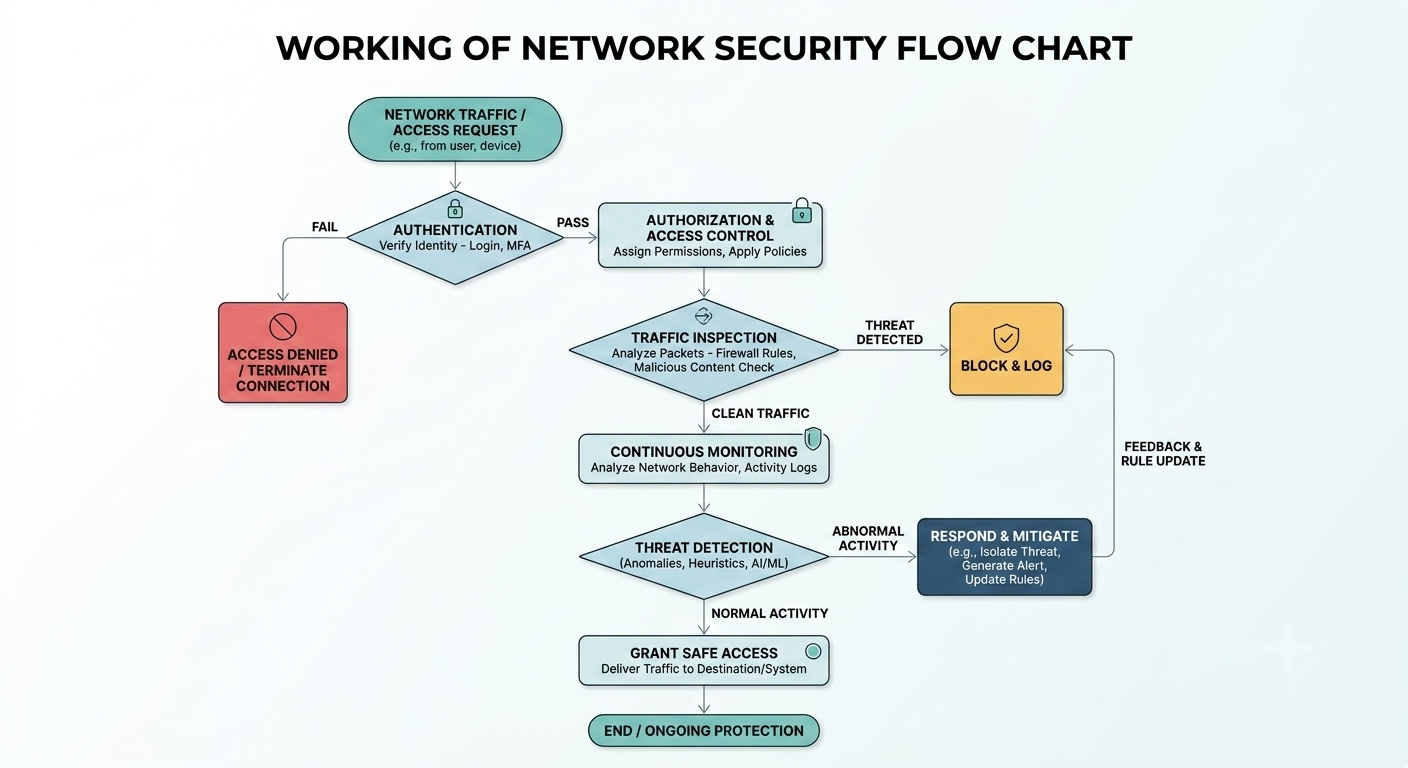
Network security workflow

From authentication and access control to continuous protection.

A network security environment uses multiple interconnected controls to validate access, regulate communication, inspect traffic, identify threats and respond to suspicious activity.

Network security workflow showing authentication, authorization and access control, traffic inspection, continuous monitoring, threat detection, incident response, blocking and logging, and safe network access
Network security workflow illustrating authentication, authorization and access control, traffic inspection, monitoring, threat detection, incident response, blocking and logging, and safe network access.

Consultancy scope

From network observations to structured technical outcomes.

Network security projects often require both technical investigation and clear documentation. The following areas illustrate how different technical activities can connect to meaningful project outcomes.

Consultancy FocusKey Technical ModulesTarget Deliverables & Outcomes
Network Architecture & SegmentationTopology analysis, network zones, trust boundaries, communication paths, device roles and segmentation concepts.Network diagrams, architecture observations, trust-boundary analysis and security recommendations.
Traffic & Packet AnalysisProtocol identification, packet headers, ports, addresses, communication sequences and traffic-pattern analysis.Packet-analysis notes, protocol observations, traffic findings and evidence-based technical explanations.
Firewall & Access ControlFirewall rules, filtering policies, authentication, authorization, access restrictions and security logging.Rule-analysis documentation, access-control observations, security gaps and improvement recommendations.
Network Monitoring & DetectionSecurity logs, event collection, anomaly detection, IDS/IPS concepts and monitoring workflows.Monitoring models, event-analysis notes, detection observations and structured security findings.
Secure CommunicationEncryption concepts, VPNs, TLS, secure protocols, authentication and protection of data in transit.Secure-communication analysis, protocol comparisons and recommendations for protecting network traffic.

Technical analysis

Network traffic, packets and security controls.

Network security analysis becomes more meaningful when technical observations are connected to the underlying behaviour of the network and its security controls.

Network traffic analysis examines communication between systems to understand what is being transmitted, which protocols are being used and whether observed behaviour matches expected patterns.

Packet analysis provides a more detailed view by examining individual packets, headers, protocols, addresses, ports and communication sequences. Packet-analysis tools can therefore be valuable in practical laboratories and technical investigations.

Firewall and access-control analysis adds another layer by examining which traffic is permitted, restricted or logged. Together, these areas provide a foundation for understanding defensive network architecture.

Architecture

Topology, devices, communication paths and segmentation.

Packet Analysis

Protocols, headers, addresses, ports and traffic patterns.

Security Controls

Firewalls, filtering, authentication and access policies.

Monitoring

Logs, events, anomalies and suspicious network behaviour.

Core competencies

From packet captures to defensible network security findings.

Effective network security work requires more than collecting screenshots or packet captures. Technical interpretation, evidence validation, security reasoning and clear documentation are central to producing meaningful findings.

Network Architecture Analysis

Understand network topology, device relationships, communication paths, trust boundaries and segmentation to establish how a network is structured and where security controls operate.

Traffic & Packet Investigation

Interpret packet captures and network traffic to identify protocols, addresses, ports, communication sequences and patterns that may be relevant to a security investigation.

Firewall & Access-Control Review

Examine how filtering rules, authentication mechanisms and access policies control communication between systems, network segments and users.

Monitoring & Threat Detection

Study security-event collection, network monitoring, anomaly identification and intrusion-detection concepts to understand how suspicious activity can be detected.

Secure Network Communication

Explore encryption, VPNs, secure protocols and authentication mechanisms used to protect information while it travels between networked systems.

Evidence & Technical Reporting

Translate network observations, packet evidence, configuration analysis and security findings into structured technical documentation suitable for academic and research projects.

Tools & environments

Technical environments relevant to network security projects.

Technical guidance can cover the configuration, responsible use, interpretation and documentation of common networking and cybersecurity tools within isolated laboratories and authorised environments.

Operating Systems & Network Labs

  • Linux networking environments
  • Windows networking environments
  • Kali Linux
  • VirtualBox and VMware laboratories
  • Docker-based network services

Network Discovery & Analysis

  • Nmap
  • Netcat
  • Traceroute
  • Ping and diagnostic utilities
  • Network interface analysis
  • Service enumeration concepts

Packet & Protocol Analysis

  • Wireshark
  • TCP/IP analysis
  • DNS traffic
  • HTTP and HTTPS traffic
  • ARP analysis
  • TCP and UDP behaviour

Security Monitoring

  • Intrusion detection concepts
  • Security event analysis
  • Network monitoring workflows
  • IDS/IPS concepts
  • Log collection
  • Alert analysis

Secure Communication

  • TLS and HTTPS
  • VPN concepts
  • IPsec concepts
  • SSH
  • Secure authentication
  • Encryption in transit

Academic & technical projects

Network security topics that can be explored through practical analysis.

Network security projects can combine theoretical concepts with practical observation and technical evidence. The exact scope can be adapted to the academic requirements, available laboratory environment and research objectives.

Network architecture and topology analysis
TCP/IP protocol analysis
Packet capture and Wireshark investigations
Firewall configuration and rule analysis
Network segmentation and access control
Intrusion detection and prevention concepts
Network monitoring and anomaly detection
VPN and secure communication analysis
Wireless network security studies
Network vulnerability identification
Security log and event analysis
Network security policy evaluation

Structured methodology

A repeatable framework for network security analysis.

A disciplined methodology helps ensure that network observations are connected to clear objectives, appropriate evidence and defensible conclusions.

01

Define the Network Environment

Establish the project scope, network topology, systems involved, communication objectives and specific security questions that the analysis is intended to answer.

02

Map Architecture & Communication

Document devices, network segments, services, communication paths and trust boundaries to create a clear model of how systems interact.

03

Observe Traffic & Events

Collect appropriate network observations, packet captures, logs or security events using a controlled laboratory or authorised environment.

04

Analyse Protocols & Controls

Interpret network protocols, traffic patterns, firewall rules, access controls and monitoring mechanisms to determine how the environment behaves.

05

Identify Security Findings

Compare observed behaviour and controls against the project objectives to identify weaknesses, anomalies, misconfigurations or areas requiring further investigation.

06

Validate & Interpret Evidence

Review relevant packet captures, logs, configuration information and observations to distinguish meaningful security findings from normal network behaviour.

07

Document Recommendations

Present methodology, evidence, findings, limitations and appropriate recommendations in a structured technical report or research document.

Framework alignment

Network security work grounded in recognised security principles.

Academic and technical projects benefit from clear terminology, structured methodology and traceability to recognised security frameworks and standards.

NIST Cybersecurity FrameworkUseful for structuring discussions around identifying, protecting, detecting, responding to and recovering from cybersecurity risks.
NIST SP 800-41Provides relevant guidance for understanding firewall policy and firewall security considerations.
NIST SP 800-115Security testing concepts can provide useful context where network security analysis overlaps with authorised technical assessment.
ISO/IEC 27001Provides an information-security management perspective for considering controls, risk and security governance.
MITRE ATT&CKCan help contextualise network-related adversary behaviour and detection concepts within broader security analysis.

Responsible technical guidance

Network analysis should remain controlled, authorised and evidence-based.

Network traffic, security configurations and connected systems can contain sensitive information. Practical network-security work should therefore be performed within an isolated laboratory, an explicitly authorised environment or another setting where the necessary permissions are in place.

Our role is to help students and researchers understand network security concepts, interpret technical evidence, structure analysis and document their findings. The objective is to strengthen technical understanding rather than replace the learner's own work.

Frequently asked questions

Network security project guidance.

Common questions about network analysis, packet inspection, security controls, monitoring and technical documentation.

What does network security analysis involve?

Network security analysis can involve examining network architecture, communication paths, protocols, traffic patterns, packet captures, firewall policies, access controls, monitoring systems and security events to understand how effectively a network environment is protected.

Can you help with a network security academic project?

Yes. Technical guidance can cover project scope, network diagrams, packet and traffic analysis, security controls, laboratory methodology, evidence interpretation, findings and technical documentation while keeping the student responsible for their own academic work.

Can you help with Wireshark or packet analysis?

Yes. Guidance can cover understanding packet captures, protocols, headers, addresses, ports, communication sequences and traffic patterns, as well as organising observations into meaningful technical findings.

Can network security projects include firewall analysis?

Yes. Firewall-related projects can examine filtering policies, rule ordering, permitted and blocked traffic, access-control decisions, logging and the relationship between firewall configuration and network security requirements.

Do you support network monitoring and intrusion detection projects?

Yes. Projects involving security monitoring, logs, alerts, anomaly detection, intrusion detection concepts and security-event analysis can be approached through structured technical methodology and evidence-based documentation.

Can network security be combined with penetration testing?

Yes. Network security analysis and penetration testing are complementary areas. Network analysis can help establish architecture, services and defensive controls, while authorised penetration testing can be used to validate selected security weaknesses in a controlled environment.

Let's make your work clearer

Bring us the difficult part.

Tell us what you're researching, building, or trying to understand. We'll help you find the clearest ethical next move.

Get Guidance
Chat with us on WhatsApp