Disk & Storage Forensics
Analyse forensic disk images, partitions, file systems, deleted files, metadata and storage artefacts to reconstruct relevant user or system activity.
Structured guidance for digital evidence acquisition, preservation, chain of custody, forensic analysis, memory investigation and technical reporting.
Digital forensics projects require both technical understanding and disciplined evidence handling. We help students and researchers connect forensic methodology, industry-standard tools, evidence interpretation and clear documentation within authorised academic and laboratory environments.
Understanding Digital Forensics
Digital forensics is the structured process of identifying, preserving, acquiring, examining and interpreting digital evidence. Depending on the investigation, evidence may exist on computers, mobile devices, removable storage, network infrastructure, cloud services or volatile memory.
A strong digital forensics assignment therefore involves much more than opening a forensic image in a tool. The investigator must understand evidence integrity, acquisition procedures, chain of custody, artefact interpretation, timestamps, investigative limitations and the relationship between individual pieces of evidence.
For academic and technical projects, these concepts can be transformed into reproducible laboratory procedures, evidence logs, screenshots, timelines, technical findings and a professionally structured forensic report.
Reliable forensic work depends on disciplined evidence handling.
Digital Forensics Investigation Process
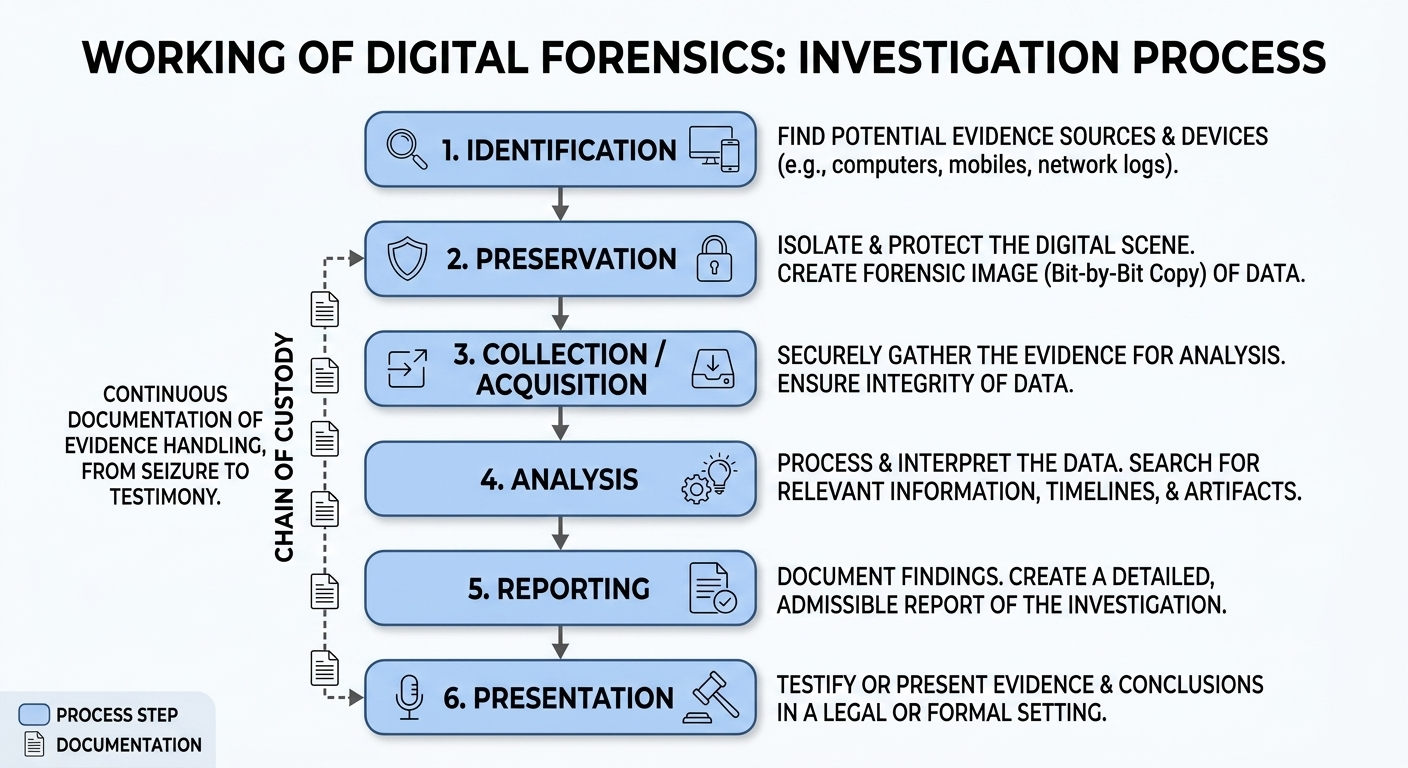
A structured investigation connects identification, preservation, evidence acquisition, analysis, reporting and presentation while maintaining continuous documentation of evidence handling.
Core Technical Areas
Digital forensics projects can focus on a single evidence source or combine multiple forensic disciplines to answer a broader investigative question.
Analyse forensic disk images, partitions, file systems, deleted files, metadata and storage artefacts to reconstruct relevant user or system activity.
Study volatile-memory evidence to investigate running processes, network connections, loaded modules and other artefacts that may disappear after system shutdown.
Examine operating-system artefacts such as NTFS metadata, MFT records, registry hives, Prefetch, Shimcache, logs and application traces.
Explore the forensic investigation of smartphones and mobile-device artefacts, including acquisition concepts, application data, communications and evidence preservation.
Study evidence-acquisition challenges associated with cloud storage, remote services, account activity, access records and distributed digital environments.
Analyse packet captures, network logs, connection records and related evidence to reconstruct communications and identify potentially suspicious activity.
Evidence Acquisition & Chain of Custody
Every forensic investigation begins with careful identification and preservation of potential evidence. The objective is to collect relevant information while minimising unnecessary changes to the original source.
Depending on the laboratory scenario, acquisition may involve forensic disk imaging, memory capture, mobile-device acquisition or collection of relevant network and cloud evidence.
Hash verification can provide an additional integrity check for acquired forensic images or files. Algorithms such as MD5 and SHA-256 may be encountered in academic exercises, although the appropriate procedure should always follow the requirements of the investigation and forensic environment.
Chain-of-custody documentation complements these technical controls by recording who handled the evidence, when it was handled, why it was transferred and how it was protected.
Create and document forensic copies of storage media while protecting the original evidence.
Use cryptographic hashes to compare evidence states and support integrity verification.
Record evidence identifiers, handling events, acquisition details and transfers.
Maintain appropriate controls to reduce the risk of accidental alteration or loss.
Forensic Analysis Concepts
Effective forensic analysis requires understanding what an artefact represents, where it came from, how reliable it is and how it relates to other evidence.
Understand how digital evidence is identified, preserved and acquired while minimising the risk of alteration. Academic laboratories can explore write-blocking, forensic imaging, acquisition documentation and evidence handling procedures.
Build a clear audit trail covering evidence identification, collection, transfer, storage and analysis. Cryptographic hashes can be used to demonstrate that acquired forensic images or files remain consistent with their documented baseline.
Investigate volatile evidence from RAM, including processes, network connections, loaded components and other artefacts that may not be recoverable from a conventional disk image.
Examine file-system structures, registry hives, application artefacts, logs, execution traces and metadata to reconstruct user and system activity.
Correlate timestamps and artefacts to build a chronological understanding of events. Timeline analysis can help connect files, processes, user activity and system events into a coherent investigative narrative.
Translate technical observations into structured findings supported by evidence, methodology, screenshots, artefact locations, limitations and clearly reasoned conclusions.
Memory Forensics
Volatile memory can contain information that is not necessarily available in a conventional disk image. A memory-forensics assignment may therefore require analysing a captured RAM image to understand processes, network connections, loaded components and other system state.
The Volatility Framework provides a structured environment for examining memory artefacts. Students may encounter analyses involving process trees, process listings, network endpoints, loaded modules and suspicious process behaviour.
The important academic objective is not simply executing a command. Findings need to be interpreted in context and linked back to the investigation question, evidence source and limitations of the memory capture.
Examples of concepts encountered in academic laboratories.
Forensic Tools & Environments
Technical guidance can cover the purpose, workflow, output interpretation and documentation associated with commonly used digital forensics tools.
Open-source digital forensics platforms used for disk-image examination, keyword searching, artefact analysis, hashing, timelines and case management.
A widely used forensic imaging and evidence-preview tool for understanding acquisition workflows, disk images, evidence containers and integrity verification.
A memory-forensics framework used to examine volatile memory and investigate processes, network activity, loaded modules and other system artefacts.
A packet-analysis platform useful for examining PCAP files, protocols, network conversations and communication patterns relevant to forensic investigations.
Command-line tools and scripting concepts can support hashing, file analysis, evidence organisation, automation and reproducible forensic workflows.
Evidence Environments
The nature of the evidence determines the acquisition, analysis and documentation techniques that are appropriate for the project.
Digital Forensics Lab Report
A good forensic report should allow a reader to understand what was investigated, what evidence was examined, how the analysis was performed, what was discovered and how the conclusions were reached.
| Report Section | Required Elements | Key Focus |
|---|---|---|
| Executive Summary | Investigation objective, high-level findings, important conclusions and concise incident context. | Clear communication of the investigation outcome for non-technical and technical readers. |
| Evidence Details | Evidence identifiers, source information, acquisition details, image information and cryptographic hashes. | Demonstrating evidence integrity and maintaining a traceable chain of custody. |
| Methodology & Tools | Forensic procedures, tool names and versions, acquisition approach, analysis environment and relevant assumptions. | Making the investigation methodology understandable and reproducible. |
| Technical Analysis | Screenshots, artefact locations, timelines, registry entries, logs, memory findings and other supporting evidence. | Connecting technical observations to the investigation question. |
| Findings & Interpretation | Individual findings, supporting evidence, significance, limitations and confidence considerations. | Separating observed evidence from assumptions or unsupported conclusions. |
| Conclusion & Recommendations | Overall conclusion, security recommendations, unresolved questions and possible follow-up analysis. | Answering the investigation objective and identifying appropriate next steps. |
Academic & Research Projects
Digital forensics projects can combine theoretical investigation concepts with practical evidence analysis. The exact scope can be adapted to the academic requirements, available evidence, tools and research objectives.
Structured Investigation Methodology
The following framework connects evidence handling with technical analysis and reporting, helping transform individual observations into a defensible investigative narrative.
Define the investigation objective, identify potential evidence sources and establish the systems, devices, accounts or storage locations relevant to the investigation.
Protect the original evidence from unnecessary alteration and document the initial condition, handling requirements and preservation measures.
Create appropriate forensic copies or acquire relevant evidence using controlled procedures. Record acquisition details and verify integrity where required.
Examine files, artefacts, memory, logs, network evidence and timelines to identify information relevant to the investigation question.
Correlate individual artefacts and observations to establish relationships, timelines and possible explanations while distinguishing evidence from inference.
Document methodology, evidence, findings, limitations and conclusions in a structured forensic report supported by appropriate technical evidence.
Responsible Forensic Analysis
Digital evidence can be technically complex and sometimes ambiguous. A timestamp, registry entry, process or network connection should therefore be interpreted in context rather than treated automatically as proof of a particular event.
Strong forensic coursework demonstrates the relationship between the evidence, the methodology used to obtain it and the conclusion being presented. It should also acknowledge relevant limitations and distinguish direct observations from investigative interpretation.
Our guidance focuses on understanding these principles and developing technically defensible academic work in authorised laboratory and research environments.
Frequently Asked Questions
Common questions about digital evidence, forensic tools, investigation methodology and technical reporting.
Yes. We can provide structured guidance for academic digital forensics laboratories and projects involving evidence acquisition, preservation, disk analysis, memory analysis, forensic artefacts, investigation methodology and technical reporting.
Chain of custody provides a documented history of how evidence was identified, collected, transferred, stored and analysed. It helps demonstrate that evidence was handled systematically and that its integrity was protected throughout the investigation.
Yes. Guidance can cover forensic imaging concepts, write protection, image formats, acquisition procedures and cryptographic hash verification using algorithms such as MD5 or SHA-256 where appropriate to the laboratory or project requirements.
Yes. Technical guidance can cover memory-forensics concepts, process analysis, network artefacts, suspicious activity investigation and interpretation of Volatility 3 results within an authorised academic or laboratory environment.
Yes. We can help explain the purpose and workflow of common forensic tools, interpret their outputs, structure evidence analysis and document findings in a clear technical report.
Yes. Guidance can cover the conceptual and methodological aspects of mobile-device and cloud evidence acquisition, preservation, artefact analysis, limitations and documentation.
Explore More
Digital forensics intersects with network security, vulnerability assessment, penetration testing and security operations. Explore related areas to understand the broader cybersecurity context of your project.
Explore network architecture, packet analysis, firewall controls, monitoring and network threat detection.
Explore controlled security testing, reconnaissance, vulnerability validation and technical security reporting.
Study vulnerability identification, classification, evidence organisation and remediation planning.
Explore security monitoring, log analysis, incident investigation and SIEM-based technical workflows.
Digital Forensics Project?
Get guidance on structuring your investigation, selecting an appropriate analysis approach, interpreting forensic evidence and organising the technical documentation.