Cybersecurity • Penetration Testing • VAPT

Hands-On Penetration Testing & Cybersecurity Technical Consultancy

Technical guidance for structured penetration testing, vulnerability assessment, ethical security laboratories, and cybersecurity project documentation. Build a stronger understanding of offensive security methodologies while keeping testing controlled, authorized, and academically responsible.

Technical scope

Structured guidance across modern offensive security environments.

Modern security assessment requires precision across network, application, wireless, cloud, and infrastructure environments. Our technical advisory approach connects methodology, tooling, evidence, analysis, and documentation.

Network Security

Understand network enumeration, service analysis, vulnerability validation, and controlled exploitation.

Application Security

Study web application vulnerabilities, APIs, security controls, and OWASP-aligned assessment techniques.

Cloud Security

Review cloud identity, storage, configuration, and container-security concepts in controlled environments.

Wireless Security

Explore wireless assessment methodology, configuration weaknesses, and defensive security considerations.
Penetration testing methodology

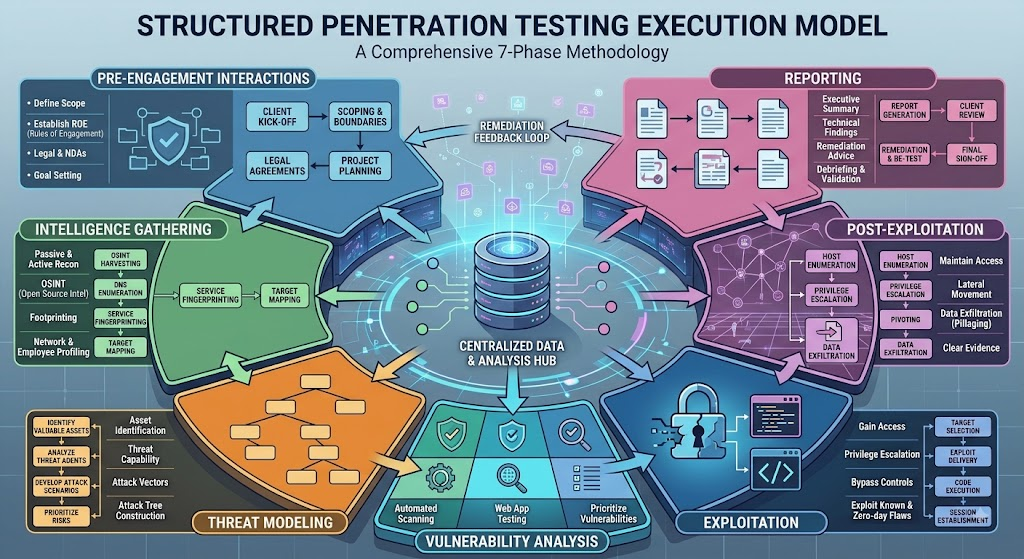
Structured Penetration Testing Execution Model

A comprehensive seven-phase methodology connecting planning, intelligence gathering, threat modeling, vulnerability analysis, controlled exploitation, post-exploitation assessment, and technical reporting.

Seven-phase penetration testing execution model covering pre-engagement, intelligence gathering, threat modeling, vulnerability analysis, exploitation, post-exploitation, and reporting
Seven-phase penetration testing execution model covering pre-engagement, intelligence gathering, threat modeling, vulnerability analysis, exploitation, post-exploitation, and reporting.

Consultancy pillars

Technical scope and expected outcomes.

Advisory can be structured around a defined technical project, assessment methodology, research requirement, or controlled cybersecurity laboratory.

Consultancy FocusKey Technical ModulesTarget Deliverables & Outcomes
Network Penetration TestingPort scanning, service enumeration, exploitation, privilege escalation, and controlled post-exploitation analysis.Network topology maps, evidence logs, root-cause analysis, and remediation matrices.
Web Application SecurityOWASP Top 10 verification, SQL injection, XSS, authentication weaknesses, CSRF, and API endpoint auditing.Vulnerability proof-of-concept documentation, security recommendations, and API security briefs.
Wireless Security AuditingWPA2/WPA3 security assessment concepts, wireless configuration analysis, rogue access-point detection, and controlled wireless testing.Wireless security assessment notes, coverage observations, and security policy recommendations.
Cloud Infrastructure TestingAWS/Azure IAM configuration reviews, storage-policy analysis, container security, and cloud security posture assessment.Cloud security findings, IAM least-privilege maps, configuration recommendations, and security rules.
Threat Modeling & ComplianceSTRIDE threat modeling, NIST control mapping, ISO 27001 risk analysis, and security-control evaluation.Risk matrices, threat models, compliance-readiness documentation, and control-mapping summaries.

Core competencies

From automated scans to defensible technical findings.

Effective penetration testing requires more than running automated tools. Technical understanding, manual validation, evidence analysis, and clear documentation are central to producing meaningful security findings.

Vulnerability Assessment & Penetration Testing Review

Structured review of automated scan results from tools such as Nessus and OpenVAS, including validation of findings, false-positive analysis, and development of controlled manual testing paths.

Security Framework & Compliance Mapping

Technical findings can be mapped to recognized frameworks and standards including NIST SP 800-53, ISO 27001, OWASP Top 10, and PCI DSS.

SIEM & Packet-Level Diagnostics

Analysis of packet captures in Wireshark and review of security-event collection in platforms such as Splunk or Elastic Security to understand monitoring and detection workflows.

Automated & Custom Scripting

Python and Bash scripting guidance for security automation, reconnaissance workflows, banner analysis, evidence collection, and controlled laboratory exercises.

Threat Modeling with STRIDE

Systematic modeling of application and infrastructure threats to identify structural weaknesses before deployment or during security-focused project analysis.

Toolchains & environments

Industry-recognized security tools in controlled environments.

Technical guidance can cover the configuration, responsible use, interpretation, and documentation of common cybersecurity tools across isolated laboratories and authorized assessment environments.

Operating Systems & Lab Environments

  • Kali Linux
  • Parrot Security OS
  • Windows Server and Active Directory labs
  • Docker-based security targets

Reconnaissance & Enumeration

  • Nmap
  • Masscan
  • Amass
  • Recon-ng
  • Maltego
  • Wireshark

Web Application Testing

  • Burp Suite Professional
  • OWASP ZAP
  • SQLmap
  • Gobuster
  • Nikto

Exploitation & Post-Exploitation

  • Metasploit Framework
  • Cobalt Strike concepts in controlled labs
  • Mimikatz
  • Empire
  • Custom Python security tooling

Defensive & Monitoring Integration

  • Splunk
  • Snort
  • Suricata
  • Elastic Stack
  • Security-event analysis

Seven-phase methodology

A repeatable framework for penetration testing execution.

Penetration testing requires disciplined planning and controlled execution. The following seven phases provide a structured framework for technical analysis and reporting.

01

Pre-Engagement, Planning & Scope

Establishing clear Rules of Engagement, defining target IP ranges or domain scopes, establishing authorization parameters, identifying testing boundaries, and scheduling appropriate test windows to prevent operational disruption.

02

Intelligence Gathering & Reconnaissance

Executing passive and active reconnaissance to understand the target environment. This can include OSINT analysis, subdomain discovery, DNS information, public repositories, technology identification, and attack-surface mapping within an authorized scope.

03

Threat Modeling & Attack-Surface Analysis

Using structured threat-modeling approaches such as STRIDE to identify likely attack paths, trust boundaries, assets, threats, and potential security weaknesses before exploitation activities begin.

04

Vulnerability Analysis

Combining automated scanning with manual analysis to identify unpatched software, insecure configurations, weak authentication mechanisms, exposed services, and architectural vulnerabilities while validating findings and reducing false positives.

05

Controlled Exploitation & Validation

Performing controlled proof-of-concept exploitation against identified vulnerabilities to establish exploitability and security impact without causing unnecessary service disruption, data corruption, or uncontrolled access.

06

Post-Exploitation & Impact Assessment

Assessing the potential consequences of a validated compromise by examining privilege escalation, internal pivoting, sensitive-data exposure, lateral movement, and other relevant impact scenarios within the authorized laboratory or assessment boundary.

07

Technical Reporting & Remediation

Transforming technical observations into structured reports containing executive summaries, detailed findings, evidence, severity ratings, CVSS context where appropriate, reproduction guidance, root-cause analysis, and practical remediation recommendations.

Framework alignment

Academic and technical work grounded in recognized security frameworks.

Cybersecurity projects often require more than technical execution. They also need a clear methodology, defensible evidence, appropriate terminology, and traceability to recognized frameworks and standards.

NIST security and control frameworks
ISO 27001 information security principles
OWASP application security guidance
PCI DSS security considerations
PTES and OSSTMM methodology concepts

Frequently asked questions

Penetration testing and VAPT guidance.

Common questions about technical reviews, controlled laboratories, vulnerability assessment, and cybersecurity documentation.

How is client confidentiality maintained during technical reviews?

Project briefs, code bases, network diagrams, and communication records are handled confidentially. Secure transmission channels are used for shared technical materials, and project information is not distributed to unrelated third parties.

Can I get guidance on setting up an isolated virtual attack lab?

Yes. Technical mentorship can cover isolated hypervisor environments using platforms such as VirtualBox or VMware, vulnerable target machines such as Metasploitable and WebGoat, containerized targets, and host-only networking for controlled security testing.

What is the distinction between Vulnerability Assessment and Penetration Testing?

A Vulnerability Assessment focuses on identifying, categorizing, and prioritizing potential security weaknesses. Penetration Testing goes further by attempting controlled exploitation of identified weaknesses to validate whether unauthorized access or other security impacts can actually be achieved.

Do you assist with formatting technical vulnerability reports?

Yes. Guidance can cover the structure of formal VAPT reports, including executive summaries, technical findings, severity and CVSS scoring, proof-of-concept documentation, evidence presentation, and remediation recommendations.

Let's make your work clearer

Bring us the difficult part.

Tell us what you're researching, building, or trying to understand. We'll help you find the clearest ethical next move.

Get Guidance
Chat with us on WhatsApp