Cybersecurity • Secure Software Development • AppSec

Secure Software Development Assignment Help & Technical Guidance

Technical guidance for secure coding, application security, threat modeling, vulnerability remediation, DevSecOps, cryptography, and secure software architecture. Build a stronger understanding of security-by-design principles while applying them to real development environments and academic projects.

Secure development scope

Security needs to be built into software—not added after the application is finished.

Secure software development connects software engineering with application security throughout the Software Development Life Cycle. Our technical guidance brings together secure architecture, defensive coding, vulnerability analysis, automated security testing, remediation, and clear documentation.

Secure Architecture

Understand threat modeling, trust boundaries, attack surfaces, security requirements, and defense-in-depth.

Secure Coding

Apply defensive programming principles across modern languages, frameworks, APIs, and application architectures.

AppSec Testing

Interpret SAST, SCA, and DAST findings and understand how automated security testing fits into development workflows.

DevSecOps

Explore security gates, dependency analysis, automated scanning, and security controls within CI/CD pipelines.
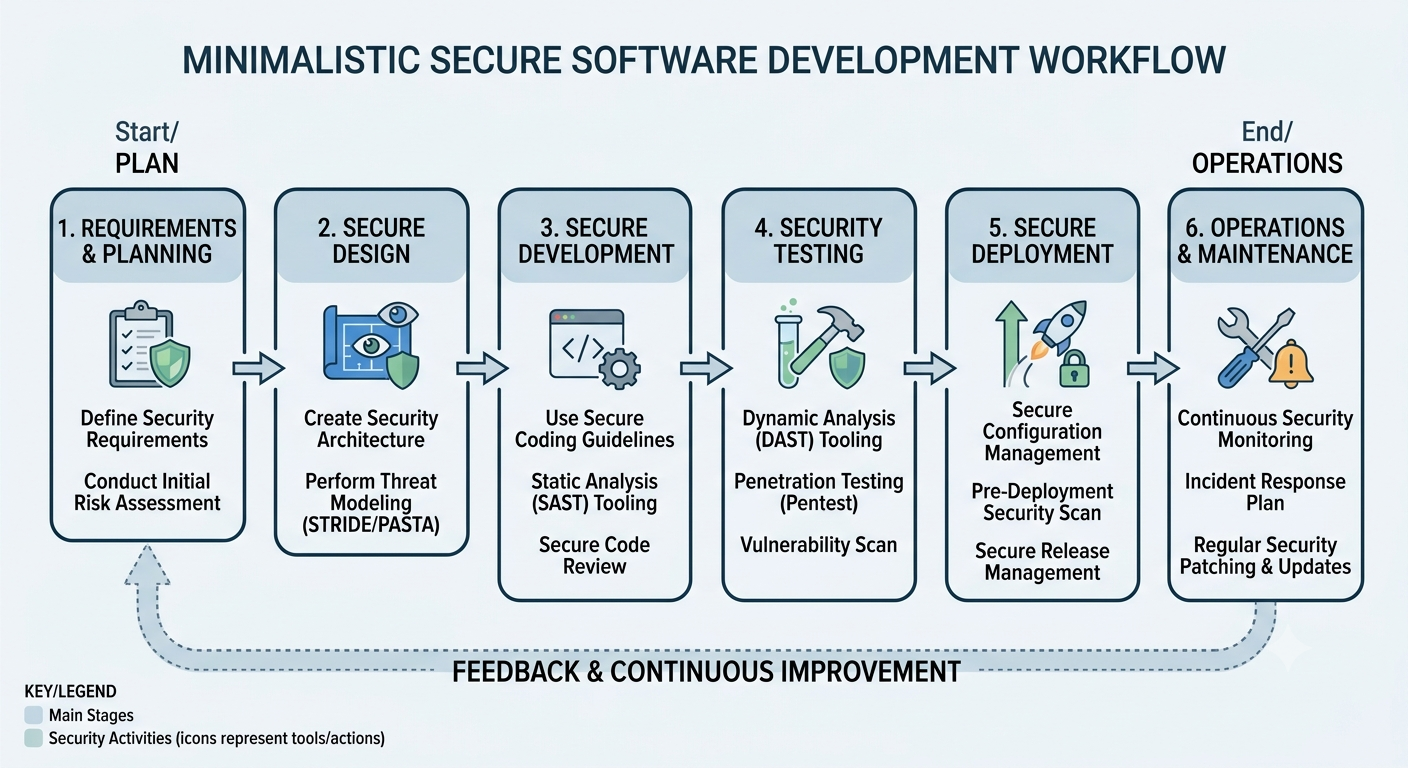
Secure software development workflow

Security Throughout the Software Development Lifecycle

Secure development works best when security considerations are connected across requirements, architecture, implementation, testing, remediation, and verification rather than treated as a final-stage activity.

Secure software development workflow showing security activities across the software development lifecycle
Secure software development workflow connecting security requirements, threat modeling, secure implementation, automated analysis, testing, remediation, and verification.

Consultancy pillars

Comprehensive support across secure software development.

Secure development assignments can involve application architecture, vulnerable code, security testing, threat models, cryptographic design, DevSecOps pipelines, or technical research. Guidance can be structured around the specific requirements of the project.

Consultancy FocusKey Technical ModulesTarget Deliverables & Outcomes
Threat Modeling & Secure ArchitectureSTRIDE, PASTA, DREAD, VAST, Data Flow Diagrams, trust boundaries, attack surfaces, abuse cases, misuse cases, and defense-in-depth.Threat models, DFDs, security requirements, mitigation matrices, and architecture analysis.
Application Vulnerability RemediationOWASP Top 10, CWE Top 25, injection flaws, XSS, CSRF, SSRF, insecure deserialization, authentication weaknesses, and broken access control.Root-cause analysis, remediation guidance, secure code patterns, vulnerability evidence, and technical documentation.
Memory Safety & Low-Level SecurityBuffer overflows, use-after-free, double-free, format-string vulnerabilities, integer overflows, pointer safety, and defensive compiler features.Secure C/C++ implementations, debugging guidance, memory-analysis findings, and hardening recommendations.
Applied CryptographyAES-GCM, AES-CBC, RSA, ECC, SHA-256, SHA-3, HMAC, digital signatures, PKI, TLS validation, and secret management.Cryptographic implementation guidance, security design analysis, key-management recommendations, and documentation.
DevSecOps & Security TestingSAST, SCA, DAST, dependency analysis, security gates, CI/CD integration, automated scanning, and vulnerability triage.Security pipeline designs, scan interpretation, remediation workflows, and security-quality documentation.
Secure APIs & Web ServicesREST, GraphQL, gRPC, authentication, authorization, rate limiting, CORS, API gateways, WAF integration, and secure service design.API security reviews, authorization models, secure configuration guidance, and technical security reports.

Core competencies

From vulnerability discovery to secure implementation.

Secure software development requires more than identifying vulnerabilities. The important step is understanding why a weakness exists, selecting an appropriate remediation, verifying the resulting behaviour, and documenting the security reasoning.

Threat Modeling & Secure Architecture

Guidance with STRIDE, PASTA, DREAD, and VAST methodologies, Data Flow Diagrams, trust boundaries, attack surfaces, abuse cases, misuse cases, and defense-in-depth architecture.

OWASP & CWE Vulnerability Remediation

Structured analysis of common application vulnerabilities including injection, XSS, CSRF, SSRF, insecure deserialization, authentication weaknesses, and broken access control.

Secure Authentication & Authorization

Support with secure session management, OAuth 2.0, OpenID Connect, JWT validation, password hashing, object-level authorization, and function-level access controls.

Memory Safety & Low-Level Hardening

Technical guidance for buffer overflows, use-after-free, double-free, integer overflow, format-string vulnerabilities, pointer safety, and defensive compiler protections.

Applied Cryptography

Guidance with encryption, hashing, MACs, digital signatures, PKI, TLS certificate validation, and secure management of cryptographic keys and application secrets.

DevSecOps & Automated Security Testing

Support for integrating SAST, SCA, DAST, dependency scanning, security gates, and policy checks into modern CI/CD workflows.

Languages, frameworks & tooling

Technical guidance across common development ecosystems.

Secure software development projects can span low-level systems programming, enterprise applications, Python services, JavaScript applications, APIs, and modern security-testing pipelines.

Java & JVM Development

  • Spring Boot
  • Spring Security
  • Jakarta EE
  • Hibernate
  • Maven
  • Gradle

Python Security Development

  • Django
  • Flask
  • FastAPI
  • SQLAlchemy
  • Jinja2
  • Bandit

C / C++ & Systems Security

  • GCC
  • Clang
  • Valgrind
  • GDB
  • CMake
  • Cppcheck

JavaScript & Web Applications

  • React
  • Express.js
  • Next.js
  • Node.js
  • NPM
  • DOMPurify

Application Security Testing

  • SonarQube
  • Semgrep
  • OWASP ZAP
  • Burp Suite
  • Snyk
  • OWASP Dependency-Check

Security & Cloud Integration

  • GitHub Actions
  • GitLab CI
  • Jenkins
  • Azure Pipelines
  • AWS Secrets Manager
  • HashiCorp Vault

Secure development methodology

A repeatable workflow for secure software projects.

The following seven phases provide a structured way to connect security requirements, design decisions, implementation, testing, remediation, and technical documentation.

01

Understand Requirements & Attack Surface

Establish the application objectives, functional requirements, technology stack, trust boundaries, user roles, external dependencies, and potential attack surface before making security changes.

02

Threat Modeling & Security Design

Identify relevant threats and security requirements using structured approaches such as STRIDE or PASTA, supported by Data Flow Diagrams, abuse cases, and security architecture analysis.

03

Secure Coding & Defensive Implementation

Apply secure coding principles such as strict input validation, output encoding, parameterized queries, secure authentication, authorization, safe error handling, and appropriate cryptographic practices.

04

Automated Security Analysis

Use appropriate SAST, SCA, dependency scanning, and other automated analysis techniques to identify potentially vulnerable code, insecure dependencies, and configuration weaknesses.

05

Dynamic Testing & Validation

Validate application behaviour using controlled DAST and security testing techniques, interpreting findings and distinguishing meaningful vulnerabilities from false positives.

06

Remediation & Verification

Address identified weaknesses while preserving application functionality, then verify the changes through appropriate testing, regression checks, and security analysis.

07

Documentation & Security Review

Document the vulnerability, root cause, remediation, evidence, residual risk, testing results, and relevant security considerations in a clear technical format.

Development ecosystems

Secure coding guidance across modern programming stacks.

Different programming ecosystems introduce different security concerns. Understanding the language, framework, runtime, dependency model, and deployment environment is essential to choosing appropriate security controls.

Language / EcosystemFrameworks & Technology StackCommon Project Applications
Java & JVM StackSpring Boot, Jakarta EE, Hibernate, Maven, and Gradle for secure enterprise application development.SQL injection and XSS remediation, Spring Security, secure dependency management, and authentication.
Python EcosystemDjango, Flask, FastAPI, SQLAlchemy, and Jinja2 for secure web and API development.SSTI and deserialization analysis, ORM security, input validation, and Python security scanning.
C / C++ & SystemsGCC, Clang, Valgrind, GDB, CMake, and related low-level development environments.Memory-safety analysis, buffer-overflow mitigation, pointer safety, and static analysis.
JavaScript / Node.jsReact, Express.js, Next.js, Node.js, and NPM-based application environments.Input sanitization, dependency auditing, JWT security, secure CORS, and web application hardening.
C# & .NETASP.NET Core, Entity Framework, NuGet, and the broader .NET security ecosystem.Input validation, anti-forgery protection, ASP.NET Identity, authorization, and static analysis.
Application Security ToolingSonarQube, Semgrep, OWASP ZAP, Burp Suite, Snyk, and dependency-analysis tools.SAST, DAST, SCA, custom security rules, vulnerability triage, and security-quality reporting.

Application security

Understanding the root cause is as important as fixing the vulnerability.

Secure coding assignments frequently involve vulnerabilities that look simple at the surface but have deeper architectural or implementation causes. We focus on helping you understand those causes and connect them to appropriate security controls.

OWASP Top 10 vulnerability analysis
CWE Top 25 weakness analysis
Secure authentication and authorization
Input validation and output encoding
Secure dependency and secret management
Secure API and service architecture

Sample secure coding scenarios

Examples of the technical problems we can help you understand.

These scenarios illustrate the type of reasoning involved in secure software development coursework and practical laboratories.

Scenario A: SQL Injection Remediation

A Flask application constructs a SQL query by directly concatenating user input. We can help identify the vulnerability, explain why the input crosses the code/data boundary, and refactor the database interaction using parameterized queries while preserving the application’s intended behaviour.

Scenario B: C Buffer Overflow Analysis

A C application copies user-controlled data into a fixed-size buffer without adequate bounds checking. Guidance can cover how the memory corruption occurs, how safer input-handling approaches work, and how compiler and operating-system protections contribute to defence in depth.

Scenario C: STRIDE Threat Model

An e-commerce payment system needs a security threat model. We can help identify trust boundaries, assets, threat agents, and the six STRIDE categories, then connect the identified threats to appropriate mitigations in a structured threat matrix.

Academic & technical guidance

Build secure software while understanding why the security controls work.

Our role is to help you understand vulnerability root causes, secure coding patterns, testing approaches, and architectural decisions so that you can explain and defend the technical work within your own project.

Before-and-after vulnerability analysis
Secure refactoring guidance
Technical evidence interpretation
Security testing and verification
Threat model and architecture review
Technical documentation support

Frequently asked questions

Secure software development guidance.

Common questions about secure coding, application security testing, threat modeling, DevSecOps, and software security projects.

What types of secure software development assignments do you cover?

We provide guidance across secure code refactoring, threat modeling, OWASP vulnerability remediation, SAST and DAST analysis, DevSecOps pipeline security, secure API development, applied cryptography, memory safety, and software security capstone projects.

Can you help me fix vulnerabilities identified by tools such as SonarQube or Snyk?

Yes. We can help interpret SAST and SCA findings, identify the underlying cause, develop appropriate remediation strategies, and explain how the changes affect the application. Guidance can also cover security quality gates and verification of the resulting fixes.

Can you help with secure coding assignments in C, C++, Java, Python, JavaScript, or C#?

Yes. Technical guidance can cover secure development concepts across common programming ecosystems, including memory safety in C and C++, secure application development in Java and C#, and web and API security in Python, JavaScript, and related frameworks.

Do you provide support for threat modeling assignments?

Yes. We can help structure Data Flow Diagrams, identify trust boundaries and threat agents, apply methodologies such as STRIDE or PASTA, and document appropriate security controls and mitigation strategies.

Can you help integrate security testing into a CI/CD pipeline?

Yes. Guidance can cover the role of SAST, SCA, DAST, dependency scanning, security quality gates, and policy checks within CI/CD environments such as GitHub Actions, GitLab CI, Jenkins, and Azure Pipelines.

Can secure software development guidance support postgraduate research?

Yes. Support can include research methodology, secure architecture analysis, vulnerability research, literature synthesis, threat modeling, experimental design, technical evaluation, and research documentation.

Let's make your work clearer

Bring us the difficult part.

Tell us what you're researching, building, or trying to understand. We'll help you find the clearest ethical next move.

Get Guidance
Chat with us on WhatsApp