Cybersecurity • Cloud Security • AWS • Azure • GCP

Hands-On Cloud Security Assignment Help & Technical Project Guidance

Technical guidance for cloud security assignments, AWS, Azure and GCP laboratories, IAM policy analysis, cloud architecture, Kubernetes security, Infrastructure as Code, DevSecOps, compliance, monitoring, and cloud incident-response projects. Get practical assistance with complex cloud environments while building a clear understanding of the underlying security concepts.

Cloud security scope

Structured guidance across modern cloud security environments.

Cloud security combines identity, network architecture, data protection, workload security, automation, monitoring, governance, and incident response. Our technical guidance connects these areas into practical academic projects, laboratory exercises, research work, and technical documentation.

Identity & IAM

Study least privilege, RBAC, ABAC, MFA, federation, permissions, roles, and cloud identity architectures.

Cloud Network Security

Explore VPCs, VNets, subnetting, security groups, NACLs, firewalls, WAFs, VPNs, and network segmentation.

Data Protection

Analyse encryption, key management, TLS, secure storage, certificates, secrets, and data-protection controls.

Cloud-Native Security

Work with container security, Kubernetes hardening, serverless security, runtime monitoring, and workload protection.

Cloud security methodology

Cloud Security Assessment & Project Workflow

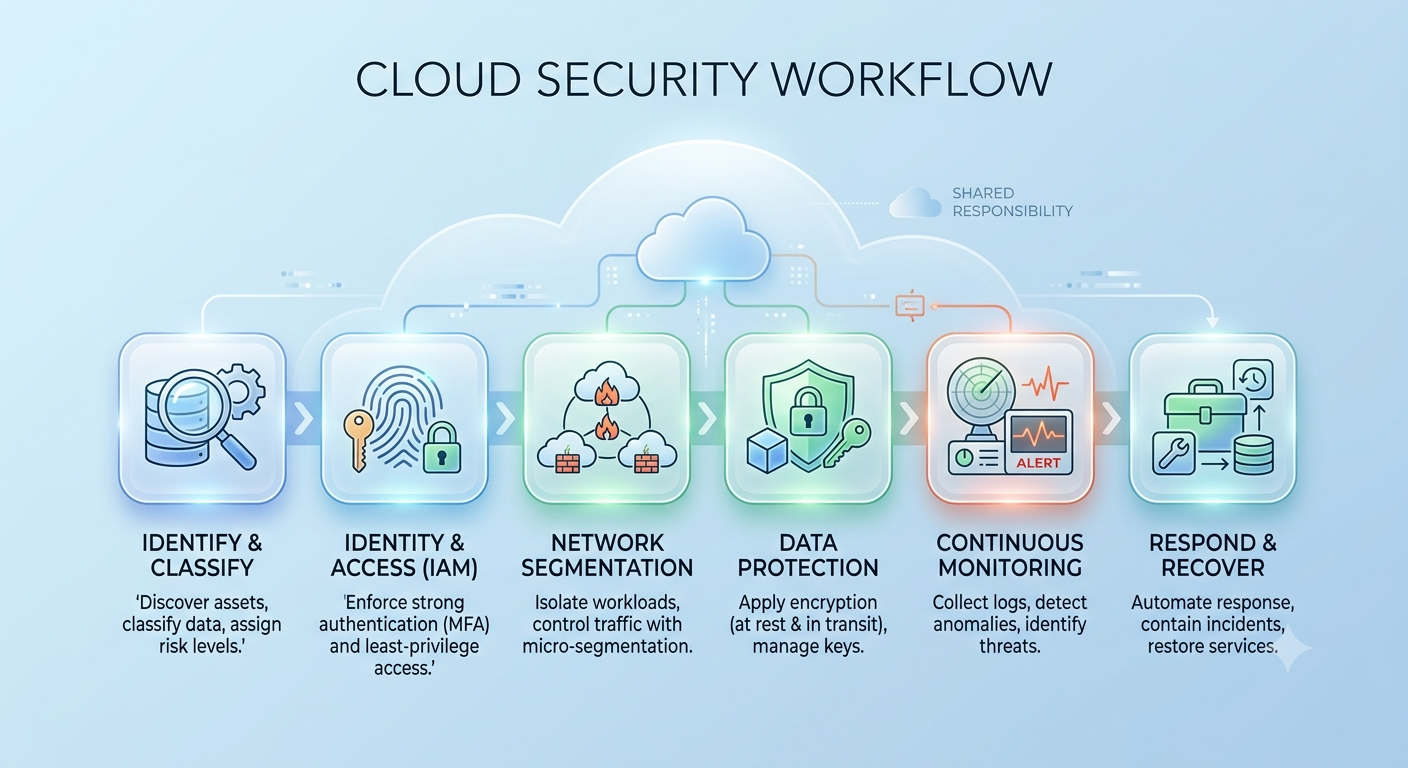
A structured cloud security workflow connects requirements, architecture analysis, identity and configuration assessment, security validation, monitoring, remediation, and technical reporting.

Cloud security workflow diagram showing cloud identity and access control, network protection, data security, workload protection, monitoring and threat detection, governance and compliance, and incident response
Cloud security workflow connecting identity and access management, network protection, data security, workload protection, monitoring, governance, threat detection, and incident response.

Technical scope

Comprehensive cloud security topics for assignments and projects.

Cloud security coursework can span individual configuration tasks or complete cloud-security architecture projects. Guidance can be tailored to AWS, Azure, GCP, Kubernetes, Infrastructure as Code, or multi-cloud environments.

Consultancy FocusKey Technical ModulesTarget Deliverables & Outcomes
Cloud Identity & Access ManagementAWS IAM, Microsoft Entra ID, GCP Cloud IAM, RBAC, ABAC, least privilege, MFA, federation, SSO, policy analysis, and privilege-escalation review.IAM policy reviews, role-permission maps, access-control recommendations, identity architecture diagrams, and documented security findings.
Cloud Infrastructure & Network SecurityVPC/VNet architecture, subnetting, security groups, NACLs, firewalls, WAF, VPNs, private connectivity, segmentation, and hybrid-cloud security.Secure network diagrams, segmentation models, firewall-rule analysis, connectivity reviews, and cloud network security recommendations.
Data Protection & Key ManagementEncryption at rest and in transit, AWS KMS, Azure Key Vault, Google Cloud KMS, TLS, certificate management, storage security, and data-loss prevention.Encryption architectures, key-management plans, storage-security findings, data-protection matrices, and technical recommendations.
DevSecOps & IaC SecurityTerraform, CloudFormation, Bicep, Checkov, KICS, CI/CD security, secret detection, SAST concepts, and shift-left security controls.IaC security audits, remediation guidance, secure configuration templates, pipeline security recommendations, and vulnerability summaries.
Container & Kubernetes SecurityDocker security, image scanning, Kubernetes RBAC, NetworkPolicies, Pod Security Standards, admission control, Falco, Trivy, Kyverno, and OPA.Container-hardening recommendations, Kubernetes manifests, security-policy reviews, vulnerability reports, and architecture documentation.
Cloud Governance & Incident ResponseCIS benchmarks, NIST controls, ISO 27017/27018, PCI DSS, cloud logging, CSPM, CloudTrail, Defender for Cloud, Security Command Center, and incident response.Compliance mappings, security posture assessments, incident-response workflows, log-analysis reports, and remediation plans.

Core competencies

From IAM policies to cloud-native security findings.

Effective cloud security requires more than knowing individual services. Projects often require understanding how identity, architecture, configuration, automation, monitoring, and governance interact across the cloud environment.

IAM, Zero Trust & Least Privilege

Analyse cloud identity architectures, IAM roles, access policies, RBAC and ABAC models, federation, MFA, SSO, and privilege boundaries while applying least-privilege principles to cloud workloads.

Cloud Network Security

Study VPC and VNet architecture, subnetting, security groups, NACLs, firewalls, WAFs, private connectivity, VPNs, hybrid networking, and microsegmentation in cloud environments.

Encryption & Key Management

Explore data-at-rest and data-in-transit protection using cloud-native key-management services, TLS, certificate management, storage encryption, and secure secrets handling.

Infrastructure as Code Security

Review Terraform, CloudFormation, Bicep, and other IaC configurations for security weaknesses and understand how automated security scanners can identify and prioritise misconfigurations.

Container & Kubernetes Security

Cover container image security, Dockerfile hardening, Kubernetes RBAC, NetworkPolicies, admission controls, Pod Security Standards, runtime monitoring, and cloud-native security architecture.

Governance, Compliance & CSPM

Map cloud environments to recognised security frameworks and study cloud security posture management, configuration assessment, compliance controls, security monitoring, and remediation workflows.

Platforms & toolchains

Major cloud platforms and security technologies.

Technical guidance can cover configuration, troubleshooting, security analysis, interpretation, documentation, and controlled laboratory use of common cloud-security platforms and tools.

Amazon Web Services

  • AWS IAM
  • AWS KMS
  • CloudTrail
  • GuardDuty
  • Security Hub
  • AWS WAF
  • Amazon Inspector
  • Amazon Macie

Microsoft Azure

  • Microsoft Entra ID
  • Azure RBAC
  • Azure Key Vault
  • Microsoft Defender for Cloud
  • Azure Sentinel
  • Network Security Groups
  • Azure WAF
  • Azure Monitor

Google Cloud Platform

  • Cloud IAM
  • Cloud KMS
  • Security Command Center
  • Secret Manager
  • VPC Service Controls
  • Cloud Logging
  • Cloud Audit Logs
  • BigQuery security analysis

Container & Kubernetes Security

  • Kubernetes RBAC
  • NetworkPolicies
  • Trivy
  • Falco
  • Kyverno
  • OPA Gatekeeper
  • Pod Security Standards
  • Docker security

IaC & DevSecOps

  • Terraform
  • AWS CloudFormation
  • Azure Bicep
  • Checkov
  • KICS
  • GitHub Actions
  • GitLab CI
  • Secret scanning

Seven-phase methodology

A repeatable framework for cloud security project execution.

Cloud security projects benefit from a disciplined methodology that connects architecture, configuration, testing, monitoring, remediation, and reporting.

01

Requirements, Scope & Cloud Environment

Define the academic or technical objectives, identify the target cloud provider, establish account and resource constraints, understand the lab environment, and determine the security questions the project needs to answer.

02

Architecture & Asset Analysis

Examine cloud resources, identities, networks, workloads, storage services, databases, containers, APIs, and trust boundaries to understand how the environment is structured and where security controls are applied.

03

Identity & Configuration Assessment

Review IAM policies, roles, permissions, security groups, network rules, storage configurations, encryption settings, exposed services, and other cloud configuration parameters to identify security weaknesses.

04

Security Testing & Validation

Use appropriate tools and controlled laboratory techniques to validate identified issues, analyse IaC configurations, inspect container images, review security logs, or test security controls without exceeding the authorised project scope.

05

Monitoring, Detection & Incident Analysis

Examine cloud audit logs, security findings, alerts, threat-detection events, network activity, and workload telemetry to understand how suspicious activity can be detected, correlated, investigated, and escalated.

06

Remediation & Security Hardening

Translate technical findings into practical remediation steps covering least privilege, network segmentation, encryption, secure configurations, container hardening, IaC improvements, logging, monitoring, and governance.

07

Technical Reporting & Documentation

Prepare structured project documentation containing methodology, architecture diagrams, configuration evidence, screenshots, findings, severity or risk context, remediation recommendations, limitations, and conclusions.

Framework alignment

Cloud security work grounded in recognised security frameworks.

Academic cloud-security projects often need more than screenshots and configuration files. They require a defensible methodology, appropriate security terminology, traceable controls, and clear connections to recognised frameworks and standards.

AWS Well-Architected security principles
Microsoft Azure security architecture principles
Google Cloud security architecture concepts
NIST Cybersecurity Framework and security controls
NIST SP 800-207 Zero Trust Architecture
CIS cloud security benchmarks
ISO 27001 information security principles
ISO 27017 and ISO 27018 cloud security considerations
PCI DSS security requirements

Practical project scenarios

Cloud security assignments can be highly hands-on.

From IAM policy debugging to Kubernetes network isolation and Infrastructure as Code security audits, practical scenarios can combine configuration, testing, evidence, analysis, and documentation.

Scenario A: AWS IAM Least-Privilege Analysis

Student objective: Analyse an AWS IAM policy containing overly broad permissions and redesign it according to the principle of least privilege.

How we guide you: We help break down the policy statement-by-statement, identify unnecessary permissions, examine resource scopes and conditions, and construct a more restrictive policy while explaining why each change improves the security posture.

Scenario B: Kubernetes Network Segmentation

Student objective: Design Kubernetes NetworkPolicies so that frontend workloads can communicate with approved backend services while preventing direct access to restricted namespaces.

How we guide you: We explain namespace selectors, pod selectors, ingress and egress controls, default-deny strategies, service dependencies, and how the resulting policy affects the intended communication paths.

Scenario C: Terraform Security Assessment

Student objective: Audit an Infrastructure as Code configuration for cloud security weaknesses and produce a remediated version.

How we guide you: We can guide the use of security scanners such as Checkov, explain the flagged controls, distinguish genuine risks from context-dependent findings, and implement appropriate remediation in the Terraform configuration.

Long-tail project topics

Focused help for specific cloud security coursework.

Cloud security assignments frequently centre on a particular technology, security control, or practical lab objective. Focused guidance can help connect the technical implementation with the required academic explanation.

AWS IAM Policy Debugging

Step-by-step analysis of IAM policies, role permissions, resource scopes, conditions, least privilege, and access control.

Kubernetes Security Assignments

Guidance for RBAC, NetworkPolicies, Pod Security Standards, container hardening, admission control, and runtime security.

DevSecOps & IaC Security

Study secure CI/CD workflows, Terraform security, Checkov findings, secret detection, and automated cloud-security controls.

Cloud Data Protection

Explore cloud storage security, encryption, KMS architectures, key rotation, data classification, and secure data handling.

How our guidance works

From project brief to verified technical submission.

We provide practical assistance throughout the project lifecycle, from understanding the assignment requirements through implementation, troubleshooting, technical explanation, and final documentation.

01

Submit Your Requirements

Share your assignment prompt, rubric, lab instructions, architecture diagrams, code, configuration files, datasets, or other project requirements.

02

Technical Review & Scoping

We analyse the requirements, identify the cloud platform and technologies involved, determine the project scope, and establish the appropriate technical approach.

03

Implementation & Explanation

Receive hands-on technical assistance, configuration guidance, code or policy examples, troubleshooting support, diagrams, and step-by-step explanations.

04

Quality & Documentation Review

Technical work can be reviewed for accuracy, consistency, formatting, originality, and alignment with the assignment requirements before final submission.

Frequently asked questions

Cloud security assignment help and guidance.

Common questions about AWS, Azure, GCP, Kubernetes, Infrastructure as Code, cloud architecture, troubleshooting, and technical documentation.

What types of cloud security assignments can you help with?

We provide technical and academic guidance for AWS, Microsoft Azure, and Google Cloud Platform security assignments, including IAM policy analysis, cloud architecture, network security, encryption, Kubernetes security, Terraform and Infrastructure as Code security, DevSecOps, compliance, monitoring, and cloud incident-response projects.

Can you help me fix an AWS IAM or Azure access-control policy?

Yes. Guidance can cover least-privilege IAM policies, role and permission analysis, resource-based policies, access-control troubleshooting, identity federation, MFA, privilege-escalation risks, and policy hardening in controlled academic or laboratory environments.

Can you help with Kubernetes and container security assignments?

Yes. Support can cover Kubernetes RBAC, NetworkPolicies, Pod Security Standards, admission controls, container image scanning, Dockerfile hardening, runtime monitoring, and cloud-native security concepts using tools such as Trivy, Falco, Kyverno, and Open Policy Agent.

Can you help with Terraform and Infrastructure as Code security?

Yes. We can assist with Terraform, CloudFormation, Bicep, and related Infrastructure as Code security tasks, including configuration review, security scanning, remediation of misconfigurations, policy interpretation, and integration of tools such as Checkov and KICS into controlled CI/CD workflows.

Do you support multi-cloud security architecture projects?

Yes. Multi-cloud assignments can involve AWS, Azure, and GCP identity models, network architecture, centralized logging, encryption, governance, security monitoring, and mapping equivalent security controls across different cloud platforms.

Can you provide urgent cloud security assignment support?

Yes. Expedited support options are available for urgent academic and technical requirements, including troubleshooting, lab guidance, technical documentation, configuration assistance, and report preparation subject to project scope and availability.

Let's make your work clearer

Bring us the difficult part.

Tell us what you're researching, building, or trying to understand. We'll help you find the clearest ethical next move.

Get Guidance
Chat with us on WhatsApp