Cybersecurity • Risk • Governance • Compliance

Cybersecurity Risk & Compliance Technical Consultancy

Structured guidance for cybersecurity risk assessments, GRC projects, compliance mapping, IT auditing, security governance, third-party risk, and technical policy documentation. Build a defensible understanding of how business risk, regulatory requirements, and security controls connect.

Cybersecurity GRC

Connecting business risk, regulatory requirements, and technical security controls.

Cybersecurity governance, risk and compliance work sits at the intersection of business objectives, legal obligations, information security, auditing, and technical controls. Effective analysis requires more than listing frameworks: it requires understanding how requirements translate into measurable controls and defensible risk decisions.

Security Governance

Explore security policies, governance structures, control ownership, security metrics, and organisational accountability.

Risk Assessment

Work through qualitative and quantitative risk analysis, risk registers, likelihood-impact scoring, and treatment strategies.

Compliance & Audit

Understand control mapping, compliance gap analysis, evidence requirements, audit testing, and assurance documentation.

Third-Party Risk

Analyse vendor security, supply-chain exposure, SOC reports, security questionnaires, and contractual requirements.
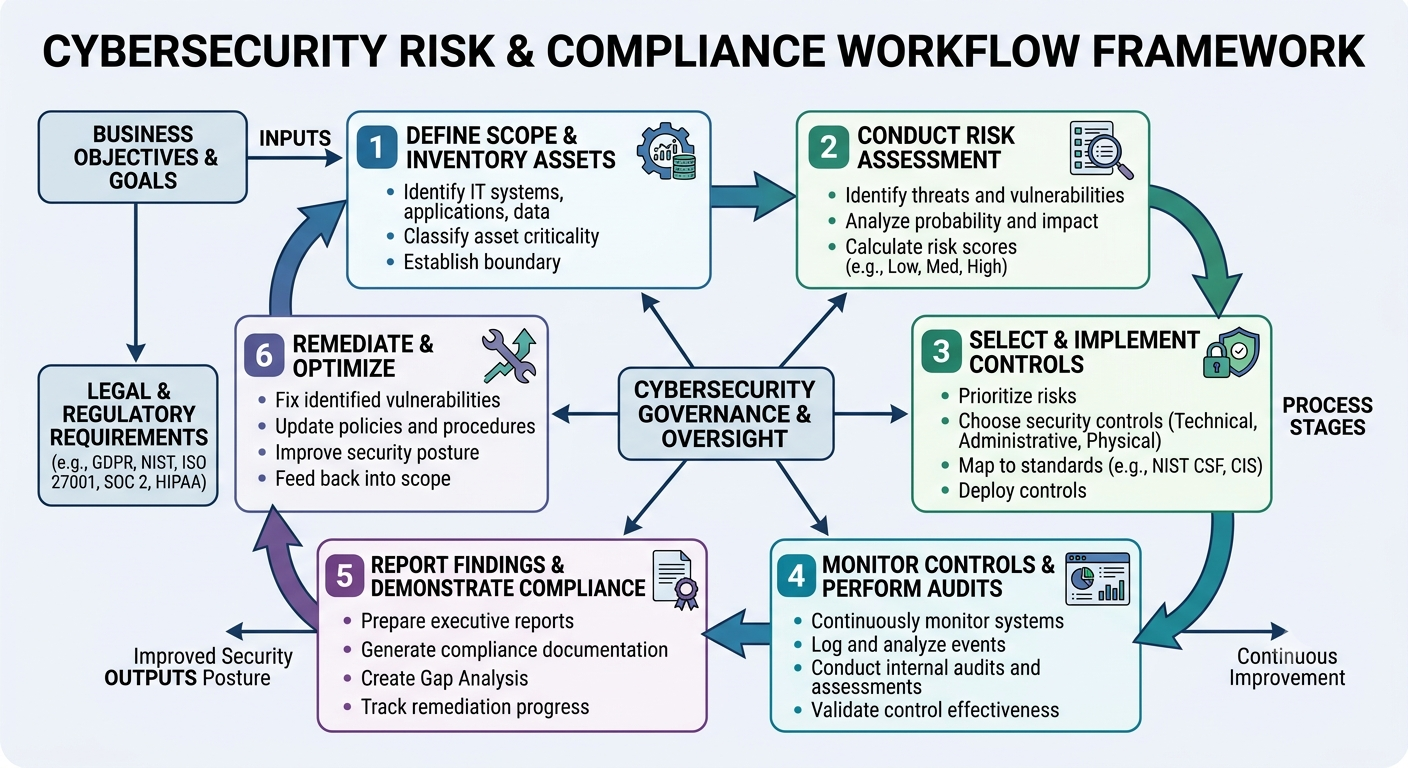
Cybersecurity GRC workflow

Structured Risk & Compliance Assessment Model

A seven-phase approach connecting project requirements, risk identification, control mapping, gap analysis, remediation, evidence, and governance reporting.

Cybersecurity risk and compliance workflow showing the relationship between governance, risk identification, framework and control mapping, gap analysis, remediation, audit evidence, and governance reporting
Cybersecurity risk and compliance workflow connecting requirements and scope with risk assessment, control mapping, gap analysis, remediation, evidence, and governance reporting.

Consultancy scope

Technical scope and expected outcomes.

Guidance can be structured around a defined cybersecurity risk project, compliance case study, audit requirement, governance problem, regulatory framework, or security policy assignment.

Consultancy FocusKey Technical ModulesTarget Deliverables & Outcomes
Cybersecurity Risk AssessmentAsset identification, threat analysis, vulnerability assessment, likelihood and impact scoring, risk matrices, risk registers, and risk treatment planning.Structured risk registers, qualitative risk matrices, quantitative calculations, treatment plans, and documented risk assumptions.
Security Framework MappingNIST CSF 2.0, NIST SP 800-53, NIST SP 800-171, ISO/IEC 27001, ISO/IEC 27002, and CIS Controls.Control crosswalks, maturity assessments, gap analysis, control rationales, and implementation recommendations.
Regulatory ComplianceGDPR, HIPAA, PCI DSS, CCPA/CPRA, GLBA, FISMA, FedRAMP, and CMMC concepts.Compliance matrices, regulatory gap assessments, scope definitions, evidence requirements, and remediation priorities.
IT Auditing & AssuranceAudit planning, control testing, evidence gathering, deficiency identification, SOC reporting concepts, and audit workpapers.Audit programs, evidence matrices, control-testing documentation, findings, recommendations, and readiness assessments.
Third-Party Risk ManagementVendor assessments, supply-chain risk, security questionnaires, SOC 2 review, contractual security requirements, and risk scoring.Vendor risk registers, assessment questionnaires, control mappings, security requirements, and risk treatment recommendations.
Security Governance & PoliciesInformation security policies, access control, acceptable use, incident response, business continuity, disaster recovery, and governance structures.Policy frameworks, governance documentation, control ownership models, RTO/RPO analysis, and security KPI/KRI structures.

Core competencies

From abstract compliance requirements to defensible security decisions.

Effective GRC analysis requires translating broad governance and regulatory requirements into practical risk statements, controls, evidence, ownership, and measurable remediation activities.

NIST & ISO Control Mapping

Structured guidance for mapping security requirements across NIST CSF 2.0, NIST SP 800-53, NIST SP 800-171, ISO/IEC 27001, ISO/IEC 27002, and related control frameworks.

Quantitative & Qualitative Risk Analysis

Work through risk matrices, risk registers, likelihood-impact scoring, SLE, ARO, ALE, mitigation value, and other quantitative or qualitative risk-analysis approaches.

Compliance Gap Assessment

Identify gaps between an organization or case-study environment and the requirements of a selected regulatory or governance framework, then structure practical remediation priorities.

IT Audit & Assurance

Understand audit planning, evidence collection, control testing, deficiency classification, audit findings, and readiness assessments for academic and professional case studies.

Third-Party & Supply-Chain Risk

Analyse vendor security questionnaires, SOC reports, contractual requirements, cloud-provider risks, supply-chain dependencies, and third-party control effectiveness.

Security Governance & Policy

Develop structured approaches to information security policies, incident response, business continuity, disaster recovery, access governance, and security accountability.

Frameworks & standards

Recognized frameworks across cybersecurity governance and compliance.

The appropriate framework depends on the project scope, industry, jurisdiction, organizational context, and academic requirements. Guidance can help you understand how different standards overlap and where their purposes differ.

NIST CSF 2.0 & NIST SP 800 Series

  • NIST Cybersecurity Framework 2.0
  • NIST SP 800-53 Rev. 5
  • NIST SP 800-30
  • NIST SP 800-61 concepts
  • NIST SP 800-171

ISO & CIS Security Standards

  • ISO/IEC 27001:2022
  • ISO/IEC 27002
  • ISO 27001 Statement of Applicability
  • CIS Controls v8
  • Security maturity and gap assessments

Privacy & Regulatory Frameworks

  • GDPR
  • HIPAA
  • PCI DSS
  • CCPA / CPRA
  • GLBA
  • FISMA and FedRAMP concepts

Audit & Assurance

  • SOC 1
  • SOC 2 Type I and Type II
  • SOC 3
  • AICPA Trust Services Criteria
  • Control testing and evidence analysis

Seven-phase methodology

A repeatable framework for risk and compliance analysis.

Cybersecurity GRC projects become easier to defend when each conclusion can be traced back to project scope, risk assumptions, control requirements, evidence, and documented treatment decisions.

01

Requirements, Scope & Context

Establishing the business, technical, regulatory, and academic context of the project. This includes identifying the systems, assets, stakeholders, jurisdictions, frameworks, and assessment boundaries that matter.

02

Asset, Threat & Risk Identification

Identifying relevant assets, threats, vulnerabilities, business impacts, and risk scenarios. Qualitative and quantitative techniques can then be selected according to the requirements of the project.

03

Framework & Control Mapping

Mapping identified security requirements to appropriate frameworks such as NIST CSF 2.0, NIST SP 800-53, ISO/IEC 27001, CIS Controls, or a relevant regulatory standard.

04

Gap & Maturity Analysis

Comparing the current-state security posture against the desired controls or compliance requirements to identify gaps, weaknesses, maturity limitations, and evidence deficiencies.

05

Risk Treatment & Remediation

Evaluating risk acceptance, avoidance, mitigation, and transfer options while prioritising remediation according to likelihood, impact, business objectives, regulatory requirements, and available resources.

06

Evidence, Audit & Assurance

Structuring evidence requirements, control-testing procedures, audit observations, deficiency statements, and supporting documentation so that conclusions are traceable to the assessment criteria.

07

Reporting & Governance

Transforming the analysis into clear risk registers, compliance matrices, audit findings, policy documents, executive summaries, remediation roadmaps, and governance recommendations.

Risk analysis

Quantitative and qualitative risk modelling.

Risk assignments frequently require students to move between qualitative risk matrices and quantitative financial models. We provide structured guidance on the assumptions, formulas, calculations, and interpretation behind both approaches.

Asset Value

$2,000,000

Sensitive customer database

Initial Exposure Factor

0.40

Estimated 40% loss exposure

Initial ARO

0.50

Estimated occurrence once every two years

Annual Control Cost

$15,000

Illustrative security-control cost

Mitigated Exposure Factor

0.05

Estimated residual exposure

Mitigated ARO

0.10

Reduced annual occurrence estimate

Illustrative quantitative risk model

Working through ALE before and after security controls.

The following example illustrates how a risk assessment can compare estimated annualized loss before and after controls. Values are illustrative and should be replaced with the assumptions specified by the relevant assignment or case study.

1. Initial risk

Single Loss Expectancy is calculated as Asset Value multiplied by Exposure Factor.

SLE = AV × EF
SLE = $2,000,000 × 0.40
SLE = $800,000

Annualized Loss Expectancy is then calculated using the Annual Rate of Occurrence.

ALE = SLE × ARO
ALE = $800,000 × 0.50
ALE = $400,000

2. Residual risk after controls

After applying the illustrative security controls, the estimated exposure factor falls to 0.05 and ARO falls to 0.10.

SLE = $2,000,000 × 0.05
SLE = $100,000

ALE = $100,000 × 0.10
ALE = $10,000

The estimated gross mitigation value is therefore $390,000 before considering the annual control cost.

3. Illustrative cost-benefit analysis

Gross Mitigation Value = $400,000 − $10,000
Gross Mitigation Value = $390,000

Net Annual Benefit = $390,000 − $15,000
Net Annual Benefit = $375,000

This type of calculation can help explain why a proposed security control may be economically justified. In a real assessment, the assumptions, uncertainty, control costs, and limitations should also be documented.

Governance & policy

Turning risk analysis into practical governance.

Cybersecurity compliance is not limited to technical controls. Strong governance connects policies, accountability, resilience, risk decisions, and executive oversight.

Policy Development

Information security policies, acceptable use, access control, data classification, password management, vendor security, and incident response documentation.

Business Continuity & Disaster Recovery

Business Impact Analysis, recovery priorities, RTO, RPO, MTO, continuity strategies, disaster recovery procedures, and resilience planning.

Risk Treatment

Risk acceptance, avoidance, mitigation, and transfer decisions supported by documented business rationale and residual-risk analysis.

Governance Reporting

Board-level reporting concepts, CISO metrics, key performance indicators, key risk indicators, steering-committee oversight, and security accountability.

Example GRC scenarios

Practical cybersecurity risk and compliance case studies.

GRC coursework often becomes clearer when abstract requirements are applied to a realistic business scenario. The following examples illustrate the types of problems we can help you analyse.

Scenario A: Cloud Storage Risk Assessment

Analyse the annualized loss expectancy associated with a sensitive cloud database before and after security controls, then compare the estimated mitigation benefit against control cost.

Scenario B: ISO 27001 to NIST CSF Crosswalk

Construct a control-mapping approach that relates ISO/IEC 27001:2022 security controls to appropriate NIST CSF 2.0 functions and categories while explaining areas of overlap and difference.

Scenario C: Enterprise Incident Response Policy

Structure an incident response policy around preparation, detection and analysis, containment, eradication, recovery, and post-incident activities, with severity classifications and escalation procedures.

What makes GRC work difficult?

Why cybersecurity risk and compliance coursework can be challenging.

GRC projects require students to move between strategic business considerations and detailed technical requirements. Several recurring challenges make these assignments particularly demanding.

Overlapping Regulatory Frameworks

GDPR, HIPAA, PCI DSS, CCPA/CPRA, FISMA, and other frameworks have different scopes, terminology, obligations, and applicability requirements.

Abstract Control Mapping

Translating high-level requirements into concrete security controls, evidence, ownership, and measurable implementation activities requires careful analysis.

Quantitative vs Qualitative Risk

Risk matrices, ALE calculations, FAIR concepts, and likelihood-impact models require different assumptions and analytical approaches.

Policy & Documentation Standards

Security policies, system security plans, audit reports, risk registers, and incident response documents need consistent structure and traceability.

Academic & professional guidance

Risk and compliance analysis grounded in recognized practices.

Cybersecurity GRC assignments often require more than naming a standard. Strong work explains why a framework applies, how requirements map to controls, what evidence demonstrates implementation, and how identified gaps should be treated.

NIST CSF 2.0 governance and risk principles
ISO/IEC 27001 information security management
NIST SP 800 security control concepts
CIS Controls and security hygiene
SOC 2 Trust Services Criteria
Risk assessment and audit methodologies

Frequently asked questions

Cybersecurity risk and compliance guidance.

Common questions about risk assessments, compliance frameworks, control mapping, auditing, governance, and cybersecurity policy projects.

What types of cybersecurity risk and compliance assignments do you support?

We provide structured guidance across quantitative and qualitative risk assessments, regulatory gap analysis, NIST and ISO control mapping, enterprise security policies, SOC 2 readiness analysis, third-party risk management, business continuity, disaster recovery, and cybersecurity governance projects.

Can you help me develop an information security policy for a case study?

Yes. Guidance can cover Acceptable Use Policies, Access Control Policies, Data Classification Standards, Vendor Risk Management policies, Incident Response Plans, Business Continuity Plans, and other governance documents tailored to the scenario and assignment requirements.

Do you provide step-by-step calculations for quantitative risk assessments?

Yes. We can explain calculations involving Asset Value, Exposure Factor, Single Loss Expectancy, Annual Rate of Occurrence, Annualized Loss Expectancy, mitigation value, and cost-benefit analysis, together with the assumptions behind the calculations.

Can you help map ISO 27001 controls to the NIST Cybersecurity Framework?

Yes. We can provide guidance on constructing crosswalks between ISO/IEC 27001:2022 controls and NIST CSF 2.0 functions and categories, including explanations for areas of overlap and differences in scope.

Can you help with GDPR, HIPAA, PCI DSS, or other regulatory compliance projects?

Yes. We can help interpret the requirements relevant to an academic case study and structure compliance matrices, gap assessments, control mappings, risk analyses, and supporting documentation. The exact regulatory requirements should always be validated against the applicable jurisdiction and current official guidance.

How do you ensure the guidance matches my university rubric?

The assignment prompt, case study and grading rubric can be used as the basis for structuring the guidance. We can help identify required sections, map them to the relevant framework or methodology, and check whether the proposed analysis addresses the stated assessment criteria.

Let's make your work clearer

Bring us the difficult part.

Tell us what you're researching, building, or trying to understand. We'll help you find the clearest ethical next move.

Get Guidance
Chat with us on WhatsApp