Working in C: Myths vs Truth
C has a reputation.
It is sometimes called too difficult for beginners, too old to matter, nothing more than a language for low-level programmers, or even a language where every program eventually becomes a memory bug.
There is some history behind those opinions. C gives programmers a level of control that many modern languages deliberately hide. With that control comes responsibility.
But the common picture of C is often much more extreme than reality.
C is still used to build operating systems, embedded devices, networking software, databases, compilers, runtimes, security tools, and performance-critical applications. More importantly, learning C exposes ideas that are easy to overlook when a language manages most of the machine for the programmer.
The better question is therefore not:
"Is C good or bad?"
The useful question is:
"What is actually true about working in C?"
This article separates common C programming myths from practical reality and explains what a modern C development workflow really looks like.
C in one sentence
C is a compiled, general-purpose programming language that gives programmers relatively direct control over memory, data representation, and system resources while remaining portable across many kinds of hardware.
That combination explains both C's strengths and many of its challenges.
C does not automatically make a program fast, safe, or efficient. It gives the programmer tools and control that can be used to build those properties deliberately.
Myth 1: C Is an Outdated Language
Truth: C is old, but it is far from irrelevant
C was developed in the 1970s. That makes it older than many languages commonly taught today.
But age and relevance are not the same thing.
C remains deeply embedded in modern computing because large parts of the software stack depend on properties that C provides:
- predictable data representation
- direct memory access
- small runtime requirements
- high performance
- portability
- the ability to interact closely with hardware
- mature compilers and tooling
- decades of existing libraries and codebases
C appears in operating-system components, firmware, embedded systems, networking software, storage systems, databases, language runtimes, and many other infrastructure projects.
A useful way to think about C is that it is part of the foundation layer of computing.
Modern applications may be written in Python, JavaScript, Java, Go, Rust, C++, or other languages while still depending indirectly on software written in C.
That does not mean every new project should be written in C.
It means that understanding C remains useful because C occupies an important position close to the machine.
Myth 2: C Is Only Used for Operating Systems
Truth: systems programming is important, but C has a much wider footprint
Operating systems are one of the most famous areas where C is used, but they are only part of the picture.
C is also common in:
Embedded systems
Microcontrollers and devices often have strict limits on memory, processing power, storage, and energy.
C is well suited to these environments because programs can operate with relatively little runtime overhead.
Networking
Networking stacks and high-performance networking components often require careful control over buffers, memory, data structures, and I/O.
Databases
Database engines need efficient storage, indexing, caching, memory management, and concurrency mechanisms. C has long been used for this kind of software.
Compilers and runtimes
Programming-language implementations often contain components written in C because the language provides efficient access to low-level facilities.
Scientific and performance-oriented software
C can also be used where predictable performance and control over data representation matter.
Security software
Security tools frequently need to inspect binary data, interact with operating-system APIs, process network packets, or work with cryptographic primitives.
So the better statement is:
C is especially valuable when software needs close control over resources, but its use is not limited to operating systems.
Myth 3: C Automatically Produces Fast Programs
Truth: C makes high performance possible; it does not guarantee it
This distinction is extremely important.
C gives programmers considerable control over:
- memory layout
- data structures
- allocation
- copying
- loops
- I/O
- system calls
- interaction with hardware
That can make highly optimized software possible.
But a badly designed C program can still be slow.
For example, an inefficient algorithm remains inefficient regardless of programming language.
Consider a program that repeatedly searches a large array when a hash table or indexed structure would be more appropriate. Rewriting the same algorithm in C does not magically solve the underlying problem.
Performance depends on several layers:
Algorithm
   ↓
Data structures
   ↓
Memory access patterns
   ↓
Compiler optimization
   ↓
CPU and hardware
   ↓
Operating system and I/O
C gives the programmer influence over several of these layers, but it does not remove the need for good engineering.
Truth: C provides a strong performance-oriented foundation. Good performance still requires good algorithms, data structures, architecture, profiling, and careful implementation.
Myth 4: Pointers Make C Impossible to Learn
Truth: pointers are difficult at first, but they become understandable
Pointers are probably the most intimidating C concept for beginners.
A pointer stores an address.
For example:
int value = 42;
int *ptr = &value;
Here:
valuestores42&valuemeans "the address ofvalue"ptrstores that address*ptraccesses the value stored at that address
The important conceptual shift is to stop treating pointers as mysterious symbols.
Think in terms of:
Variable
   ↓
Memory location
   ↓
Address
   ↓
Pointer
Once this mental model becomes comfortable, pointers become much less mysterious.
Pointers are also useful because they allow C programs to work with:
- arrays
- dynamically allocated memory
- strings
- structures
- buffers
- function callbacks
- linked data structures
- memory-mapped resources
The difficulty is real, but "impossible" is an exaggeration.
A good learning progression is:
- variables
- addresses
- pointers
- arrays
- strings
- structures
- dynamic memory
- function pointers
Learning these concepts in isolation first is usually easier than attempting complex pointer-heavy programs immediately.
Myth 5: Every C Program Has to Manually Manage Everything
Truth: C gives manual control, but programs can still be structured and disciplined
C does not provide automatic garbage collection in the way languages such as Java or Python do.
When dynamically allocated memory is no longer needed, a C program generally needs to release it explicitly.
For example:
int *numbers = malloc(10 * sizeof(int));

if (numbers != NULL) {
    /* use numbers */
    free(numbers);
}
That responsibility is real.
But professional C programming is not simply a matter of scattering malloc() and free() throughout a codebase.
Good C projects establish clear ownership rules.
For example:
Function A allocates
        ↓
Function B owns
        ↓
Function B releases
Or:
Caller owns memory
        ↓
Callee only borrows it
The exact conventions depend on the project.
This is one of the most important lessons in C:
Memory management is not just about allocation. It is about ownership.
Once ownership is clear, memory management becomes much more predictable.
Myth 6: C Has No Safety
Truth: C provides fewer built-in safety guarantees than many modern languages
This myth contains an important piece of truth, but it is often overstated.
C gives programmers considerable freedom, including freedom that can lead to serious mistakes.
Common problems include:
- buffer overflows
- use-after-free
- double-free errors
- uninitialized memory
- invalid pointer access
- integer overflow
- out-of-bounds access
- data races in concurrent programs
The language itself does not automatically prevent all of these problems.
However, modern C development does not have to mean "write code and hope."
Developers can use:
- compiler warnings
- static analysis
- sanitizers
- unit tests
- fuzz testing
- code review
- debugging tools
- secure coding guidelines
- automated CI pipelines
A modern workflow can therefore look like:
Write code
   ↓
Compile with strong warnings
   ↓
Run tests
   ↓
Run sanitizers/static analysis
   ↓
Review changes
   ↓
Run CI
   ↓
Deploy
The correct conclusion is not that C is inherently unusable.
The correct conclusion is:
C requires stronger engineering discipline because the language exposes more opportunities for programmer error.
Myth 7: You Need to Understand Assembly Before Learning C
Truth: assembly knowledge helps, but it is not a prerequisite
C sits relatively close to hardware, so understanding assembly can eventually be valuable.
It can help explain:
- registers
- calling conventions
- stack frames
- instructions
- CPU operations
- compiler output
But a beginner does not need to understand assembly before writing useful C programs.
A sensible progression is:
Programming fundamentals
        ↓
C syntax and control flow
        ↓
Functions and data structures
        ↓
Pointers and memory
        ↓
Compilation and linking
        ↓
Operating-system concepts
        ↓
Assembly and machine-level details
Assembly becomes more useful after the foundations are established.
It should not be treated as an entrance exam for learning C.
Myth 8: C Code Is Always Difficult to Read
Truth: poorly designed C can be difficult; well-designed C can be surprisingly clear
C provides relatively few language features compared with large modern languages.
That can actually be an advantage.
A small function such as:
int add(int a, int b)
{
    return a + b;
}
is immediately understandable.
Problems usually appear when code lacks structure.
For example, a large function that mixes:
- input validation
- memory allocation
- file operations
- business logic
- error handling
- logging
- cleanup
can become difficult to understand in any language.
Readable C benefits from familiar engineering practices:
Use meaningful names
Prefer:
user_count
over:
x
when the meaning is important.
Keep functions focused
A function should have a clear responsibility.
Make ownership visible
If a function allocates or frees memory, the ownership expectations should be clear.
Keep error handling explicit
C often requires explicit error checking. That can make code longer, but it also makes failure paths visible.
Avoid cleverness
Readable code is generally more valuable than code that demonstrates obscure language tricks.
Myth 9: C Has No Modern Development Tools
Truth: the C tooling ecosystem is mature
C may be an old language, but the development environment around it is not frozen in time.
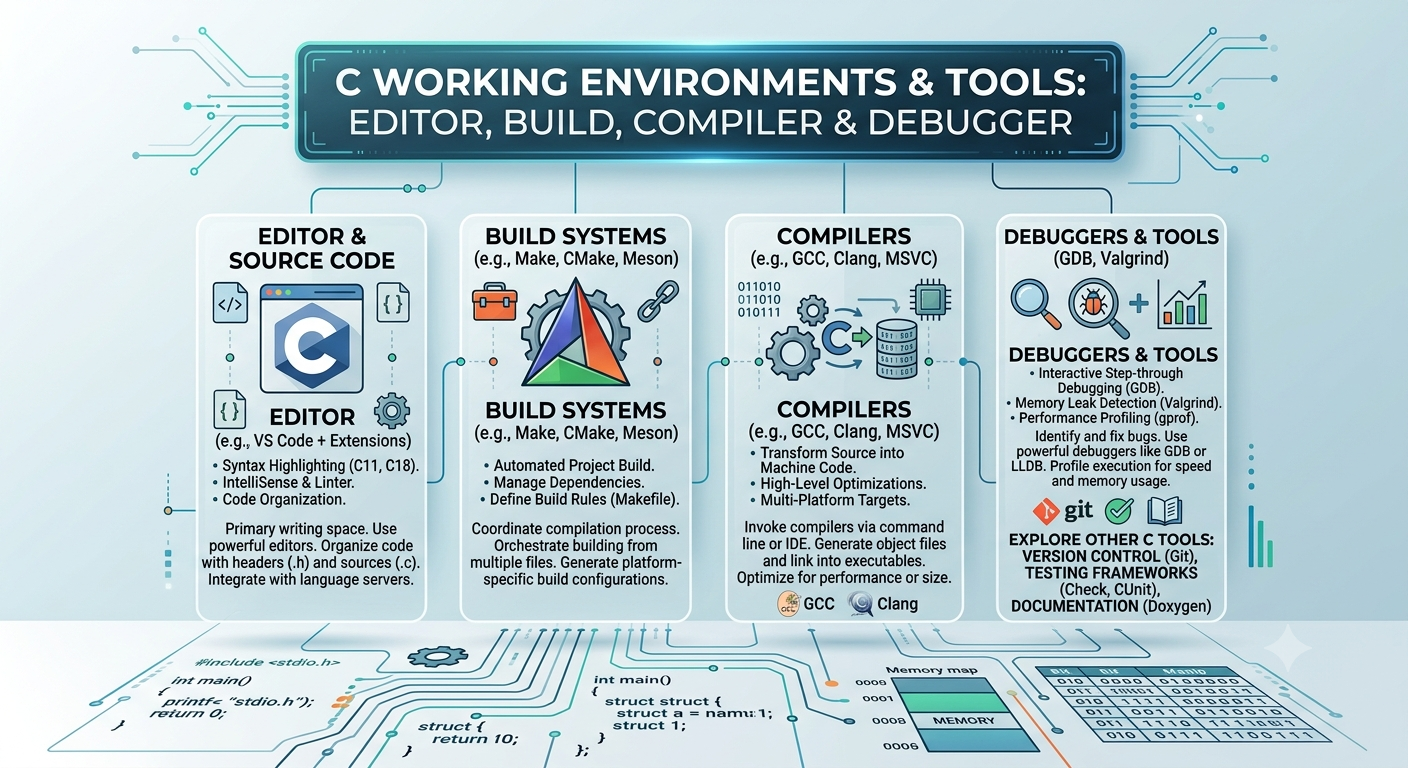
A modern C project can use:
- GCC
- Clang
- CMake
- Make
- Ninja
- Git
- debuggers
- static analyzers
- sanitizers
- IDEs and code editors
- CI/CD systems
- test frameworks
- formatters and linters
A developer can work in an editor such as VS Code and have:
Source code
   ↓
Compiler
   ↓
Build system
   ↓
Tests
   ↓
Static analysis
   ↓
CI
This is very different from the stereotype of editing a .c file and manually typing a compiler command every time.
The language may be old. The workflow does not have to be.
Myth 10: C and C++ Are Basically the Same
Truth: they are related, but they are different languages
C++ grew historically from C, and the two languages share many concepts and syntax patterns.
But modern C and modern C++ have significantly different language features, design philosophies, libraries, and development practices.
C focuses on a relatively small core language and procedural programming.
C++ provides a much larger language with features such as:
- classes
- templates
- exceptions
- operator overloading
- RAII
- extensive standard-library facilities
- multiple programming paradigms
Code that looks similar at first glance can behave differently between the languages.
It is therefore useful to treat:
C ≠ C++
Learning one can make learning the other easier, but the two should not be treated as interchangeable.
Myth 11: C Is Only for Experts
Truth: beginners can learn C, but the learning curve exposes important concepts
C is not necessarily the easiest first language.
A beginner may encounter concepts such as:
- compilation
- linking
- pointers
- memory layout
- header files
- declarations
- undefined behavior
- data representation
earlier than in languages that hide these details.
That can be challenging.
But it can also be educational.
A programmer who learns C carefully develops a stronger mental model of questions such as:
- Where does this value live?
- How much memory does this object use?
- What does this pointer point to?
- Who owns this memory?
- What happens when this function returns?
- What does the compiler actually produce?
- How are separate source files combined?
These questions are valuable beyond C.
So C should not be described as "only for experts."
A better description is:
C is accessible to beginners, but it rewards deliberate learning and strong fundamentals.
Myth 12: C Is Unsafe Because the Language Is Badly Designed
Truth: C deliberately prioritizes control and minimal abstraction
Many criticisms of C become clearer when its original design goals are considered.
C was designed in an era when:
- hardware resources were limited
- operating systems needed efficient implementations
- portability mattered
- programmers needed relatively direct access to machines
- compiler technology was much less sophisticated
The language therefore avoids automatically imposing many abstractions.
That design has consequences.
More control means more responsibility.
A useful analogy is driving a manual vehicle: more direct control can be valuable, but it also requires more decisions from the operator.
Modern languages often move some of those decisions into the language runtime or compiler.
C leaves more of them to the programmer.
Neither approach is universally correct. The right choice depends on the problem.
What Working in C Actually Feels Like
After separating the myths from reality, the day-to-day experience of C development becomes easier to understand.
A typical workflow might look like this:
1. Write source files
A project may contain files such as:
src/
    main.c
    parser.c
    network.c

include/
    parser.h
    network.h
The .c files contain implementations, while .h files commonly expose declarations and interfaces.
2. Compile
A compiler translates C source into object code.
Conceptually:
main.c
parser.c
network.c
    ↓
Compiler
    ↓
Object files
3. Link
The linker combines object files and required libraries into an executable or another binary artifact.
Object files + Libraries
          ↓
       Linker
          ↓
      Executable
This compilation-and-linking model is one of the fundamental differences between working in C and using many interpreted or runtime-heavy environments.
4. Run tests
Tests check expected behavior and help catch regressions.
5. Debug
When something goes wrong, developers may inspect:
- variables
- stack frames
- memory
- function calls
- program state
6. Analyze
Static analysis and sanitizers can identify classes of problems that ordinary tests might miss.
7. Review and integrate
Changes move through version control, code review, automated tests, and CI.
That is modern C development.
It is not simply:
write code → compile → hope
The Most Important C Concepts to Understand
Someone beginning C does not need to memorize the entire language.
A stronger approach is to understand the concepts underneath the syntax.
Variables and types
Understand what types represent and how values are stored.
int age = 30;
double temperature = 21.5;
char initial = 'A';
Functions
Understand parameters, return values, scope, and lifetime.
Arrays
Understand that an array represents a contiguous collection of elements.
Pointers
Understand addresses and indirect access.
Strings
Understand that C strings are conventionally represented as arrays of characters terminated by a null character.
Structures
Structures allow related pieces of data to be grouped together.
struct User {
    int id;
    char name[50];
};
Dynamic memory
Understand allocation, ownership, lifetime, and cleanup.
Compilation
Understand the difference between source code, preprocessing, compilation, object files, and linking.
Undefined behavior
This is particularly important.
C does not define meaningful behavior for every operation a programmer might write. Some invalid operations can produce unpredictable results.
Learning to recognize and avoid undefined behavior is part of becoming a competent C programmer.
Why C Still Matters for Modern Programmers
Even developers who never plan to become full-time C programmers can benefit from learning it.
C helps make several normally hidden concepts visible.
In a high-level language, a programmer might write:
items.append(value)
and never need to think about the underlying storage strategy.
In C, implementing a dynamic collection can require thinking about:
- memory allocation
- capacity
- resizing
- pointers
- copying
- ownership
That extra work can reveal what higher-level abstractions are doing underneath.
C can therefore act as a computer science microscope.
It does not merely teach syntax. It exposes the relationship between:
Source code
     ↓
Compiler
     ↓
Machine code
     ↓
Memory
     ↓
CPU
     ↓
Operating system
     ↓
Running program
That understanding can transfer to many other areas of software engineering.
When C Is a Good Choice
C is particularly attractive when a project needs some combination of:
- predictable resource usage
- low-level control
- high performance
- small runtime requirements
- hardware interaction
- portability
- mature tooling
- integration with existing C libraries
Examples include:
- embedded software
- operating-system components
- device drivers and low-level system components
- networking infrastructure
- databases and storage engines
- compilers and runtimes
- performance-sensitive libraries
When C May Not Be the Best Choice
C is not automatically the right language for every project.
A higher-level language may be a better fit when the priority is:
- rapid application development
- extensive built-in abstractions
- automatic memory management
- a large application framework
- minimizing memory-safety risks
- building a typical web application quickly
The right engineering question is not:
"Can this be written in C?"
Almost anything can be.
The better question is:
"Does C provide advantages that justify its additional complexity and responsibility for this particular system?"
That question leads to better technology decisions.
A Practical Learning Path for C
For someone learning C today, a sensible sequence is:
Stage 1: Fundamentals
Learn:
- variables
- types
- operators
- conditions
- loops
- functions
Stage 2: Core data structures
Learn:
- arrays
- strings
- structures
- enumerations
- pointers
Stage 3: Memory
Learn:
- stack and heap concepts
- dynamic allocation
- ownership
- lifetime
malloc()calloc()realloc()free()
Stage 4: Multi-file programs
Learn:
- header files
- declarations
- definitions
- separate compilation
- linking
Stage 5: Tooling
Learn:
- compiler warnings
- debugger usage
- Git
- build systems
- tests
- sanitizers
- static analysis
Stage 6: Systems concepts
Then explore:
- processes
- files
- sockets
- concurrency
- operating-system APIs
- memory layout
- performance profiling
This progression avoids one of the most common mistakes in C education: jumping into complicated systems code before understanding the language's basic memory model.
C Myths vs Truth: Quick Reference
| Myth | Truth | |---|---| | C is outdated | C is old but remains important in modern systems | | C is only for operating systems | It is also used in embedded, networking, databases, runtimes, and more | | C automatically makes programs fast | C enables performance; algorithms and design still matter | | Pointers are impossible | Pointers are difficult initially but become manageable with a memory model | | C has no safety tools | Modern C uses compilers, sanitizers, static analysis, tests, and reviews | | You must know assembly first | Assembly helps later but is not required to start | | C code is always unreadable | Good structure and naming can make C quite clear | | C has no modern tooling | The ecosystem includes mature compilers, build systems, debuggers, CI, and analysis tools | | C and C++ are the same | They are related but distinct languages | | C is only for experts | Beginners can learn it with a structured approach | | C is inherently useless for modern applications | Its strengths remain valuable in the right problem domains |
Final Takeaway
The biggest myth about C is perhaps that it must be either great or terrible.
Neither view is particularly useful.
C is a language that gives programmers substantial control while placing substantial responsibility on them.
That trade-off explains almost everything about working in C.
It can be:
- fast
- portable
- small
- predictable
- close to hardware
- extremely powerful
It can also require careful attention to:
- memory
- pointers
- ownership
- undefined behavior
- security
- error handling
- testing
The goal should not be to memorize every C feature.
The goal is to understand the underlying model well enough to answer questions such as:
Where is this data stored?
Who owns this memory?
What happens when this function returns?
What does the compiler do with this code?
What happens when this pointer is invalid?
How can this program be tested and analyzed before it reaches production?
Once those questions become natural, C stops looking like a collection of dangerous tricks and starts looking like what it really is:
a small language that gives programmers a remarkably direct way to build software close to the machine.