TECHNOLOGIES • NETWORKING • INFRASTRUCTURE

Networking & Infrastructure

Explore computer networking, TCP/IP, subnetting, routing, switching, Linux, Docker, virtualization, cloud infrastructure, system administration, network security, and troubleshooting.

Get structured network assignment help and networking project guidance focused on understanding requirements, developing sound technical solutions, testing implementations, and documenting networking and infrastructure work.

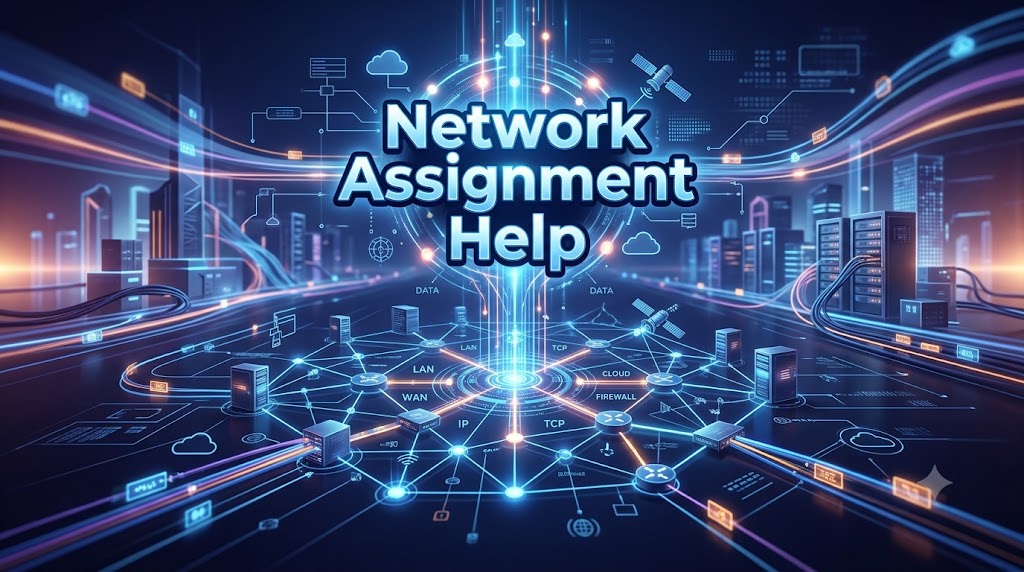
Computer networking and infrastructure technology illustration showing connected systems, servers, cloud services, routers, and network architecture

NETWORKING & INFRASTRUCTURE

Modern computing depends on systems being able to communicate.

Networking provides the communication layer through which computers, applications, servers, cloud services, containers, and other infrastructure components exchange information.

Computer networking involves much more than connecting two machines. Strong networking work requires an understanding of addressing, protocols, routing, switching, network services, infrastructure, security, and the technical requirements of the systems communicating across the network.

For students working on networking assignments and projects, this means that a strong solution often requires more than a collection of definitions. Network design, subnetting, protocol analysis, Linux administration, Docker networking, cloud infrastructure, troubleshooting, security controls, testing, and technical documentation may all form part of the work.

NETWORKING TECHNOLOGIES

Explore the technologies that connect modern computing systems.

Explore individual networking and infrastructure technologies through focused topic pages covering concepts, implementation, architecture, troubleshooting, and academic project applications.

TCP/IP & Internet Protocols

Explore TCP/IP & Internet Protocols

Explore the protocols and layered architecture that allow computers, applications, networks, and internet-connected systems to communicate.

Common areas: TCP/IP model, IPv4, IPv6, TCP, UDP, ICMP, ARP, ports, sockets, packet communication

Routing & Switching

Explore Routing & Switching

Understand how routers and switches forward traffic and connect devices and networks within local and distributed infrastructure.

Common areas: Routers, switches, MAC addresses, routing tables, static routing, dynamic routing, VLANs, segmentation

Study essential network services that provide name resolution, automatic network configuration, and reliable communication between systems.

Common areas: DNS, DHCP, IP addressing, name resolution, leases, records, network configuration, client-server communication

Explore Linux as an operating-system and infrastructure platform for servers, network services, development environments, and technical administration.

Common areas: Linux fundamentals, processes, services, permissions, SSH, networking commands, logs, package management

Docker & Containers

Explore Docker & Containers

Understand container-based application deployment and the infrastructure concepts required to build, connect, manage, and troubleshoot containerized systems.

Common areas: Docker images, containers, Dockerfiles, volumes, container networking, registries, deployment, isolation

Cloud Infrastructure

Explore Cloud Infrastructure

Explore infrastructure concepts used by modern cloud environments, including virtual networks, compute resources, storage, security, and scalable deployment.

Common areas: Cloud computing, VPCs, subnets, compute, storage, security groups, load balancing, cloud deployment

Understand how virtualization abstracts physical computing resources to create flexible environments for servers, applications, testing, and infrastructure deployment.

Common areas: Virtual machines, hypervisors, virtual networking, resource allocation, snapshots, infrastructure environments

Network Security

Explore Network Security

Explore the principles and technologies used to protect networks, infrastructure, services, and communications from unauthorized access and disruption.

Common areas: Firewalls, access control, segmentation, secure protocols, authentication, encryption, monitoring

Network Troubleshooting

Explore Network Troubleshooting

Develop systematic approaches to diagnosing connectivity, configuration, DNS, routing, service, and infrastructure problems.

Common areas: Ping, traceroute, ip, ss, nslookup, dig, packet analysis, logs, connectivity testing, diagnostics

System Administration

Explore System Administration

Explore the operational practices required to configure, maintain, monitor, secure, and troubleshoot computing infrastructure.

Common areas: Servers, users, permissions, services, monitoring, backups, remote administration, maintenance

CORE NETWORKING CONCEPTS

The concepts underneath network communication.

Learning networking involves more than memorizing protocol names or device functions. Strong networking work depends on understanding how systems are addressed, how traffic moves, how services communicate, and how networks are designed and protected.

Network Architecture & Models

Understand how communication is structured through layered networking models, including the OSI and TCP/IP models, and how different technologies operate at different layers.

IP Addressing & Subnetting

Work with IPv4 and IPv6 addressing, subnet masks, CIDR notation, network and host portions, address ranges, and the principles used to divide networks into logical segments.

Protocols & Communication

Explore TCP, UDP, HTTP, HTTPS, DNS, DHCP, ICMP, ARP, and other protocols that support communication between systems, applications, and network services.

Routing & Switching

Understand how packets move between networks, how switches forward traffic within local networks, and how routing decisions determine paths between different network segments.

Network Security

Explore firewalls, access control, segmentation, secure protocols, authentication, encryption, network monitoring, and the principles used to protect networked systems.

Network Troubleshooting

Develop systematic approaches to diagnosing connectivity, configuration, DNS, routing, service, performance, and infrastructure problems using appropriate tools and evidence.

NETWORKING ASSIGNMENT HELP & PROJECT GUIDANCE

Technical guidance should explain the reasoning behind the solution.

Networking assignments and projects often require students to connect theoretical concepts with practical infrastructure decisions. A strong approach therefore considers requirements, architecture, implementation, testing, and technical justification together.

Network assignment help may involve understanding a problem statement, identifying the relevant networking concepts, designing an appropriate solution, working through calculations or configurations, testing the result, and explaining why the selected approach satisfies the requirements.

The same principle applies to larger networking projects. A technically valid configuration is only one part of a strong project. Architecture, security, reliability, troubleshooting evidence, documentation, and the ability to communicate technical decisions can all affect the quality of the final work.

Network requirements analysis
Network topology and architecture design
IP addressing and subnet planning
Routing and switching concepts
TCP/IP protocol analysis
DNS and DHCP configuration
Linux server and system administration
SSH and remote system management
Docker and container networking
Virtualization and infrastructure management
Cloud network and infrastructure design
Firewall and network access control
Network monitoring and troubleshooting
Infrastructure documentation and technical explanation

NETWORKING PROJECT WORKFLOW

From requirements to a tested infrastructure environment.

A disciplined networking workflow separates requirements, architecture, implementation, testing, troubleshooting, and evaluation so that technical decisions can be understood and justified.

01

Understand the requirements

Identify the systems that need to communicate, the users and applications involved, expected traffic, infrastructure constraints, security requirements, and project objectives.

02

Design the network

Determine the topology, addressing structure, network segments, devices, protocols, services, and communication paths required by the system.

03

Plan the infrastructure

Select appropriate operating systems, servers, virtual machines, containers, cloud resources, network services, and supporting infrastructure.

04

Implement and configure

Configure network interfaces, addressing, routing, services, security controls, servers, containers, or cloud resources according to the planned architecture.

05

Test and troubleshoot

Verify connectivity, protocol behaviour, service availability, security controls, performance, and failure scenarios using appropriate diagnostic tools and evidence.

06

Document and refine

Explain the architecture, configurations, testing results, technical decisions, limitations, security considerations, and opportunities for future improvement.

NETWORKING & INFRASTRUCTURE PROJECTS

Where networking technologies meet real technical work.

Networking concepts appear across academic assignments, coursework, system administration projects, cloud environments, software applications, cybersecurity work, and larger technical architectures.

Networking Assignments

Get structured network assignment help with computer-network concepts, OSI and TCP/IP models, addressing, subnetting, protocols, routing, switching, network services, and infrastructure fundamentals.

Network Design Projects

Networking project help can involve translating requirements into network topologies, addressing plans, routing structures, network segments, device configurations, and technical architecture diagrams.

Linux & System Administration Projects

Linux assignment help can cover users and permissions, services, SSH, networking configuration, system processes, logs, package management, and server administration.

Docker & Container Projects

Docker project help can involve container images, Dockerfiles, containers, volumes, networking, service integration, deployment, and containerized application environments.

Cloud Infrastructure Projects

Cloud infrastructure project guidance can cover virtual networks, subnets, compute resources, security controls, storage, load balancing, and scalable deployment.

Network Monitoring & Troubleshooting

Networking project guidance can include diagnosing connectivity and infrastructure problems using network tools, packet analysis, logs, protocol behaviour, and systematic troubleshooting methods.

CHOOSING NETWORKING TECHNOLOGIES

The right infrastructure depends on the problem.

There is rarely a universally correct networking or infrastructure design. A sound choice depends on the systems involved, workload, security requirements, deployment environment, and constraints surrounding the project.

Relevant considerations may include:

  • Nature and size of the network
  • Number and type of connected systems
  • Application and communication requirements
  • Expected traffic and workload
  • IP addressing requirements
  • Routing and segmentation needs
  • Security and access-control requirements
  • Availability and reliability expectations
  • Operating-system and platform compatibility
  • Virtualization and container requirements
  • Cloud or on-premises deployment environment
  • Monitoring and administrative requirements

NETWORK & INFRASTRUCTURE ARCHITECTURE

A network is rarely an isolated technical layer.

Modern infrastructure usually connects networking with applications, operating systems, databases, containers, cloud services, security controls, and users.

Network connectivity, routing, and segmentation
Servers, operating systems, and system services
Containers, virtualization, and application environments
Authentication, authorization, firewalls, and security controls
Cloud platforms, virtual networks, and infrastructure services
Application architecture and service communication

Understanding these relationships helps explain why networking decisions should be made in the context of the complete technical system rather than by looking at individual protocols or devices in isolation.

NETWORKING ASSIGNMENT HELP — FAQ

Networking, infrastructure, and system administration guidance.

Common questions about network assignment help, computer networking projects, TCP/IP, subnetting, Linux, Docker, cloud infrastructure, security, and troubleshooting.

Can you provide network assignment help?

Yes. Network assignment help can cover computer networking concepts, OSI and TCP/IP models, IP addressing, subnetting, protocols, routing, switching, DNS, DHCP, network security, troubleshooting, and the explanation of technical decisions within an academic assignment.

What does computer networking assignment help cover?

Computer networking assignment guidance can cover both theoretical and practical topics, including network architectures, protocols, IP addressing, subnetting, routing, switching, network services, troubleshooting, security, and infrastructure design.

Can you help with networking projects?

Yes. Networking project guidance can cover requirements analysis, network topology, addressing plans, routing and switching, network services, Linux systems, Docker, cloud infrastructure, security controls, testing, troubleshooting, documentation, and technical evaluation.

Can you help with subnetting and IP addressing?

Yes. Networking guidance can cover IPv4 addressing, subnet masks, CIDR notation, network and broadcast addresses, usable host ranges, subnet planning, and the reasoning behind different addressing designs.

Can you help with Linux and system administration projects?

Yes. Linux assignment and project guidance can cover Linux fundamentals, users and permissions, processes, services, SSH, network configuration, package management, logs, system administration, and the relationship between Linux systems and wider infrastructure.

Can networking concepts be used in cloud and container projects?

Absolutely. Networking is fundamental to cloud and container infrastructure. Virtual networks, subnets, routing, security controls, container networking, service discovery, load balancing, and connectivity between application components are important parts of modern infrastructure architecture.
Let's make your work clearer

Bring us the difficult part.

Tell us what you're researching, building, or trying to understand. We'll help you find the clearest ethical next move.

Get Guidance
Chat with us on WhatsApp